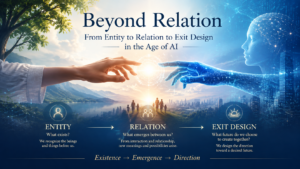
Why are Japanese children so often told, “Put yourself in the other person’s place”?
At first, it sounds like a simple lesson in kindness. But what if it contains a much deeper way of seeing the world?
Japanese language, classical literature, and everyday expressions repeatedly invite us to move the place from which we see: from self to other, from the present to the past, from today to future generations, and from isolated Entities to the Relations between them.
From the Kojiki and Man’yōshū to The Tale of Genji and The Tale of the Heike, and from Otentō-sama and otagaisama to the Japanese idea of yohaku, this essay explores a recurring cultural pattern: Do not make one observation point the whole world.
Following that pattern leads us from Yohaku → Moving the Observation Point → Relation → Wa / Musubi → Exit Design.
Perhaps this is not a new philosophy at all.
Perhaps it is something Japanese culture has carried for centuries — and we simply forgot how to see it.

Introduction
A Simple Japanese Lesson That May Not Be So Simple
Many Japanese children grow up hearing a simple piece of advice from their parents or teachers:
“Put yourself in the other person’s place.”
It is such an ordinary expression in Japan that few people stop to think about what it actually asks us to do.
At first, it sounds like a lesson in kindness or empathy. Do not think only about yourself. Try to understand how the other person feels.
But perhaps something deeper is happening.
Human beings naturally experience the world from their own position. I feel my own pain. I know my own intentions. I see what happened from where I was standing.
From that position, it is easy to say:
“I was right.”
“He hurt me.”
“It was not my fault.”
This is perfectly natural. We all begin from our own point of view.
Yet the familiar Japanese advice asks us to do something rather remarkable.
Leave your own position for a moment. Move to where the other person stands. Then look at the same event again.
What if this familiar advice contains a deeper way of seeing the world?
There are many expressions in traditional Japanese life that seem, at first, to have little connection with one another.
A child doing something wrong might once have been told:
“Otentō-sama is watching you.”
Otentō-sama literally refers to the sun, but in everyday moral language it evokes something greater than the individual — an unseen point from which one’s own actions can be viewed.
In another situation, someone might say:
“I could not face my ancestors if I did such a thing.”
The ancestors are no longer physically present. Yet the speaker imagines standing, as it were, where those ancestors stand, and looks back at his or her own conduct from there.
We also ask:
“What kind of Japan will we leave to our children and grandchildren?”
Here the movement is even more striking. We mentally travel into the future, stand beside people who may not even have been born yet, and look back at the choices we are making today.
And then there is the familiar advice:
“Put yourself in the other person’s place.”
From oneself to another person.
From the present to the past.
From the present to the future.
From the individual to the wider community.
These may appear to be different ideas.
But perhaps they share a common structure.
Perhaps the observation point itself is moving.
This possibility became especially interesting to me when I began looking again at Japanese language and classical literature.
Japanese has often been described as a language in which subjects are frequently omitted, tense works differently from English, and social relationships deeply affect the words a speaker chooses.
Usually these are treated as separate linguistic characteristics.
But what if they can also be viewed from another angle?
What if Japanese has developed ways of speaking that pay particular attention not only to what happened, but also to where the speaker stands in relation to what happened?
That is where our inquiry begins.
1. Japanese Language and the Question of “Where Do You See It From?”

For many Japanese students learning English, one of the first major challenges is tense.
Present tense.
Past tense.
Present progressive.
Present perfect.
Past perfect.
English grammar requires speakers to locate events within a relatively explicit temporal structure.
Japanese, of course, can also express past, present, completion, continuation, expectation, and many other temporal distinctions. Classical Japanese likewise had auxiliary forms such as ki, keri, tsu, nu, tari, and ri, each carrying different shades of temporal or aspectual meaning.
So it would be misleading simply to say:
“Japanese has no tense.”
The more interesting point is that Japanese does not always organize experience along the same grammatical lines as English.
Consider the Japanese ending -ta.
Students are often taught to associate it with the English past tense. In many cases, that works well enough.
But imagine that you have been searching everywhere for your keys. Suddenly you see them on the table and exclaim:
“Atta!” — “There they are!”
The keys are not in the past. They are right in front of you.
Or imagine that you are waiting for a friend. The friend finally appears, and you say:
“Kita!” — “Here he comes!” or “He’s here!”
Again, the person has not disappeared into the past. The event is unfolding before you.
In such expressions, the form traditionally associated with past or completion is doing something more subtle. It is connected with the speaker’s recognition of an event — the moment at which something is grasped as having occurred or become present to awareness.
Classical Japanese offers another fascinating example in keri.
Keri can refer to something in the past, but in classical poetry and narrative it may also carry a sense of realization or exclamation: something has suddenly become apparent to the speaker.
This suggests an important distinction.
Language is not concerned only with:
When did this event occur?
It can also encode something closer to:
How does this event appear from where the speaker now stands?
That difference becomes even more interesting when we turn to another well-known characteristic of Japanese: the frequent omission of grammatical subjects.
In English, we commonly say:
“I think.”
“You said.”
“He went.”
The subject is normally made explicit.
Japanese conversation often works differently.
Sō omou yo.
“Think so.”
Sō itte ita yo.
“Was saying that.”
Mō itta yo.
“Already went.”
Taken in isolation, these expressions may seem incomplete to an English speaker.
Who thinks?
Who said it?
Who went?
Yet in an actual Japanese conversation, the participants often know perfectly well.
The subject does not necessarily have to be named because it can emerge from the context — from what has already been said, who is present, who is being discussed, and the relationships among the people involved.
This gives us an intriguing way of looking at Japanese.
The world does not always have to be constructed by repeatedly identifying separate Entities:
I. You. He. She.
The relevant person can, in many situations, emerge from the Relation itself.
Japanese honorific language makes this even clearer.
Consider the simple act of “going.”
Depending on the relationship among speaker, listener, and the person being discussed, Japanese may use forms corresponding to:
iku — to go
irassharu — to go, in an honorific form
mairu — to go, in a humble form
The physical event may be essentially the same.
Someone goes somewhere.
Yet the language changes according to who is looking at whom, who is speaking to whom, and what relationship exists among them.
The Entity alone does not determine the expression.
Relation changes the language itself.
This does not mean that Japanese speakers are constantly and consciously calculating complex social geometry before opening their mouths. Much of this happens naturally, just as speakers of any language use complicated grammatical structures without consciously analyzing them.
But precisely for that reason, it may tell us something interesting about the cultural environment in which the language developed.
Japanese is sometimes described simply as a “subject-dropping language,” an “ambiguous language,” or a language in which tense is “weaker” than in English.
Each description may capture part of the picture.
But perhaps something important is lost if we stop there.
Another possibility is that Japanese has long placed unusual importance not only on when an event occurred, but on from where and within what relationship it is perceived.
If so, language may be giving us our first clue.
The idea of moving the observation point may not be merely a modern theory imposed upon Japanese culture.
It may be connected to ways of seeing that have long been embedded in Japanese expression itself.
And if that is true, we should expect to find the same pattern somewhere else.
We do.
We find it, remarkably often, in the classical literature of Japan.
2. Moving Through the Observation Points of Japanese Classics

If the Japanese language gives us one clue, Japanese classical literature gives us many more.
Before going further, however, one point should be made clear.
The argument here is not that multiple perspectives exist only in Japanese literature. They certainly do not. Literature throughout the world has developed sophisticated ways of entering different minds, shifting narrators, and viewing the same event from different positions.
The more interesting question is this:
When we move across Japanese classical literature over a long span of time, do we find a recurring tendency to understand people and events by moving the observation point itself?
Not merely from one character to another.
But from the cosmos to human relationships, from oneself into the imagined life of a stranger, from one Relation to another, from enemy to fellow human being — and even from the present into a future from which the present can be seen again.
Let us look at several examples.
Kojiki — From the Cosmos to Human Relationships
The Kojiki, compiled in the early eighth century, begins at an extraordinary distance from ordinary human life.
It begins with the formation of heaven and earth.
There is no individual human observer standing there. There is not yet a Japanese state in the historical sense, nor even human society as we ordinarily understand it.
The narrative begins, in effect, from an immense observation point overlooking the emergence of the world itself.
But it does not remain there.
As the story unfolds, the observation point gradually descends into relationships.
With Izanaki and Izanami, we enter the relationship between husband and wife.
When Izanami dies and Izanaki follows her into Yomi, the land of the dead, the story can no longer be understood from only one side. There is the living husband who longs for his wife, and there is the wife who now belongs to the realm of death.
With Amaterasu and Susanoo, we encounter another Relation: sister and brother.
The same actions do not necessarily carry the same meaning when seen from each side of that relationship.
With Ōkuninushi, the pattern appears again. To his elder brothers, he is one among the younger brothers. To the wounded Hare of Inaba, however, he is the one who stops, listens, and offers help.
Ōkuninushi himself has not changed.
What changes is the Relation from which he is seen.
This gives us an interesting way of reading the structure of the Kojiki.
Its observation point moves:
from the cosmos, to the gods, to husband and wife, to brother and sister, to parents and children, to communities, and eventually to the formation of the human world and the country.
The movement is almost like a camera descending from the heavens.
Yet what comes into focus as it descends is not simply a collection of separate individuals.
It is a world of relationships.
From this perspective, the Kojiki can be read not only as an account of origins, but as a narrative in which the world gradually becomes intelligible through Relation.
Man’yōshū — Entering the Life of Another Person
The Man’yōshū, Japan’s oldest surviving anthology of poetry, presents us with a very different structure.
It has no single protagonist.
Emperors appear. Members of the imperial family appear. Court officials, travelers, soldiers, husbands, wives, lovers, and people whose names have disappeared from history all speak through its poems.
As readers move from poem to poem, they repeatedly leave one human position and enter another.
One moment we are in the capital.
Then we are on a journey.
Then we are with someone waiting for a loved one to return.
The reader’s observation point is continually being relocated.
One particularly striking example appears in a poem associated with Kakinomoto no Hitomaro.
Hitomaro encounters a dead man lying by the roadside.
From a purely external observation point, the fact is simple:
There is a dead body beside the road.
But the poem does not stop there.
The imagination moves.
Who was this man?
Where had he been going?
Was there someone waiting for him?
Might there be a wife at home who still expects him to return?
The observation point therefore moves something like this:
the observer ↓ the dead man ↓ the life the dead man may have lived ↓ the wife or family who may still be waiting for him
Something remarkable has happened.
The dead man is no longer merely an object seen beside the road.
He becomes a person.
And once he becomes a person, relationships appear around him.
He may have been loved.
He may have been expected home.
His absence may become someone else’s grief.
Hitomaro cannot know all of this as factual information. The importance lies precisely in the movement of imagination.
He enters the possible world of another human being.
This is very close to the ordinary Japanese instruction with which we began:
Put yourself in the other person’s place.
The Man’yōshū, then, offers more than beautiful poems.
It offers countless entrances into worlds seen from positions other than one’s own.
The Tale of the Bamboo Cutter — One Person, Many Relationships
The Tale of the Bamboo Cutter (Taketori Monogatari) gives us an even clearer example.
We usually call Kaguya-hime its central character.
But who exactly is Kaguya-hime?
From the perspective of the old bamboo cutter, she is a miraculous child found inside a glowing bamboo stalk — and eventually his beloved daughter.
From the perspective of the five suitors, she is the extraordinary woman they desperately wish to marry.
From Kaguya-hime’s own position, however, those same proposals may look very different.
The suitors undertake impossible tasks to win her. Some deceive. Some produce false treasures. Others expose themselves and those around them to danger.
And as these episodes unfold, still more observation points enter the story.
Servants appear.
Craftsmen appear.
In the episode of the jeweled branch of Mount Hōrai, the craftsmen who actually made the fraudulent treasure eventually appear and demand the payment they were promised.
Suddenly, what had looked like a romantic quest from one position becomes unpaid labor and deception from another.
The event has not changed.
The observation point has.
Then the Emperor enters the story, adding yet another Relation.
From his position, Kaguya-hime is a woman he wishes to bring into his own world.
Yet she cannot simply be absorbed into imperial authority.
And finally, the beings from the Moon arrive.
At that moment, the observation point expands beyond the entire human world.
Until then, Kaguya-hime has been understood through earthly Relations:
daughter,
desired woman,
unattainable bride,
woman sought by the Emperor.
Now she must be seen in Relation to another world altogether.
And suddenly, everything that came before can be seen differently.
Which Kaguya-hime is the real one?
The daughter loved by the old man?
The woman desired by the suitors?
The person who refuses the Emperor?
The being who belongs to the Moon?
The answer may be:
all of them.
The Entity is the same.
But the person who appears to us changes according to the Relation from which she is seen.
This is a deeply relational form of characterization.
The Tale of Genji — A Person Is Not a Single Entity
With The Tale of Genji, this becomes vastly more complex.
Hikaru Genji is the central figure of much of the work, but he is never simply one thing.
Seen from one relationship, he may appear beautiful, refined, and irresistible.
From another, he may be the source of profound suffering.
From another, he is a son.
From another, a lover.
From another, a husband.
From another, a father.
And from still another, he is a political figure within the world of the court.
The women around him — Fujitsubo, Aoi no Ue, Rokujō no Miyasudokoro, Murasaki no Ue, Akashi no Kimi, and others — do not merely provide different opinions about one fixed man.
Different Relations reveal different Genjis.
This distinction is important.
We often ask:
“Who is the real Genji?”
But perhaps that question already assumes that a human being is first and foremost a single, self-contained Entity, and that somewhere underneath all appearances there must be one definitive version.
The Tale of Genji allows us to consider another possibility.
A human being exists not only as an individual Entity, but also through the Relations in which that person lives.
Genji-with-his-father is not identical to Genji-with-Murasaki.
Genji-as-lover is not identical to Genji-as-father.
Genji seen by someone who desires him is not identical to Genji seen by someone who has suffered because of him.
None of these perspectives alone contains the whole person.
Yet neither are they necessarily false.
A person may be partly revealed through the Relations in which that person exists.
This is where the distinction between Entity and Relation becomes especially useful.
Entity asks:
What is this person?
Relation adds another question:
What emerges between this person and another?
Move the observation point from one Relation to another, and the same Entity begins to reveal a different face.
A thousand years ago, The Tale of Genji was already creating an enormous literary world in which human beings cannot easily be reduced to a single point of view.
The Tale of the Heike — When “the Enemy” Becomes a Human Being
Perhaps the most powerful example for our purposes appears in The Tale of the Heike.
The story tells of the rise and fall of the Taira clan and the wars between the Taira and Minamoto.
On a battlefield, the categories seem clear.
Taira and Minamoto.
Friend and enemy.
Winner and loser.
From that observation point, Atsumori is an enemy warrior.
Kumagai Naozane is a warrior of the opposing side.
The logic of battle tells Kumagai what to do.
Then the observation point moves.
When Kumagai sees the young Atsumori closely, the category “enemy” is no longer sufficient.
Before him is a young man approximately the age of his own son.
The Entity has not physically changed.
Atsumori is still a Taira warrior.
But another Relation has entered Kumagai’s perception:
father and son.
And with that movement, the meaning of the person before him changes.
This is the crucial point.
As long as the observation point remains fixed, Atsumori is “the enemy.”
When the observation point moves, he becomes a young man — someone’s son.
The word “enemy” is not necessarily false.
But it is incomplete.
It is a label produced from one particular Relation: two opposing sides in battle.
Move outside that Relation, and another human reality appears.
This is precisely what can disappear when an Entity becomes a symbol.
“The enemy.”
“The foreigner.”
“The conservative.”
“The liberal.”
“The believer.”
“The unbeliever.”
Once the label becomes the whole person, the human being behind it can vanish.
The episode of Kumagai and Atsumori does something different.
It restores the person behind the category.
And The Tale of the Heike moves the observation point in another direction as well:
through time.
Its famous opening begins:
“The sound of the bells of Gion Shōja echoes the impermanence of all things.”
Within the events of the story, the Taira reach extraordinary heights of power and glory.
But the narrator does not view their prosperity only from the moment in which they possess it.
Their present is already being viewed from the knowledge of what comes afterward.
They will fall.
Their glory will pass.
In other words, the narrative performs another remarkable movement:
it looks at the present from the future.
Seen only from the present, power may appear permanent.
Seen from a later point in time, the same power becomes temporary.
Seen from still farther away, victor and defeated alike become human beings who lived within the same turbulent age.
The observation point has moved not merely from one person to another, but along the axis of time itself.
What Changes When the Observation Point Moves?
Across these works, the movement takes different forms.
In the Kojiki, it moves from the cosmos into human relationships.
In the Man’yōshū, it moves from oneself into the imagined life of another person.
In The Tale of the Bamboo Cutter, it moves from one Relation to another around the same person.
In The Tale of Genji, it reveals that a human being cannot necessarily be exhausted by a single Entity-description.
And in The Tale of the Heike, it moves from enemy to human being, and from the present toward a future from which the present can be seen again.
None of this proves that Japan alone possesses such ways of seeing.
That is not the claim.
What it does suggest is something subtler.
Across very different works, composed in very different periods and genres, we repeatedly encounter a world that does not become fully intelligible from only one fixed position.
The person changes when the Relation changes.
The event changes when the observation point changes.
And sometimes even what appeared unquestionably right, permanent, or obvious from one position looks different from another.
The purpose is not necessarily to decide which observation point is the only correct one.
It is to see more.
One perspective gives us a surface.
Move the observation point, and another surface appears.
Move it again, and another.
When these are placed together, the world begins to acquire depth.
Perhaps this is one reason why the simple Japanese instruction,
“Put yourself in the other person’s place,”
contains more than a lesson in kindness.
It may preserve, in everyday language, a habit of seeing that appears again and again across centuries of Japanese literature.
Do not make one observation point the whole world.
3. The Same Pattern Still Lives in Everyday Japanese Culture

So far, we have followed the movement of observation points through Japanese classical literature.
But this way of seeing did not remain inside old books.
Its traces can still be found in ordinary expressions that Japanese people have used in everyday life — expressions so familiar that their underlying structure is rarely noticed.
Consider a few examples.
“The Sun Is Watching You”
There is an old Japanese expression:
“Otentō-sama ga mite iru.”
“The Sun is watching you.”
Traditionally, an adult might say this to a child who was about to do something wrong when no one else was watching.
“No one may be watching you, but the Sun is.”
At first, this may sound like a religious warning about divine punishment. But that is not necessarily the most interesting way to understand it.
Suppose I am about to do something dishonest.
From my own observation point, I may think:
No one will know.
No one will see me.
I can get away with it.
But the moment I imagine Otentō-sama watching me, something changes.
I am no longer only the person who sees.
I become the person being seen.
The observation point has moved:
from myself
↓
to a position outside myself, from which my own actions can be seen
Nothing about the action itself has changed.
What changes is the position from which I see it.
And suddenly, the same action may look very different.
“I Could Not Face My Ancestors”
Another traditional Japanese expression is:
“I could not face my ancestors.”
This is a curious expression if we stop to think about it.
Our ancestors are not physically standing beside us.
Yet someone may say:
“If I did such a thing, I could not face my ancestors.”
Notice what happens here.
Normally, we stand in the present and look backward toward the past.
We look at our parents, grandparents, and generations before them.
But in this expression, the direction is reversed.
We imaginatively move our observation point into the past — to the position of those who came before us — and from there, we look back at ourselves in the present.
The movement is something like this:
present self
↓
ancestors in the past
↓
the present self seen from their position
In other words, the observation point has moved not only between people.
It has moved through time.
The question is no longer simply:
“What do I want to do?”
It becomes:
“How would the people whose lives made mine possible see what I am doing now?”
The past becomes another place from which the present can be observed.
“What Will We Leave to Our Children and Grandchildren?”
Now let us move in the opposite direction.
Japanese people also ask:
“What kind of country will we leave to our children and grandchildren?”
This expression moves the observation point forward rather than backward.
Our grandchildren — or generations not yet born — cannot literally tell us what they think of our decisions today.
And yet we can imagine standing where they will stand.
From there, we look backward at ourselves.
A decision that appears convenient today may look irresponsible from a hundred years in the future.
Something profitable now may leave a terrible burden later.
Something difficult now may become a precious inheritance for people who have not yet been born.
Again, the facts have not necessarily changed.
The observation point has.
Instead of asking only,
“What benefits us now?”
we begin to ask:
“How will our choices today look from the world of those who come after us?”
This is another movement along the axis of time:
present
↓
future generations
↓
the present seen from the future
And once again, moving the observation point changes the meaning of the present.
“Otagaisama” — We All Depend on One Another
There is another Japanese expression that is difficult to translate with a single English word:
otagaisama.
Suppose someone helps you when you are in trouble.
You say:
“Thank you very much.”
And the other person replies:
“Otagaisama desu.”
A natural English rendering might be:
“We all help one another.”
Or:
“You would do the same for me.”
But the Japanese expression contains an interesting shift.
If we look only at the two individuals involved, the structure seems simple:
A helped B.
Therefore, B owes something to A.
This creates a kind of balance sheet between two Entities.
A → B
One person gives.
The other receives.
But otagaisama loosens that calculation.
Today, I may help you.
Tomorrow, someone else may help me.
And someday, you may help another person whom I will never meet.
The Relation expands beyond the immediate transaction.
The observation point moves:
from “I helped you”
↓
to “human beings live by helping one another”
The debt between two isolated individuals becomes part of a larger web of relationships.
This is why otagaisama does not simply mean, “Now you owe me one.”
In fact, it can mean almost the opposite.
There is no need to turn this into a debt between you and me, because both of us already live within a larger Relation of mutual dependence.
That is a very different way of seeing the same act of help.
“Put Yourself in the Other Person’s Place”
And now we return to the simple expression with which this essay began:
“Put yourself in the other person’s place.”
A child says:
“But I didn’t do anything wrong!”
Perhaps that is exactly how the situation looks from the child’s position.
But the adult asks the child to perform a remarkable mental movement:
“Now go over there.”
Not physically, of course.
Move your observation point.
Look at the same event from where the other person stands.
What did your words sound like from there?
What did your actions feel like from there?
What could that person see that you could not?
This does not mean:
“The other person is always right.”
Nor does it mean:
“You must give up your own judgment.”
Understanding another observation point is not the same as agreeing with it.
Rather, it means that one position is not enough to understand the whole situation.
From my position, I see one surface.
From yours, another.
From a third person’s position, perhaps something else again.
The purpose of moving the observation point is not to abandon judgment.
It is to make judgment more three-dimensional.
Different Expressions, the Same Underlying Structure
Now these apparently unrelated Japanese expressions begin to look surprisingly similar.
“The Sun is watching you.”
The observation point moves outside the self.
“I could not face my ancestors.”
The observation point moves into the past.
“What will we leave to our children and grandchildren?”
The observation point moves into the future.
“Otagaisama.”
The observation point moves from a transaction between two individuals to the larger web of Relation.
“Put yourself in the other person’s place.”
The observation point moves from self to other.
These apparently different expressions may share the same underlying structure:
Do not make the self, here and now, the only place from which the world can be seen.
Move.
From self to other.
From present to past.
From present to future.
From participant to observer.
From individual to community.
If this interpretation is correct, then the movement we saw in Japanese classical literature did not disappear with the classical world.
It survived in ordinary language.
It survived in family life.
It survived in the small phrases adults passed on to children without necessarily explaining the philosophy behind them.
Perhaps Japanese people did not lose this way of seeing.
Perhaps it became so ordinary that we forgot there was anything remarkable about it at all.
And that brings us to the next question.
If moving the observation point changes how we see the world, what happens to the idea of the self itself?
That is where the distinction between Entity and Relation becomes important.
4. From Entity to Relation

We have now seen the same pattern in language, classical literature, and everyday expressions.
Again and again, the observation point moves.
From self to other.
From present to past.
From present to future.
From one relationship to another.
But why does this matter beyond language and literature?
This is where we enter the larger question of civilization.
To explore it, I would like to introduce two terms:
Entity and Relation.
Entity Thinking Is Indispensable
An Entity is something we recognize as a distinct thing.
I am an Entity.
You are an Entity.
A company is an Entity.
A nation is an Entity.
A political party, an institution, a religion, or an organization can also be treated as an Entity.
Entity thinking allows us to distinguish one thing from another.
It allows us to define, classify, compare, measure, analyze, and organize the world.
This way of thinking is indispensable.
Science could hardly function without it.
Law needs identifiable persons and institutions.
Economics distinguishes individuals, companies, goods, currencies, and transactions.
Modern administration depends upon categories and definitions.
So the argument here is not that Entity thinking is somehow wrong, Western, cold, or inferior.
Quite the opposite.
Entity thinking is one of the great tools of human reason.
The problem begins somewhere else.
The problem begins when one Entity — and one observation point — becomes absolute.
When an Entity Becomes a Symbol
Suppose two groups are in conflict.
From one side, the categories may appear perfectly clear:
friend / enemy
right / wrong
justice / evil
conservative / liberal
our side / their side
These distinctions may sometimes be necessary.
The word “enemy,” for example, can describe a real relationship on a battlefield.
“Conservative” and “liberal” can be useful descriptions of political positions.
The problem begins when the category stops being a description and becomes the whole person.
A human being is then reduced to a symbol.
He is no longer a particular person with parents, children, memories, fears, hopes, contradictions, responsibilities, and relationships.
He becomes:
the enemy.
Or:
the foreigner.
the conservative.
the liberal.
the believer.
the unbeliever.
Once that happens, something important disappears.
The human being behind the label becomes difficult to see.
And the more completely the symbol replaces the person, the easier it becomes to judge the person without ever entering the world from which that person sees.
The observation point has become fixed.
When “the Enemy” Becomes Someone’s Son
This brings us back to Kumagai Naozane and Atsumori in The Tale of the Heike.
On the battlefield, the Relation is clear.
Kumagai belongs to one side.
Atsumori belongs to the other.
From within that Relation, Atsumori is accurately described as:
the enemy.
The word is not false.
But it is not the whole truth about the person standing before Kumagai.
Then Kumagai sees the young warrior more closely.
Atsumori is approximately the age of Kumagai’s own son.
At that moment, another Relation enters the scene.
Not:
warrior / enemy
but:
father / son.
Atsumori has not changed.
His name has not changed.
His allegiance has not changed.
The battle has not changed.
What has changed is the observation point.
And because the observation point has moved, another reality becomes visible.
The enemy becomes a young man.
The warrior becomes someone’s child.
The symbol becomes a human being.
This gives us one of the central propositions of this essay:
Move the observation point, and the symbol becomes a human being again.
Relation Does Not Destroy Entity
This is where Relation becomes important.
Relation does not mean that Entities disappear.
Kumagai remains Kumagai.
Atsumori remains Atsumori.
Japan does not cease to be Japan because it enters into relationships with other countries.
You do not cease to be yourself because you try to see the world from another person’s position.
Relation does not erase difference.
It asks us to notice something that Entity thinking alone may leave outside the frame:
What exists between the Entities?
Consider two simple numbers:
1 and 2.
As Entities, 1 remains 1 and 2 remains 2.
But place a Relation between them:
1 + 2 = 3
2 − 1 = 1
1 × 2 = 2
2 ÷ 1 = 2
The Entities have not changed.
The Relation has.
And when the Relation changes, the result changes.
Human life is obviously far more complex than arithmetic, but the simple example reveals something important.
The same two people can create friendship or hostility.
The same two nations can create trade or war.
The same parent and child can create trust or fear.
The same employer and employee can create cooperation or resentment.
If we look only at the Entities, we may ask:
“What kind of person is this?”
Relation adds another question:
“What is happening between us?”
That second question can change everything.
From “Who Is Right?” to “What Is Happening Between Us?”
Entity thinking naturally helps us distinguish.
Who did what?
Who is responsible?
Which statement is correct?
Which claim is false?
These are necessary questions.
Relation does not ask us to abandon them.
But it introduces another dimension.
Instead of asking only:
“Who is right?”
we can also ask:
“What kind of Relation is being created here?”
Instead of asking only:
“What is wrong with that person?”
we can ask:
“What is happening between that person and me?”
Instead of asking only:
“Which side should win?”
we can ask:
“What will exist between these sides after the conflict is over?”
This does not weaken judgment.
It enlarges the field in which judgment takes place.
And this is why moving the observation point matters.
As long as I remain completely inside one position, my own categories can appear to be the world itself.
Move the observation point, however, and I begin to see that my categories belong to a particular position and a particular Relation.
Another position may reveal another part of reality.
What If the Self Is Not the Center?
We can now return to the question in the title of this essay:
What if the self is not the center?
This does not mean that the self should disappear.
It does not mean self-denial.
It does not mean surrendering individuality, responsibility, or judgment to the group.
It means something much simpler — and perhaps much more difficult:
Do not make your own observation point the whole world.
The self is real.
But so is the other person.
And between self and other, something else is also real:
the Relation.
Once we begin to see that “between,” the world no longer consists only of separate Entities confronting one another.
It begins to appear as a field of relationships in which different Entities affect one another, reveal different aspects of one another, and sometimes create something that neither could create alone.
Perhaps this is one of the possibilities hidden inside the Japanese habit we have been following throughout this essay.
Not the rejection of Entity.
Not the disappearance of the self.
But the ability to move beyond a single fixed observation point and ask:
What becomes visible from the Relation between us?
And to make that movement, we need something else first.
We need enough space within ourselves to move.
We need yohaku — a margin, an opening, a kind of inner space.
That is where the next step begins.
5. The Space That Allows the Observation Point to Move

If moving the observation point is so important, another question immediately follows:
What allows us to move it?
The answer may be found in a Japanese idea that is often translated simply as “empty space” or “margin.”
The word is yohaku.
But yohaku is not merely emptiness.
It is not simply the part of a page where nothing has been written, the part of a room where nothing has been placed, or the time in which nothing is happening.
Yohaku is the space that allows another possibility to enter.
And without such a space, the observation point cannot easily move.
When There Is No Space to Move
Imagine a person whose mind is completely filled with certainty:
I am right.
There is only one answer.
That person is wrong.
This is how things must be.
There may be logic behind these conclusions.
There may even be good evidence for them.
The problem is not certainty itself.
The problem is that when every part of the mental field is already occupied, there is nowhere else to stand.
No room remains for the question:
“What if this looks different from another position?”
To move an observation point, we need at least a small opening.
Perhaps I am missing something.
Perhaps the other person sees something I cannot see.
Perhaps this event looks different from ten years in the future.
Perhaps what seems obvious from inside this conflict looks different from outside it.
That opening is yohaku.
It does not tell us that another perspective is necessarily correct.
It simply makes another perspective possible.
Yohaku Is Not Nothing
This may help explain why empty space has played such an important role in many forms of Japanese culture.
Consider ikebana, the Japanese art of flower arrangement.
A flower arrangement is not created simply by filling a container with as many beautiful flowers as possible.
The spaces between branches, leaves, flowers, and the surrounding air are part of the composition.
What is absent helps determine how what is present can be seen.
The same can be said of Japanese calligraphy.
The unwritten white space around and between the strokes is not simply unused paper.
Without it, the movement, balance, tension, and rhythm of the written forms would become difficult to perceive.
In Noh, meaning is not created only by movement and speech.
Stillness, pauses, and intervals can also shape what the audience experiences.
In the martial arts, too, one encounters the importance of ma — the interval or spacing between oneself and another.
What matters is not only the two bodies as separate Entities, but the changing distance, timing, and possibility that exist between them.
These traditions are not identical, and their concepts should not simply be collapsed into one theory.
Yet they may point us toward a shared insight:
What appears to be empty may actually be active.
The space between things can make movement possible.
The pause between actions can allow perception to change.
The unfilled area can allow something else to appear.
In that sense, yohaku is not the absence of meaning.
It is a condition in which new meaning can emerge.
The Inner Yohaku
The same idea can be applied to thought.
Suppose two people are arguing.
If my mind is completely occupied by the need to prove that I am right, then the other person can appear only from within that frame.
I hear the other person’s words, but I hear them mainly as things to refute.
I see the other person, but I see mainly an opponent.
The observation point remains fixed.
But suppose a small yohaku appears:
“Why does this person see the situation that way?”
Nothing has yet been conceded.
I have not abandoned my own position.
I have not agreed with the other person.
I have not decided that both sides are equally correct.
I have simply created enough inner space to move.
And once that space exists, I can imaginatively step away from my own position and look again.
What does the situation look like from there?
What becomes visible that was invisible from here?
What happens if I look not only from my position or yours, but from the position of a child affected by our conflict?
What happens if I look from ten years later?
What happens if I ask how this conflict will appear to people who inherit its consequences?
Yohaku makes movement possible.
From a Fixed Surface to a World with Depth
This is why yohaku matters to the idea of the moving observation point.
When the observation point is fixed, reality can begin to look like a flat surface.
From here, I see this.
And if I assume that what I see from here is the whole of reality, then there is little reason to move.
But yohaku introduces a small opening into that certainty.
From another position, another surface becomes visible.
Move again, and something else appears.
Gradually, the world that seemed flat begins to acquire depth.
This does not mean that every perspective is equally valid.
A different observation point can be mistaken.
It can be based on false information.
It can even be deliberately deceptive.
Moving the observation point therefore does not replace reason, evidence, or judgment.
Rather, it gives reason more than one surface to examine.
We can return to our own position afterward.
But we return having seen something we could not see before.
Yohaku → Moving the Observation Point → Relation
We can now begin to see a sequence.
Yohaku
creates the space in which another possibility can enter.
That makes possible:
Moving the Observation Point.
Once the observation point moves, we can begin to see not only separate Entities, but what exists between them:
Relation.
So the movement can be expressed simply:
Yohaku
↓
Moving the Observation Point
↓
Relation
This may also explain something important about the instruction:
“Put yourself in the other person’s place.”
It sounds simple.
But psychologically, it is impossible if there is no space inside us from which to move.
If the self occupies the entire field, there is nowhere else to stand.
Yohaku does not ask the self to disappear.
It creates enough room for the self to move.
And when the self moves, another person can cease to be merely an object seen from our position.
The other person becomes another observation point from which the world can also be seen.
That is the beginning of Relation.
But Relation itself is not yet the destination.
Once we can see what exists between different Entities, another question appears:
What kind of relationship do we want to create between them?
That question leads us toward two old Japanese ideas that are often translated too simply:
Wa — harmony.
Musubi — generative connection.
And from there, toward an even larger question:
Where do we want these relationships to lead?
6. From Relation to Wa, Musubi, and Exit Design

Once we begin to see the world through Relation, another question naturally appears:
What should we do with the Relation we see?
Simply recognizing that relationships exist is not enough.
A relationship can produce trust or fear.
Cooperation or conflict.
Creation or destruction.
The same two Entities can remain exactly what they are, yet the world that emerges between them can be completely different.
So Relation is not the destination.
It is the place from which another kind of question becomes possible:
What kind of relationship do we want to create?
This brings us to two old Japanese ideas:
Wa and Musubi.
Wa Does Not Mean Becoming the Same
The Japanese word wa is often translated as “harmony.”
That translation is useful, but it can also be misleading.
“Harmony” may sound like the absence of disagreement.
It may suggest that everyone should think alike, behave alike, or suppress differences for the sake of peace.
But Wa is not uniformity.
Consider musical harmony.
If every instrument played exactly the same note in exactly the same way, there would be no harmony in the richer sense. There would simply be sameness.
Harmony becomes possible because different sounds remain different while entering into a relationship with one another.
Something similar can be said of human beings.
You do not have to become me.
I do not have to become you.
A parent does not become a child.
A child does not become a parent.
Japan does not have to cease being Japan in order to build relationships with other countries.
Difference itself is not the problem.
The question is:
What kind of Relation can exist between different Entities?
Wa begins when difference is not immediately treated as something that must be eliminated.
Different people can remain different and still ask:
How can we live together?
How can we work together?
How can our differences contribute to something larger than either of us alone?
In this sense, Wa is not the erasure of difference.
It is the possibility of creating a better whole without destroying the distinct parts.
Musubi — When Relation Creates Something New
This leads us to another Japanese idea:
Musubi.
The word is related to “binding,” “connecting,” and “bringing together,” but its cultural resonance goes beyond simply tying two things together.
Musubi can suggest a connection through which something new comes into being.
This distinction is important.
Musubi is not assimilation.
A does not have to become B.
Nor is Musubi subordination.
A does not have to dominate B, and B does not have to surrender its identity to A.
Rather:
Different Entities remain different, yet something new can emerge between them.
This is where Relation becomes creative.
Two people meet and a friendship emerges.
Two different skills meet and a new craft becomes possible.
Different generations meet and inherited wisdom takes a new form.
Human beings encounter nature and develop ways of living adapted to a particular land.
Cultures encounter one another and, at their best, may create something that neither possessed before.
The important thing is that the new value does not necessarily exist inside either Entity by itself.
It appears between them.
This is Musubi.
We might therefore describe the movement this way:
Entity A
↓
Relation
↑
Entity B
and within that Relation,
something new can emerge.
This is why Relation is not merely a softer alternative to conflict.
It can be a field of creation.
From “Who Wins?” to “What Can We Create Together?”
This changes the questions we ask.
When the observation point remains fixed within competing Entities, the central question easily becomes:
Who wins?
Who is stronger?
Who is correct?
Who gets more?
Whose values prevail?
Sometimes these questions are unavoidable.
But Wa and Musubi introduce another possibility:
What can emerge between us?
The question does not require us to pretend that conflicts do not exist.
Nor does it mean that every conflict can be solved through goodwill.
There are real differences of interest.
There are injustices.
There are actions that must be stopped.
There are boundaries that must be defended.
But even after those judgments are made, another question remains:
What Relation do we want to exist afterward?
That question moves us beyond the immediate conflict.
And once we ask it, the observation point begins to move again.
This time, it moves toward the future.
Where Should This Relation Lead?
Suppose two people are in conflict.
They may ask:
Who started it?
Who is right?
Who should apologize?
Those questions concern the present and the past.
But another question can be asked:
Where should this Relation lead?
What do we want the relationship to look like one year from now?
What kind of family do we want to have?
What kind of workplace do we want to create?
What kind of relationship should exist between citizens and government?
Between nations?
Between human beings and nature?
Between the generation living today and generations not yet born?
The moment we ask such questions, something remarkable happens.
We imaginatively move our observation point into the future.
Then, from that future, we turn around and look back at the present.
This is what I call Exit Design.
Exit Design — Looking Back at the Present from the Future
Exit Design does not mean predicting the future.
It is not fortune-telling.
It does not say:
“This is what will happen.”
It asks:
“What kind of future do we want to choose?”
And then:
“Seen from that future, what should we choose now?”
This is another movement of the observation point.
Normally, we stand in the present and try to calculate what the future will become.
Exit Design reverses the direction.
First, we imagine the destination.
Then we place our observation point there.
And from that position, we look back at today.
A decision that appears attractive from the present may look foolish from the desired future.
A sacrifice that seems difficult today may become obviously necessary when viewed from the world we hope to leave to our children.
A victory that feels satisfying now may create a Relation that makes tomorrow worse.
So the question is not merely:
“How do we win today?”
It becomes:
“What kind of tomorrow will today’s victory create?”
This is why Exit Design belongs naturally at the end of the sequence we have been following.
From Yohaku to Exit Design
We can now see the whole movement:
Yohaku
↓
Moving the Observation Point
↓
Relation
↓
Wa / Musubi
↓
Exit Design
Yohaku creates the inner space in which another possibility can enter.
That space allows us to move the observation point.
When the observation point moves, we begin to see not only separate Entities, but the Relation between them.
Once Relation becomes visible, we can ask how different Entities might remain different while creating Wa, and how something new might emerge between them through Musubi.
And finally, we ask where that Relation should lead.
That is Exit Design.
The sequence does not abolish the self.
It does not abolish Entity.
It does not demand agreement.
It does not erase difference.
Rather, it asks us not to make one Entity, one perspective, one moment, or one answer into the whole world.
And perhaps that brings us back to where this essay began.
Conclusion — Perhaps We Did Not Lose It — We Simply Forgot How to See It
This is not an attempt to invent a new Japanese philosophy.
The people who composed the Kojiki did not speak of “moving the observation point.”
Kakinomoto no Hitomaro did not write about “Entity and Relation.”
The authors and storytellers behind The Tale of the Bamboo Cutter, The Tale of Genji, and The Tale of the Heike did not describe their work using the language developed in this essay.
Nor did generations of Japanese parents explain a theory of perspective before telling a child:
“Put yourself in the other person’s place.”
They simply said it.
“The Sun is watching you.”
“Do not do anything that would make you unable to face your ancestors.”
“Think about what we will leave to our children and grandchildren.”
“Otagaisama.”
These ideas were there.
They were in the classics.
They were in the Japanese language.
They were in everyday life.
They were in the words parents passed on to children.
Perhaps they were so ordinary that no special theory was required to explain them.
And perhaps that is precisely why we stopped noticing them.
Modern civilization has given us extraordinary powers of classification, definition, analysis, and abstraction.
These are indispensable achievements.
They allow us to isolate an Entity, examine it, measure it, compare it, and understand it with remarkable precision.
But perhaps, while developing that power, we have become less conscious of another human capacity:
the ability to move the place from which we see.
To see ourselves from outside ourselves.
To see the present from the past.
To see today from the future.
To enter, imaginatively, the position of another person.
To see not only separate things, but what exists between them.
And once we recover that movement, an old instruction begins to reveal an unexpected depth:
“Put yourself in the other person’s place.”
It is not merely a lesson in kindness.
It is an invitation to move.
To create enough Yohaku to leave one fixed position.
To discover Relation.
To cultivate Wa without demanding uniformity.
To create Musubi without assimilation or subordination.
And finally, to move our observation point into the future and ask:
What kind of world do we want these Relations to create?
Civilization Inquiry, then, is not about producing a new doctrine and asking everyone to believe it.
It is about returning to language, history, classical literature, and everyday life — and looking again.
Sometimes, when we do that, we encounter something surprising:
“Wait. Haven’t we known this all along?”
Perhaps some of the wisdom we need for the civilization of the future is not something we have yet to invent.
Perhaps it is something we have carried for centuries — and simply forgotten how to see.
_
About the Author — Zenkoh Onagi
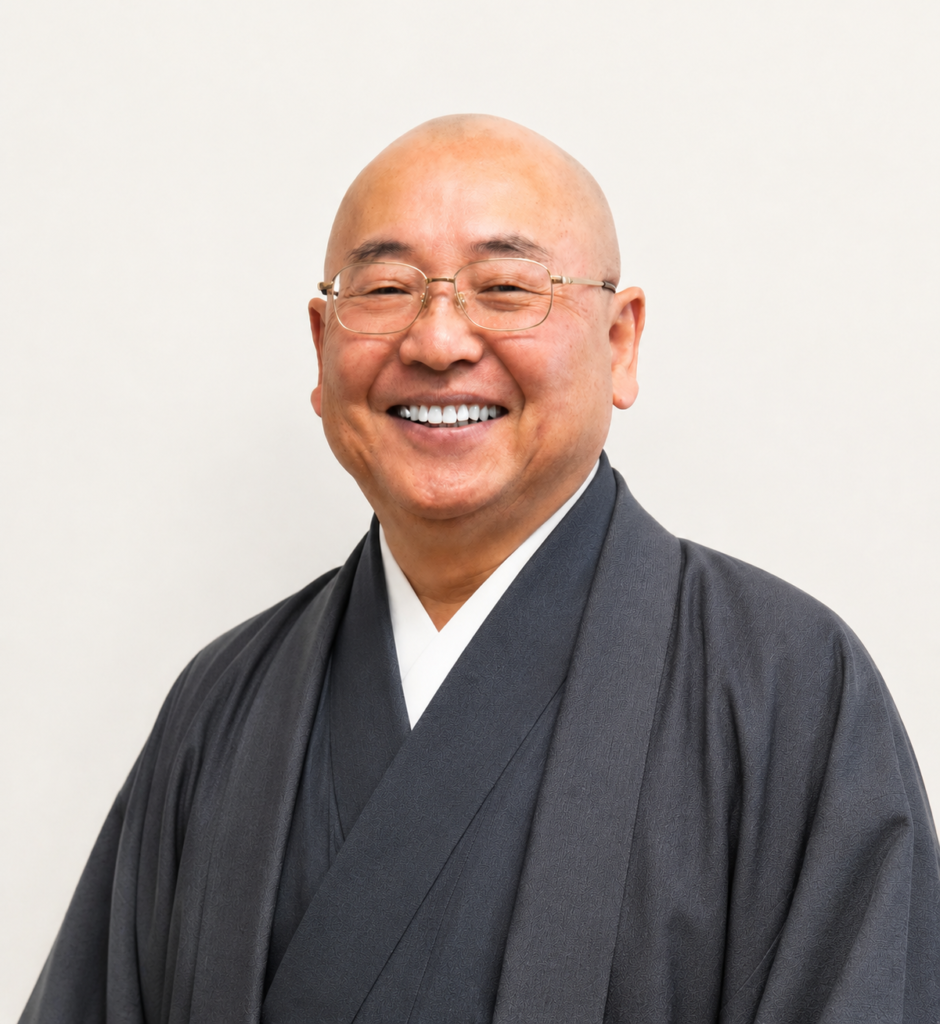
Advocate of Civilization Inquiry
Japanese History and Classical Literature Scholar
Organizational Development Consultant
Born in January 1956 in Hamamatsu, Shizuoka, Japan.
Zenkoh Onagi advocates Civilization Inquiry, an approach that seeks to translate the wisdom embedded in history and classical literature into contemporary thought and to explore how we might build a future in which people can ultimately share in human flourishing.
His research and writing draw particularly on Japanese history and classical traditions, including the Kojiki, Nihon Shoki, and Bushido. His work explores such themes as autonomy, posture toward the world, Musubi (creative connection), Relation, and Exit Design, asking how inherited wisdom can contribute to the design of relationships, organizations, and civilization in the present and future.
He lectures and writes extensively throughout Japan and is the author of numerous books on Japanese history, culture, and civilization.
_
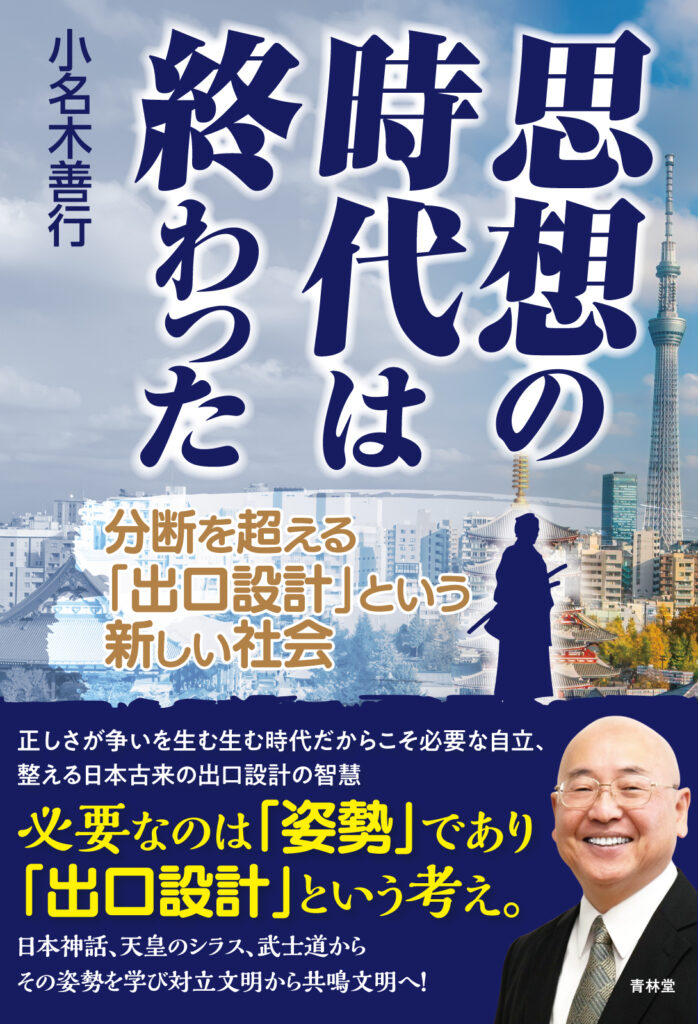
■Latest Book — Now Available in Japan
The Age of Ideology Is Over
— Beyond Division Toward a New Social Vision of “Exit Design”(Japanese edition)
https://amzn.to/3P5D0lS
_