What if the greatest challenge facing humanity today is not a lack of knowledge, but the way we understand the world itself?
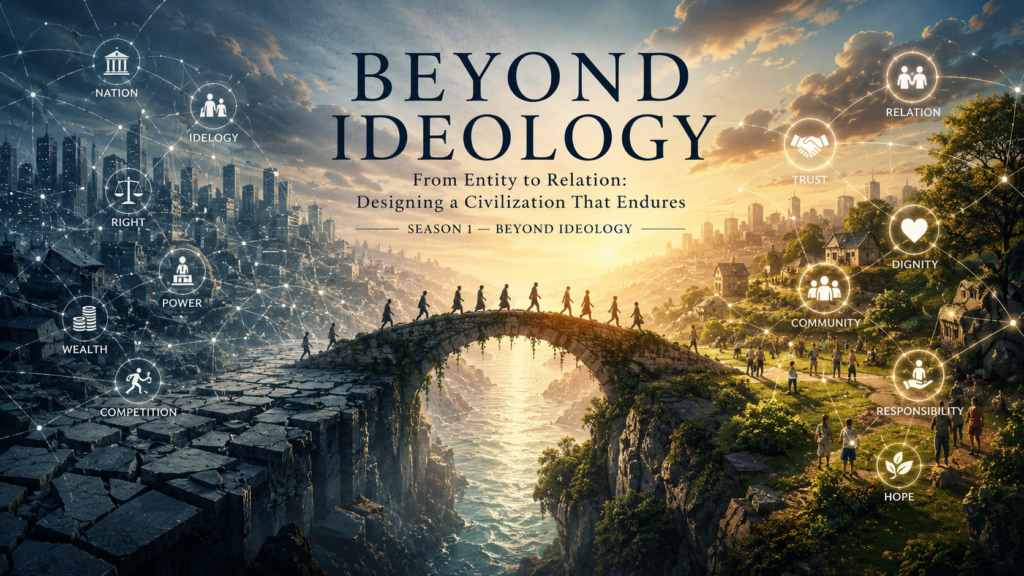
This series invites readers to explore a different framework for thinking about civilization—one that moves beyond ideology, from an Entity-centered view of society toward a Relation-centered one. Rather than asking only who is right, we will ask what kind of future our choices create, and how we might design a civilization that truly endures.
_
_
Introduction
This article is the opening chapter of a five-season series entitled Beyond Ideology.
Throughout this series, we will explore how humanity can move from an Entity-centered civilization toward a Relation-centered civilization, and how we might design a civilization that truly endures.
The overarching theme of this series is:
From Entity to Relation: Designing a Civilization That Endures.
In this opening chapter, we will explore the following questions:
- Why This Series, and Why Now?
- Beyond Ideology Does Not Mean Abandoning Ideas
- Why Move from Entity to Relation?
- What Does It Mean to Design a Civilization That Endures?
- Why Explore Japanese History and the Classics?
- What Readers Will Gain from This Series
- How This Series Will Unfold
- Closing Reflections
Let us begin.
1 Why This Series, and Why Now?
An Invitation to Civilization Inquiry
The world has accumulated more knowledge than ever before.
Our institutions have become increasingly sophisticated.
Science and technology continue to advance at an astonishing pace.
And yet, despite all this progress, something essential seems to be slipping away.
Societies are becoming more divided.
Justice collides with justice.
On social media, attacks often spread faster than dialogue.
Tensions between nations continue to grow.
Even within families and workplaces, being “right” can damage relationships.
These are not isolated problems.
They may be symptoms of something much deeper.
This raises an important question.
Do we simply need more knowledge?
Or have we reached the limits of the very framework through which we understand society?
This series is an invitation—not to choose another ideology, but to discover a different way of seeing civilization itself. Together, we will explore the possibility that the next step in human civilization begins not with better answers, but with a different way of asking questions.
2. Beyond Ideology Does Not Mean Abandoning Ideas
The expression Beyond Ideology can easily be misunderstood.
It does not mean abandoning democracy.
It does not mean rejecting freedom, human rights, or the rule of law.
It does not mean turning away from reason.
Nor does it mean becoming people without principles or convictions.
Ideas have always played an essential role in the development of civilization.
They have given societies direction, shaped institutions, inspired reform, and helped humanity move forward.
Democracy, liberty, equality, human rights, capitalism, and socialism all emerged from sincere efforts to build a better society.
Whatever their limitations, each has made an important contribution to the modern world.
The problem, therefore, is not that ideas exist.
Problems arise when a single idea comes to define the world so completely that everything must be placed either inside or outside its boundaries.
Every definition draws a line.
Once that line is drawn, an inside and an outside inevitably appear.
Those inside the boundary are more easily regarded as right.
Those outside it are more easily regarded as wrong.
This does not happen simply because people are dishonest or intolerant.
More often, it happens because people genuinely believe that what they defend is true, just, and necessary.
Yet when one form of justice confronts another, sincere conviction can harden into judgment, and dialogue can gradually give way to conflict.
For this reason, moving Beyond Ideology does not mean rejecting ideas.
It means asking a different question.
How can we put our ideas into practice without destroying the relationships that make society possible?
Ideas can show us a direction.
But direction alone is not enough.
A civilization must also know how to preserve relationships, accommodate differences, and guide conflict toward an outcome in which people can continue living together.
That is the meaning of Beyond Ideology.
It is not a rejection of ideas.
It is an invitation to discover the human posture and the social design that allow ideas to serve life—rather than allowing life to be sacrificed in the name of ideas.
3. Why Move from Entity to Relation?
Throughout history, humanity has made extraordinary progress by learning to understand the world as a collection of distinct entities.
We identify individuals, organizations, nations, ideas, laws, rights, and property as separate and independent realities.
This way of seeing has given us remarkable achievements.
It has strengthened science, advanced technology, established legal systems, and expanded individual freedom.
There is nothing inherently wrong with this perspective.
Yet it also has its limits.
Human life is not made only of independent entities.
Trust cannot exist by itself.
Neither can love, gratitude, responsibility, or friendship.
These realities emerge only within relationships.
When we focus exclusively on entities, relationships tend to become secondary.
People become competitors.
Communities become collections of individuals.
Success is measured by what one possesses rather than by what one contributes.
As a result, societies may become wealthier while becoming increasingly fragmented.
Perhaps what humanity needs today is not simply a better understanding of entities, but a deeper understanding of relationships.
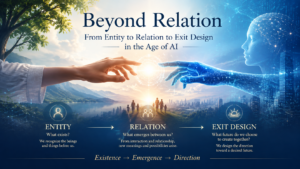
This series calls these two perspectives Entity and Relation.
Entity asks,
“What is it?”
Relation asks,
“How is it connected?”
Neither perspective is sufficient on its own.
Human civilization has advanced largely through the first.
Its future may depend upon rediscovering the second.
The purpose of this series is not to replace one with the other.
It is to explore how both can work together in building a civilization that truly endures.
4. What Does It Mean to Design a Civilization That Endures?
Throughout this series, I will often use the expression Designing a Civilization That Endures.
What does that mean?
A civilization does not endure simply because its institutions survive.
Nor does it endure because its economy grows, its military becomes stronger, or its technology advances.
A civilization truly endures when people can continue living together with hope.
It is a civilization where people can live in safety and dignity.
Where disagreements do not inevitably destroy society.
Where each generation can pass hope on to the next.
Where one person’s prosperity does not require another person’s destruction.
And where, in the end, as many people as possible are able to smile.
These are not merely desirable outcomes.
They are questions about the destination toward which a civilization is moving.
Throughout this series, I will refer to this way of thinking as Exit Design.
Most discussions begin by asking,
“What should we do?”
Exit Design begins with a different question.
“When everything is over, what do we hope will remain?”
The future is shaped not only by the choices we make today, but also by the destination we choose before making them.
Designing a civilization that endures means learning to think from that destination.
5. Why Explore Japanese History and the Classics?
Some readers may wonder why this series places such emphasis on Japanese history and classical texts.
The purpose is not to praise Japan.
Nor is it to argue that Japan is somehow superior to other civilizations.
Every civilization has developed its own wisdom through history.
Japan is simply one place where certain patterns of social continuity have been preserved with unusual clarity.
Within Japanese history and tradition we find ideas such as:
- Kojiki and Nihon Shoki
- the principle of Shirasu—governing for the well-being of the people rather than ruling over them
- the institution of the Emperor
- Bushidō
- festivals that strengthen community bonds
- the practice of passing kindness forward rather than merely repaying it
- local communities built upon mutual responsibility
- and the cultural ideal of Wa—social harmony without requiring uniformity.
These are not presented here as exotic customs unique to Japan.
Rather, they invite a more universal question:
Do these traditions preserve patterns of human relationship that people everywhere can learn from?
This series seeks to read Japanese history not as a story of national exceptionalism, but as a source of universal structures that may help humanity imagine a more enduring civilization.
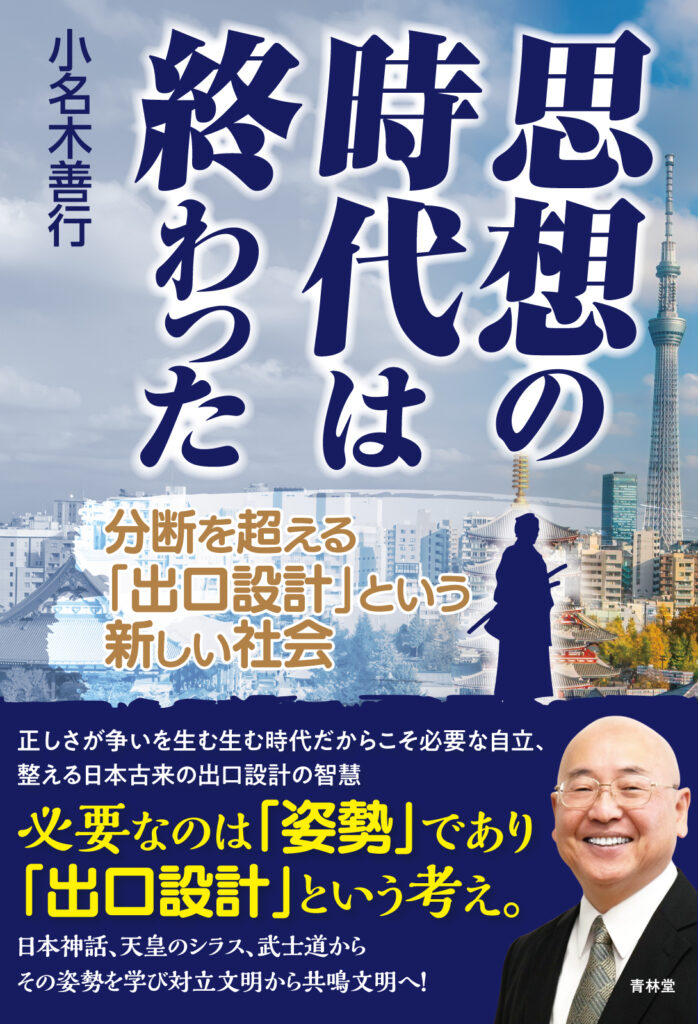
The Japanese edition of this work was never intended as a nostalgic celebration of the past, nor as an argument for Japanese superiority.
It was written as an exploration of how civilization might move beyond systems built primarily upon competition and opposition toward one grounded in relationship, resonance, and continuity.
The English edition makes that purpose even more explicit.
6. What Readers Will Gain from This Series
This series does not promise to give readers a single correct answer.
Civilization is too complex for one answer to resolve every problem.
And any answer that claims to be universally correct may itself become another boundary separating the right from the wrong.
Instead, this series offers new ways of seeing, questioning, and choosing.
A New Perspective on the World
Readers will learn to ask not only,
“Who is right?”
but also,
“What will happen to this relationship in the end?”
This shift allows us to look beyond immediate victory or defeat and consider what our choices will leave behind.
The Ability to See Conflict as a Structure
Conflicts do not always arise because one side is evil or irrational.
Sometimes conflict is produced by the way different forms of justice have been designed.
By examining the structure behind disagreement, we can move beyond blaming individuals and begin to understand why sincere people may still become divided.
A Universal Way of Reading Japanese Culture
The Kojiki, the Nihon Shoki, Bushidō, and other Japanese traditions will not be treated merely as exotic features of a distant culture.
They will be explored as sources of practical wisdom about relationships, social continuity, responsibility, and civilizational design.
Clues to Human Value in the Age of AI
As artificial intelligence assumes more of the work once associated with human knowledge and ability, we must ask what remains uniquely important in human life.
This series will explore the significance of human posture, relationship, resonance, responsibility, and the ability to give meaning to our choices.
Questions That Help Us Design the Future
Above all, readers will encounter questions that can guide their own decisions:
Who will be affected by this choice?
What kind of relationship will it create?
What will remain when the immediate goal has been achieved?
Whose smile will be made possible—and whose may be lost?
What are we passing on to the next generation?
The purpose of this series is not to tell readers what to think.
It is to help us ask questions that make a more enduring future possible.
7. How This Series Will Unfold
This series will unfold across five seasons.
Each season approaches the same central question from a different direction:
How can humanity move beyond a civilization built primarily upon separation, competition, and opposition, and begin designing one that can truly endure?
Season 1 — Beyond Ideology
The first season examines the role ideas have played in the development of civilization.
Ideas have inspired progress, created institutions, and given societies direction.
At the same time, they have often divided the world into opposing camps of right and wrong, friend and enemy, insider and outsider.
This season asks how we can preserve the value of ideas without allowing them to destroy the relationships that make society possible.
Season 2 — Entity and Relation
The second season explores two different ways of seeing the world.
The Entity perspective understands people, nations, organizations, rights, and ideas as distinct and independent realities.
The Relation perspective asks how these realities are connected, and what emerges between them.
This season considers how civilization might move beyond seeing relationship as secondary and begin treating it as one of the foundations of human life.
Season 3 — Exit Design
The third season introduces a different way of making decisions and designing society.
Instead of asking only what is correct, profitable, or efficient, Exit Design asks:
What will happen in the end?
What will remain?
Will relationships survive?
Will the next generation inherit hope—or damage?
This season explores how decisions can be made from the future we hope to create.
Season 4 — Japan’s Civilizational Wisdom
The fourth season turns to Japanese mythology, history, classical literature, and cultural tradition.
The Kojiki, the Nihon Shoki, the principle of Shirasu, the institution of the Emperor, Bushidō, festivals, mutual aid, and the spirit of Wa will be examined not as isolated customs, but as sources of civilizational insight.
The purpose is to identify patterns that may help people everywhere think about how relationships can be preserved across generations.
Season 5 — Designing the Future
The final season brings these themes together.
It asks what human value will mean in an age when artificial intelligence can perform many tasks once associated with knowledge, judgment, and ability.
It will explore how posture, responsibility, resonance, relationship, and Exit Design may help humanity build the next civilization together.
**********
These five seasons are not intended to provide a finished doctrine.
They form a continuing inquiry.
Each season invites us to see civilization from a different perspective.
Together, they invite us to imagine—and begin creating—a civilization in which progress does not require division, prosperity does not require destruction, and the future can be passed on with hope.
8. Closing Reflections
This series does not begin with an answer.
It begins with a question:
What kind of civilization are our choices creating?
Civilization is not created only by governments, laws, institutions, or great historical events.
It is also created through the choices we make each day.
How we speak to someone who disagrees with us.
How we respond when our interests conflict.
How we use knowledge, technology, authority, and wealth.
Whether we choose immediate victory or a relationship that can endure.
Whether we leave damage behind—or hope.
Each of these choices may seem small.
Yet civilization is nothing more than the accumulation of such choices across people, communities, and generations.
The purpose of this series is not to present a final theory of civilization.
Nor is it to offer another ideology that divides the world into those who understand and those who do not.
It is an invitation to a shared inquiry.
Together, we will examine the assumptions beneath modern civilization, rediscover wisdom preserved in history and the classics, and ask what kind of future our present choices are making possible.
The journey begins not by deciding who is right.
It begins by asking where our choices will lead.
And so, before we continue, I invite you to hold one question in mind:
When future generations look back upon the civilization we leave behind,
what will they say we chose to preserve?
_
■新刊 大好評発売中
これが私の集大成本です。
『思想の時代は終わった』
https://amzn.to/3P5D0lS
_