What if learning is not something we stack up, but something we deepen?
Starting from a small four-panel comic, this essay explores adult learning, human relationships, AI, labor, desire, and the future of civilization. At its heart is one simple image: two people kneeling beneath the blue sky, digging together—and finding a treasure that grows the more it is shared.
_
1. Introduction: Learning Is Not Stacking Up
I made a small four-panel comic recently.
It is part of a daily series I call Today's Words — short, simple illustrations meant to carry a single thought into someone's morning.
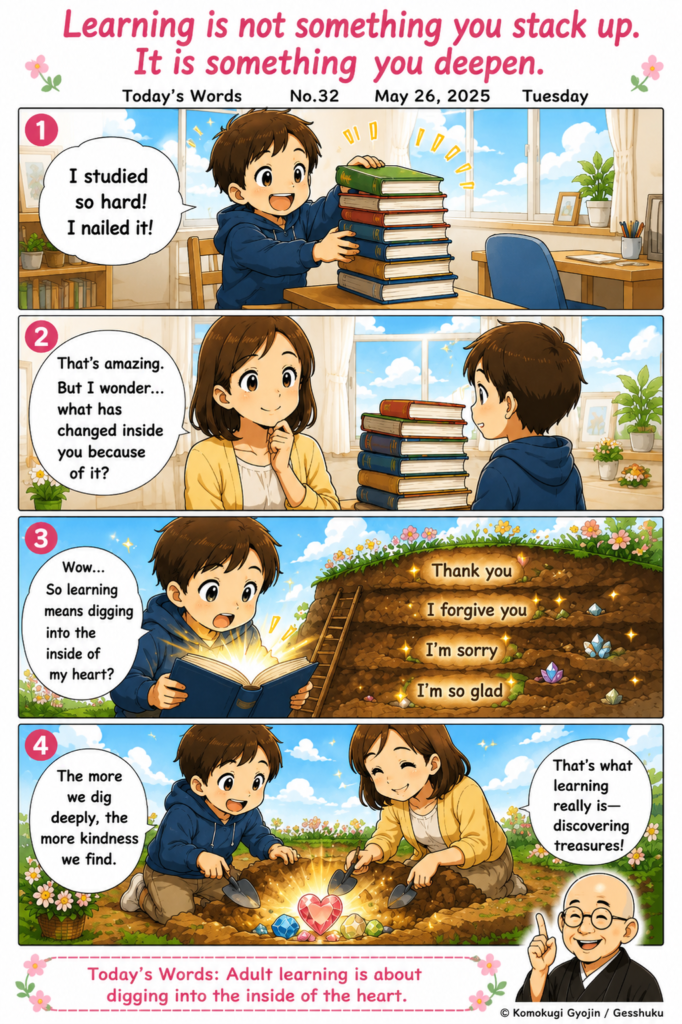
In this particular comic, a boy proudly holds up a towering stack of books.
"I studied so hard! I nailed it!"
His teacher smiles gently, and asks a question he does not expect.
"That's amazing. But I wonder… what has changed inside you because of it?"
The boy pauses.
And then something shifts.
He realizes that what he had been doing was not learning so much as accumulating — stacking books like bricks, measuring knowledge by weight and height.
The next panels show another kind of digging altogether. Not upward, into towers of information. But downward, into the layered earth of the human heart — where the words thank you, I forgive you, I'm sorry, and I'm so glad are buried like gemstones, waiting to be found.
In the final panel, the teacher and the boy are kneeling in the soil together, smiling, their small shovels catching light.
"The more we dig deeply, the more kindness we find."
"That's what learning really is — discovering treasures."
When I finished drawing this comic, I sat back and felt something unexpected: my eyes were wet.
I stayed with that feeling for a while, trying to understand it.
And slowly, a realization surfaced.
I had not drawn a story about learning.
I had drawn a story about accompaniment.
Human beings do not simply want a method for digging.
What we truly want is someone who will dig beside us.
This small comic, I believe, contains the seed of a very large question — one that touches not only education, but the future of civilization itself.
2. What Adult Learning Really Means
Children learn by expanding outward.
Words. Numbers. Names of things. Rules of the world. They reach toward the sky like young branches, and their world grows visibly larger with each passing year. This is beautiful, and necessary.
But at some point — often quietly, without announcement — the direction of learning begins to change.
It stops moving outward.
It begins to move inward.
An adult may return to a book they first read at fifteen and discover that the sentences feel entirely different. The words have not changed. The person reading them has.
A poem that once seemed merely decorative now breaks something open. A historical event that was once a date on a page suddenly carries weight — because you have lived long enough to understand what loss feels like, what betrayal costs, what it means to be responsible for another human being.
This is the secret of adult learning: it does not add to the person. It changes the person.
In the comic, the layers buried in the earth — thank you, I forgive you, I'm sorry, I'm so glad — are not abstract concepts. They are emotional truths that must be lived before they can be truly understood. A ten-year-old can recite the phrase "I forgive you." But forgiving someone who has genuinely hurt you is a different kind of knowing — one that requires years, often pain, sometimes tears in the dark.
This is why people who continue learning deeply throughout their lives often become gentler, not harsher.
Those who merely accumulate information sometimes grow rigid. They confuse knowing about something with understanding it. They become proud of the height of their stack.
But those who learn inwardly — who keep digging — tend to grow softer. More patient. More capable of listening without needing to respond immediately. More comfortable with not knowing.
They have discovered something the stackers have not: that the deeper you go into your own interior, the more you find that you share with other human beings.
The roots of different trees, deep underground, touch one another.
3. We Do Not Need a Tool to Dig Alone
Modern civilization has grown extraordinarily skilled at providing functions.
Faster transport. Instant communication. Automated calculation. Optimized systems. Measurable outcomes.
And now, artificial intelligence is inheriting many of the intellectual functions that once belonged exclusively to human beings — writing, translation, analysis, design, research, programming. The list extends further each year.
Many people are afraid of this.
They are afraid because they have unconsciously accepted a civilization's deepest assumption: that a human being's worth is determined by functional output. By productivity. By how efficiently one performs.
If that assumption is true, then the rise of AI is genuinely terrifying. Because on that measure, machines will win.
But I want to suggest that the assumption itself is what needs to be questioned.
When I looked at the final panel of my comic — the teacher and child kneeling in the soil together, smiling — what moved me was not the act of digging. It was that no one was digging alone.
The teacher was not standing above, evaluating. She was not optimizing the child's technique. She was not measuring how efficiently the treasure was being extracted.
She was there.
Beside him.
With dirt on her hands.
Smiling.
This is something no function can replicate — not because the task of smiling is technically difficult, but because what matters is not the smile itself. What matters is the human being behind it. The presence. The choice to remain.
People do not become emotionally fulfilled by being processed efficiently. They become fulfilled when they feel accompanied.
A society can become extraordinarily comfortable and still become extraordinarily lonely. This is not a paradox — it is a predictable outcome of optimizing for function while neglecting relationship. We have built faster roads to destinations that feel empty upon arrival.
Perhaps the future of humanity lies not in competing with AI on functional grounds, but in recovering what AI cannot offer: genuine human presence. The willingness to kneel in the soil beside someone else. The warmth of digging together.
4. From Functional Labor to Relational Value
For most of recorded history, civilization has been organized around a single principle: human value derives from human labor.
Work and produce, and you will eat. Work and produce, and you will belong. Work and produce, and you will matter.
This is so deeply embedded in modern consciousness that most people accept it as natural — as though it were a law of physics rather than a historical arrangement.
But it is an arrangement. And like all arrangements, it can change.
Consider what is actually happening as AI expands its reach. Not only are machines absorbing physical labor — they are absorbing intellectual labor. Writing. Legal analysis. Financial modeling. Medical diagnosis support. Educational tutoring. Creative assistance.
As this happens, the old equation — human worth equals functional output — begins to destabilize. For the first time in history, it becomes at least imaginable that human beings might not be primarily valued for what they produce.
What fills that space?
I believe the answer has always been present, though it has been systematically undervalued by functional civilization: relational value.
The value of being trusted.
The value of making someone feel genuinely seen.
The value of holding space for another person's grief.
The value of teaching with patience and warmth.
The value of repairing a relationship instead of abandoning it.
The value of digging together.
These things are difficult to quantify, and for that reason, the instruments of modern economics have largely ignored them. But they are not economically irrelevant — they are simply measured by instruments too blunt to detect them.
In a functional civilization, value flows like oil: extracted from a finite source, transported, sold, depleted.
In a relational civilization, value behaves more like a conversation: the more genuinely it is shared, the richer it becomes. Trust, when offered, tends to generate more trust. Warmth, when given freely, tends to return. Wisdom, when passed to another person, does not diminish in the giving — it deepens.
This is not sentimentality. It is a different economic logic — one that functional civilization has never properly understood, because its instruments were designed to measure the wrong things.
5. The Problem of Human Desire
At this point, a serious objection must be raised — and I want to raise it myself, plainly.
If relational value is so powerful, why have all previous attempts to build civilization around it eventually decayed?
Why do communes dissolve? Why do idealistic communities fracture? Why do movements built on love and solidarity so often end in betrayal and bitterness?
Human beings are not consistently capable of what we at our best aspire to. We become jealous. We grow exhausted. We turn relationships into transactions when we are frightened. We reach for power when we feel powerless. We use others as emotional resources and then resent them for running dry.
History is littered with beautiful visions and collapsing utopias.
In Japan, there is an old phrase that captures something honest about romantic love: "Even smallpox scars look like dimples when one is in love." When passion is strong, even flaws appear beautiful. But passion changes. Reality reasserts itself. The scar becomes a scar again.
This is not a failure of love. It is a feature of being human — and any serious attempt to build a relational civilization must reckon with it honestly rather than simply wish it away.
Modern functional civilization made a different kind of error: it expected human beings to perform continuously, without fatigue, without fluctuation, without the natural rhythms of retreat and return that characterize every living thing. Efficiency requires consistency. But human beings are not consistent. Our energy rises and falls. Our hearts open and close. We are sometimes magnificent, and sometimes very small.
And because functional civilization cannot easily accommodate this — because it rewards output and penalizes slowness — people learned to hide their interior lives. To perform wellness. To keep the scar invisible.
Perhaps the deepest loneliness of modern life is not the absence of other people, but the inability to be genuinely present among them — because genuine presence requires showing the parts of yourself that do not perform well.
The question, then, is not how to build a civilization of perfect people.
It is: how do imperfect people continue living together without destroying one another?
This is the question that every civilization must eventually answer. And civilizations that ignore it — that assume human goodness will simply flourish if the right conditions are provided — tend to collapse from within.
6. Exit Design: How a Relational Civilization Can Survive
This is where the concept of exit design becomes essential.
Exit design is the practice of thinking not only about how something begins, but about what happens when it runs into difficulty — which it always does.
Modern civilization became brilliant at expansion. It learned how to grow economies, accelerate communication, increase efficiency, and amplify desire. It was extraordinarily good at starting things and at scaling them.
But it was often careless about what comes after success. After power accumulates. After comfort increases. After desire — with no internal guidance — begins consuming the very relationships it was supposed to serve.
Without exit design, even beautiful systems collapse under their own momentum.
Consider how many Japanese aesthetic traditions addressed precisely this problem — not with idealistic proclamations, but with practical forms of cultivation.
The concept of do — the Way — as found in sado (tea ceremony), kendo, judo, and dozens of other disciplines — is not primarily about mastering a technique. It is about subjecting oneself to a form that continues to discipline desire over time. The form does not ask whether you feel like practicing today. It simply asks you to return to the practice, again and again, regardless of mood.
The concept of wa — harmony — was not a description of how Japanese society naturally was. It was a prescription for what needed to be continually cultivated, because everyone understood that human beings naturally tend toward conflict without ongoing effort.
Seasonal awareness — the sensitivity to mono no aware, the gentle melancholy of impermanence — trained people to hold beauty without clinging, to let go without bitterness. It was, among other things, a technology for preventing attachment from curdling into possession.
These were not decorative cultural features. They were practical solutions to the problem of human desire in community — refined over centuries, embedded in daily life, made second nature through repetition.
A relational civilization cannot survive on beautiful intentions. It requires something more difficult: ongoing practice. Not perfection — practice. The difference matters enormously. Perfection demands a destination that is never reached, and exhausts the traveler. Practice simply asks that you return to the effort, again and again, imperfectly, honestly, without giving up.
The survival of a relational civilization may depend less on creating the right institutions and more on cultivating the right habits — daily, quietly, in ways too small to be measured by the instruments of functional economics, but too essential to be ignored.
7. Sky, Soil, and the Human Between Them
Let me return to the comic.
In the final panel, there is a blue sky.
There is soil.
And between them, a teacher and a child are kneeling together, smiling, small shovels in their hands, light rising from the earth at the place where they have been digging.
It is a very simple image.
And yet I believe something genuinely profound is compressed inside it — something that touches the oldest understanding of what it means to be human.
Human beings have always lived between heaven and earth. We stand beneath the sky, yet we touch the soil. We dream of what lies beyond, yet we are rooted in the specific weight of physical life — in hunger, fatigue, affection, grief, the smell of rain on warm ground.
Perhaps true civilization only emerges when both dimensions remain connected.
Modern civilization often loses this balance. Some people escape entirely into abstraction — ideology, digital reality, systems of thought that float free of embodied life. Others remain trapped entirely in material concerns — efficiency, consumption, the relentless optimization of the physical world without any reference to why it might matter.
Human beings cannot truly flourish in either extreme. We need ideals, but we need touch. We need vision, but we need warmth. We need to reach toward something larger than ourselves, but we need, at the end of the day, to feel accompanied.
In classical Japanese thought — particularly in the tradition that shaped concepts like satoyama (the landscape between mountain and village), and the cosmology embedded in many folk practices — there exists a quiet awareness of the inseparability of heaven, earth, and the human being who stands between them. Not as master of either, but as participant in both. Not extracting, but attending. Not dominating, but belonging.
The teacher and child in the comic are not escaping reality. They are kneeling in the actual earth, getting soil on their hands. They are present to the specific ground beneath them.
Yet they are not heavy, not despairing, not lost in the weight of the material world.
Above them is open sky.
Light.
Space.
Breath.
Perhaps this balance — rooted in earth, open to sky, sustained by the presence of another person — is what learning, at its deepest, is trying to restore in us.
Not knowledge as inventory.
But the human being, properly oriented between heaven and earth, capable of growing.
8. AI and the End of Slave-Labor Civilization
For thousands of years, the labor of the majority sustained the freedom of the minority.
In ancient Athens — celebrated as the birthplace of democracy and philosophy — historians estimate that slaves constituted roughly seventy to ninety percent of the population in some city-states. The citizens who debated ethics in the agora, who wrote philosophy that still shapes Western thought, who developed mathematics and political theory — their freedom to think was purchased by the unfreedom of those who performed the necessary labor beneath them.
Modern civilization abolished legal slavery. But it retained, in modified form, the same structural logic: the majority of human beings spend the majority of their lifetimes exchanging functional labor for survival.
The forms are softer. The legal protections are real. But the underlying arrangement — your worth is measured by what you produce, and you must produce in order to exist — has proven remarkably durable.
And now something unprecedented is happening.
AI is beginning to inherit the functional dimension of civilization — not just physical labor, as steam engines and machines did before, but intellectual labor as well. Writing, analysis, translation, design, programming, research. The scope expands monthly.
This creates genuine disruption and genuine fear.
But I want to suggest that something else may also be happening: for the first time in human history, the functional foundation of civilization is being transferred away from human beings.
If this transition is navigated with wisdom rather than merely with speed, it opens an extraordinary possibility.
What becomes possible when human beings are no longer primarily defined by their necessity as functional units?
What kind of life becomes available when survival no longer requires the sacrifice of most of one's waking hours to the production of economic output?
The answer will not arrive automatically. Technology does not determine civilization — people do. If the gains from AI are concentrated into the hands of a small elite, the result will not be liberation. It will be a new form of stratification: a digital aristocracy presiding over populations stripped of both labor and dignity.
This is entirely possible. Perhaps probable, without deliberate countervailing effort.
But the possibility of something else also exists. A civilization in which human beings are freer — genuinely freer — to spend their lives cultivating what has always been most distinctively human: learning, creating, teaching, healing, building relationships, transmitting wisdom, caring for the old and the young, attending to one another with patience and warmth.
The question is not whether AI will become more capable. It will.
The question is what human beings will choose to do with the freedom its capabilities might create.
9. A Society of Citizens, Not Slaves
The ancient Greek ideal of the polis — a society of free citizens engaged in the common pursuit of wisdom and justice — was always contradicted by the reality of who it excluded. The freedom of the citizen rested on the labor of the slave.
Every subsequent era of civilization has struggled with some version of this same contradiction: the aspiration toward universal human dignity, constrained by the structural requirement that someone must perform the necessary labor.
What is historically unprecedented about the present moment is that this constraint may, for the first time, be dissolving — not through political reform, but through technological change.
The labor that once required human bodies and human minds is increasingly performable by machines. This does not automatically produce a just civilization. But it removes one of the oldest arguments against one: that universal dignity is a beautiful ideal that must yield to economic necessity.
Imagine a civilization in which every person — not only the privileged, not only the talented, not only the economically useful — is considered to have inherent worth independent of functional output.
This is not a new idea. It is, in fact, one of the oldest moral intuitions of human civilization, expressed across traditions and cultures. What is new is the possibility of actually building a civilization around it, because the old structural argument that such a civilization was economically impossible is losing its force.
The danger, of course, is that the transition produces not a society of citizens, but a new form of dependency — populations rendered economically irrelevant, managed by systems designed to keep them passive, their human potential untapped because it is no longer economically necessary.
Preventing this requires the same thing it has always required: communities of people who take seriously the task of cultivating human dignity, not as an abstraction, but as a daily practice. People who choose, again and again, to kneel beside one another in the soil. Who treat the development of another person as genuinely valuable — not because it produces something, but because it is something.
Education, in this vision, is not preparation for labor.
It is the practice of becoming more fully human.
10. The Real Buried Treasure
Japan has a famous legend: the Tokugawa埋蔵金 — the buried gold of the Tokugawa shogunate, said to have been hidden somewhere in the mountains at the fall of the old regime. For generations, people searched for it. Maps were drawn. Theories multiplied. Television programs were produced. People dreamed of fortune rising suddenly from the earth.
As far as anyone knows, it was never found.
But perhaps the real buried treasure was never gold.
Perhaps it has always been something that modern civilization, dazzled by its own material wealth, consistently failed to recognize as treasure at all.
The ability to repair a relationship after conflict.
The capacity to hold someone else's grief without flinching.
The willingness to remain present to a person who is slow, or uncertain, or temporarily broken.
The art of growing something together over time — a friendship, a community, a shared understanding of what makes life meaningful.
These things behave differently from material wealth.
Gold decreases when divided. A bar of gold cut in half becomes two smaller bars. Material resources are subject to the logic of scarcity: when I have more, you have less.
But trust, when genuinely offered, tends to generate more trust. Warmth, freely given, tends to return. Wisdom passed to another person does not diminish in the passing — it deepens, sometimes in ways the teacher never anticipated, sometimes in ways that eventually surpass the teacher's own understanding.
This is the extraordinary feature of relational value: it does not obey the economics of scarcity. It obeys, instead, something more like the logic of cultivation — the older, quieter logic of the garden, where patient attention over time produces abundance that could not have been forced or rushed.
The final panel of the comic captures this exactly.
The teacher and child have not simply found treasure. They have found it together. The act of digging together was not separate from the finding — it was the finding. The treasure and the relationship that discovered it cannot be separated.
Perhaps this is the deepest thing the image is saying.
The treasure is not waiting underground, independent of the people who seek it.
The treasure grows in the space between people who are genuinely present to one another.
It cannot be extracted. It can only be cultivated.
It cannot be monopolized. It can only be shared.
It cannot be exhausted. It expands, the more truly it is given.
11. Conclusion: The Future Begins with a Small Smile
When people hear the phrase civilizational phase transition, they imagine something dramatic.
Revolutions. Upheaval. The collapse of old orders, the violent birth of new ones.
Sometimes that is how transformation arrives.
But I wonder whether the deeper transformations — the ones that actually change what it means to be human — have always begun more quietly.
With a question asked gently: What has changed inside you?
With a teacher kneeling in the dirt beside a child, not above him.
With someone choosing to repair rather than abandon.
With the decision, repeated daily without fanfare, to remain present to another imperfect human being.
In Japanese thought, there is a question I return to often — simple enough for a child, but capable of testing the most sophisticated system:
In the end, can everyone still smile?
Not: has it been optimized?
Not: has it been made efficient?
Not: has it produced measurable outcomes?
Simply: can everyone still smile?
This question cannot be answered by technology alone. It cannot be answered by political theory alone, or economic restructuring alone. It can only be answered in the accumulated texture of specific, daily human choices — the ongoing practice of treating other people as though their interior lives matter, as though their growth is worth accompanying, as though the treasure buried in their hearts is worth kneeling in the soil for.
Civilization will continue to be complicated. Human desire will not disappear. Conflict will not end. The work of building and repairing relationships will remain difficult, imperfect, and occasionally heartbreaking.
But perhaps maturity — for a person, and perhaps for a civilization — is the capacity to continue walking together despite all of this. Not because we have resolved our contradictions, but because we have decided that the journey is worth making even so.
In the final panel of a small comic, a teacher and child kneel together beneath an open sky.
Their hands are in the soil.
Their faces are turned toward one another.
They are smiling.
The treasure is rising from the earth between them.
And perhaps that image — small, simple, drawn with care — contains more civilizational wisdom than many more ambitious visions.
Not domination.
Not optimization.
Not competition.
Just two human beings, present to one another, discovering together what was buried all along.
That, I think, is where the future begins.
_
■新刊 大好評予約受付中
これが私の集大成本です。
『思想の時代は終わった』
https://amzn.to/3P5D0lS
_