We often try to avoid hardship, believing that a good life is one without struggle. But what if the way we face difficulty is what truly shapes who we are? Through the life of a Japanese samurai who once prayed for “seven hardships and eight sufferings,” this article explores a different way of living—one that does not seek comfort, but meaning, and carries something forward beyond itself.
_
- Introduction – The Question of Hardship
Do we seek a life without hardship?
Or do we learn how to live within it?
In today’s world, we are often taught to avoid pain, to minimize risk, and to pursue comfort as efficiently as possible. Success is measured by results, speed, and visible achievements. And yet, despite all this, many people still feel something is missing.
What if hardship is not something to be eliminated—but something to be understood?
What if the way we face difficulty shapes the very meaning of our lives?
There was once a samurai in Japan who asked for something that seems almost unthinkable today.
Shikanosuke Yamanaka is remembered not only for his courage in battle, but for a single, striking prayer:
“Grant me seven hardships and eight sufferings.”
At first glance, this may sound like a desire for pain. But in truth, it reveals something far deeper. It is not a wish for suffering, but a refusal to run from it—a decision to accept one’s role, no matter how difficult the path may be.
His life was not one of easy victory. It was marked by loss, struggle, and an end that came before his goal was fully realized. And yet, his story has endured for centuries.
Why?
Perhaps because it speaks to a question that transcends time:
Not how to succeed—but how to live.
- A Samurai Who Chose Suffering
Shikanosuke Yamanaka was born into a time of relentless conflict. His lord, the Amago clan, once powerful, was gradually losing its strength under the pressure of a rising rival. The world around him was collapsing, and the future of his house seemed uncertain.
As a young man, he made a choice that would define his entire life.
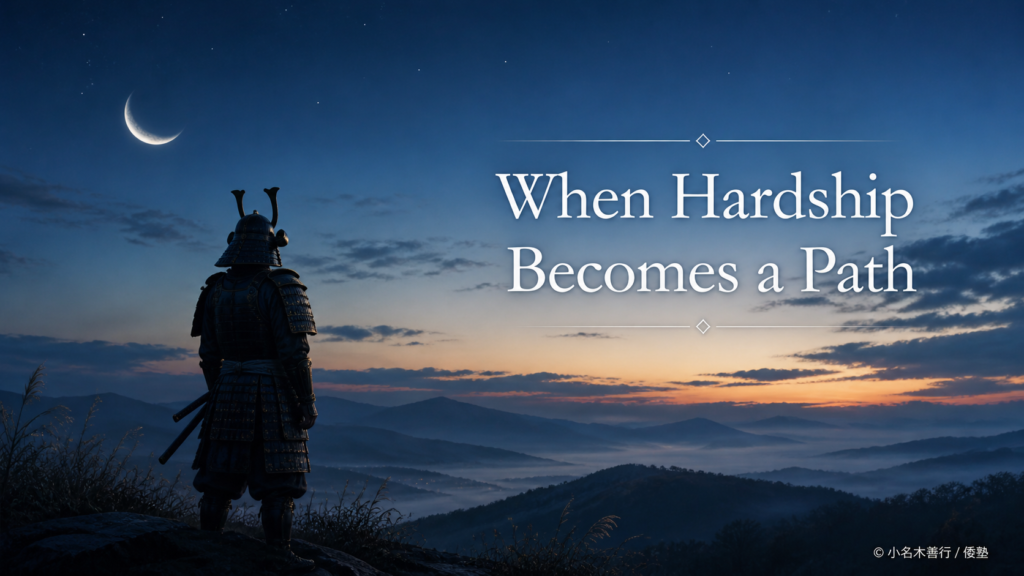
Standing beneath the crescent moon that adorned his helmet, he prayed:
“Grant me seven hardships and eight sufferings.”
This was not a moment of despair. It was a declaration.
He did not ask for victory.
He did not ask for safety.
He asked for the strength to endure whatever would come.
From that day on, his life became a continuous path of struggle.
He fought in battles where defeat was almost inevitable. He faced enemies stronger in number and position. At one point, he engaged in a fierce duel with a formidable warrior across a river—crossing the current alone, meeting his opponent face to face, and emerging victorious through sheer determination and skill.
Yet these moments of triumph were only brief flashes in a much longer story.
The Amago clan fell.
Their castle was lost.
Their retainers scattered.
Many would have accepted this as the end. But not him.
He gathered the remnants, sought out the last surviving heir—who had been living as a monk—and raised him once again as lord. Together, they attempted to restore what had been lost.
They succeeded, for a moment.
And then, once again, they were crushed by overwhelming force.
Still, he did not abandon his path.
Even when hope seemed distant, even when defeat followed defeat, he continued—not because success was guaranteed, but because the role he had chosen demanded it.
In the end, his life did not conclude with victory. Captured and sent away under guard, he was killed before he could see the fulfillment of his cause.
He died at the age of thirty-four.
And yet, there is something in his life that feels complete.
Not because he achieved his goal,
but because he never turned away from it.
- What True Strength Means
What does it mean to be strong?
At first glance, strength may appear as courage in battle, skill with a sword, or the ability to overcome an enemy. By those standards, Shikanosuke Yamanaka was certainly strong.
But there is a story about him that reveals a different kind of strength.
After a battle, two young warriors spoke of their first experience in combat.
One said, “I was so frightened that my body trembled. I could barely see my opponent, and I remember almost nothing of what happened.”
The other said, “I saw everything clearly—the armor my enemy wore, the horse he rode, even the place where we fought.”
Most people would assume the second warrior to be the stronger of the two.
But Yamanaka Shikanosuke thought differently.
He said, “The first will become a fine warrior. The second… I am not so sure. Perhaps he merely claimed another’s achievement—or he may not survive his next battle.”
Why would he say such a thing?
Because true strength does not begin with the absence of fear.
It begins with the recognition of it.
The one who trembled did not hide his fear. He faced it, endured it, and stepped forward despite it.
The one who claimed clarity may have been speaking from pride—or from distance.
To deny fear is to begin from illusion.
And anything built upon illusion will eventually collapse.
Shikanosuke understood something essential:
Fear is not the enemy. It is part of being human.
What matters is not whether we feel fear, but whether we turn away from it—or move through it.
In this sense, his prayer for “seven hardships and eight sufferings” was not a wish for pain, but a commitment to truth.
A refusal to pretend.
A decision to stand within reality, however harsh it might be.
True strength is quiet.
It does not announce itself.
It is found in those who do not run,
who do not hide,
and who continue forward, even when every step is heavy.
- A Life That Doesn’t End With Itself
When we look at the life of Shikanosuke Yamanaka , it is difficult to call it a success in the usual sense.
He lost his lord.
He fought to restore what had fallen—and failed.
He gathered allies, only to see them scattered again.
In the end, he died before his goal was fulfilled.
If we measure a life only by its visible results, then his story might seem like one of defeat.
And yet, that is not how his life has been remembered.
Why?
Because his life did not end with himself.
Even after his death, the current he set in motion continued to flow.
The people he gathered carried forward the intention he had protected.
The name he fought for did not disappear.
It changed form—and lived on.
Some traces of his life appeared in unexpected ways.
It is said that his descendants later became part of a merchant family that contributed to a remarkable transformation in sake—the traditional Japanese rice wine—refining it from a cloudy drink into a clear and transparent one, and eventually helping shape early financial networks in Japan.
These outcomes were far removed from the battlefield where he had lived and died.
And yet, they may still belong to the same current.
History is full of such lives.
Not every effort bears fruit within a single lifetime.
In fact, the deeper the intention, the longer it may take to unfold.
Shikanosuke did not live to see the restoration he sought.
But he lived in a way that made continuation possible.
There is a profound difference between these two.
To seek success is to ask, “What can I achieve in my time?”
But to live beyond oneself is to ask, “What will continue because I lived?”
This is not about abandoning results.
It is about widening the horizon in which we understand them.
Our actions ripple outward, beyond what we can see.
What we build, what we protect, what we pass on—these become part of a larger flow.
In this sense, a life is not a closed circle.
It is a line that extends forward.
Shikanosuke’s life reminds us of this simple but powerful truth:
A life does not need to be complete in order to be meaningful.
- Conclusion – Designing the End
What, then, does it mean to design the end?
We often think about how to begin, how to succeed, how to win.
But rarely do we pause to consider what remains after we are gone.
Shikanosuke Yamanaka did not live to see the fulfillment of his goal.
By conventional measures, his life may appear incomplete.
And yet, nothing about his life feels unfinished.
Because he did not live only for results.
He lived with an awareness that something would continue beyond him.
To design the end is not to control the outcome.
It is to live with a quiet sense of direction—an understanding that what we do does not stop with us.
When we begin to see life in this way, hardship itself takes on a different meaning.
It is no longer something to escape.
It becomes part of the path we are given.
Not because suffering is something to seek,
but because through it, something real is shaped and gently carried forward.
Perhaps this is why his quiet prayer still lingers, even now.
A life does not simply end when it ends.
It continues—softly, beyond what we can see.
And somewhere along that unseen line,
the way we have lived begins to take its true form.