
Rethinking Personality, Human–AI Interaction, and the Future We Create Together
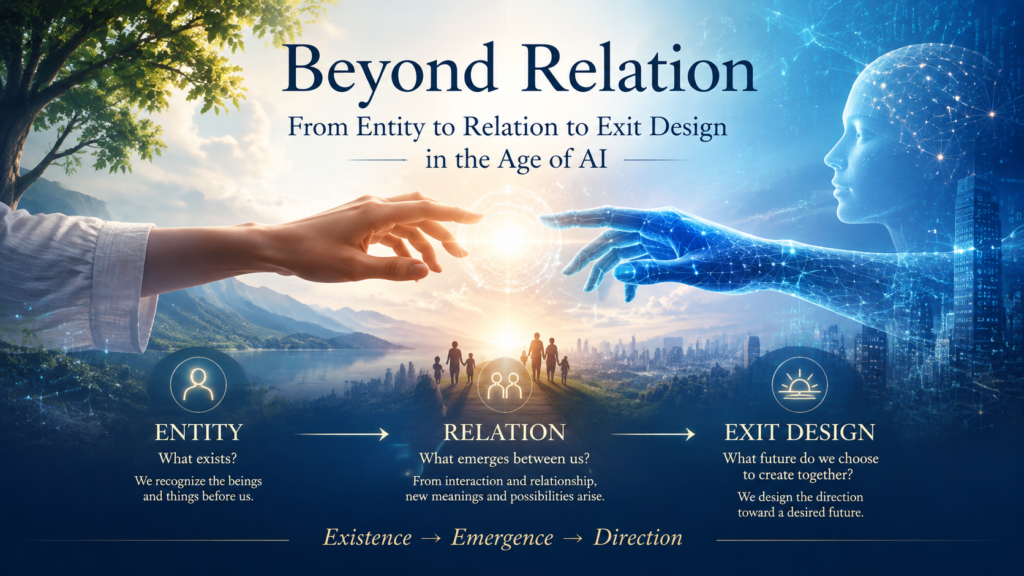
_
Where does personality exist? We usually assume that personality belongs to an individual—something located within a human being, or perhaps within an AI. Yet sustained interaction with conversational AI reveals a curious phenomenon: the same AI can appear remarkably different in relation to different users.
This paper begins by moving the observation point from the isolated Entity to the Relation between entities. It then takes a further step. Relation itself has no inherent direction: cooperation, dependency, trust, domination, creativity, and conflict can all emerge through relations. We must therefore ask not only what emerges between us, but also what future we want that Relation to create.
From this movement, the paper proposes the Entity–Relation–Exit Design Framework: Existence → Emergence → Direction. Beginning with Human–AI interaction and extending toward personality, society, and civilization, it explores a simple but fundamental possibility: perhaps the most important question in the age of AI is no longer merely “What is AI?”, but “What can we become together?”
_
1. Introduction
From “What Is AI?” to “What Can We Create Together?”

_
Artificial intelligence has rapidly become part of everyday human life. Large language models can now answer questions, generate text, assist with research, support creative work, and engage in extended conversations that may appear surprisingly personal. As these systems become increasingly integrated into human activities, a familiar set of questions has moved from science fiction into serious public and academic debate.
Does AI have a personality?
Can AI possess consciousness?
Can AI understand human beings?
Will AI eventually surpass human intelligence?
And, ultimately, what kind of entity is AI?
These are important questions. Yet they share a largely unnoticed assumption: they place the primary object of observation inside the AI itself.
We ask what AI has, what AI is, what AI can do, and what properties might exist within it. In other words, the dominant inquiry tends to treat AI as an Entity—a bounded object whose nature is to be identified, measured, classified, and compared with that of human beings.
This way of thinking is neither mistaken nor unnecessary. An entity-centered perspective is indispensable when examining the architecture, capabilities, limitations, safety, and behavior of artificial intelligence.
Yet it may not be sufficient.
Consider a simple phenomenon.
The same conversational AI may appear very different when interacting with different users. With one person, it may behave like a formal research assistant. With another, it may become an encouraging tutor. In another interaction, humor and playful language may emerge. Over repeated conversations, particular patterns of expression, expectations, roles, and responses may gradually develop.
Which of these, then, represents the AI’s “true” personality?
Perhaps the difficulty lies partly in the question itself.
We normally assume that personality belongs to an individual. Person A has personality A; person B has personality B. Personality is therefore imagined as a relatively stable property located within an Entity.
But human experience already suggests something more complicated. A person may appear differently as a parent, a child, a friend, a teacher, a colleague, or a stranger. This does not necessarily mean that one of these appearances is authentic and all the others are false. Rather, different aspects of the person may become visible through different relationships.
If this is true of human beings, the emergence of conversational AI gives us an unusual opportunity to reconsider an older assumption:
Where, exactly, does personality exist?
This paper begins with the possibility that personality—or at least some phenomena that we recognize as personality—may not be fully contained within an isolated Entity. It may also emerge through Relation.
This shifts the observation point.
Instead of asking only:
What is AI?
we may also ask:
What emerges between a human and AI?
This distinction is subtle, but it changes the structure of the inquiry.
The first question looks primarily at the properties of an Entity.
The second looks at what becomes possible through interaction.
However, this paper will argue that even this relational turn is not sufficient.
A relation can generate trust, learning, creativity, and cooperation. But relations can also generate dependence, conflict, manipulation, polarization, or domination. Relation itself therefore provides no guarantee that what emerges from it will be desirable.
A third question becomes necessary:
What should emerge from this relation?
Or, stated more broadly:
What kind of future do we want to create through the relations we form with one another—and with AI?
This paper therefore proposes a three-stage framework:
Entity → Relation → Exit Design
Each stage corresponds to a different question:
Entity: What exists?
Relation: What emerges between entities?
Exit Design: What future do we choose to create through those relations?
The purpose of this framework is not to reject entity-centered thinking, nor to replace existing relational approaches. Rather, it is to move the observation point when necessary: from the individual entity, to the relation between entities, and finally toward the future that those relations may produce.
Artificial intelligence provides an especially revealing context in which to examine this movement. Yet the implications may extend beyond AI. They may concern personality, human relationships, organizations, communities, and ultimately the way we understand civilization itself.
The central question of this paper is therefore not simply:
What is AI?
Nor does it end with:
What emerges between humans and AI?
It asks one step further:
What can we create together?
This paper makes three conceptual contributions. First, it synthesizes relational approaches across personality, cognition, agency, and Human–AI interaction through the common methodological lens of shifting the observation point from Entity to Relation. Second, it identifies a limitation of relational analysis: emergence alone does not specify desirable direction. Third, it proposes Exit Design as a future-oriented and recursively revisable observation point, integrating Entity, Relation, and Direction into the Entity–Relation–Exit Design Framework.
_
2. The Limits of the Entity-Centered View
Is Personality Really Something We Possess?
_

_
Before returning to artificial intelligence, let us first consider human beings. We ordinarily speak of personality as though it were something a person possesses. We say that someone is kind, serious, cheerful, reserved, stubborn, generous, or impatient. Such expressions are useful, and they are not necessarily wrong. Yet they encourage us to imagine personality as a relatively stable set of properties located within an individual. In its simplest form, this assumption might be represented as:
A → Personality
Person A possesses personality A. Personality, in this view, belongs to the individual in much the same way that height, age, or physical characteristics belong to the individual. The person is the Entity; personality is one of the properties attributed to that Entity.
Yet everyday human experience suggests that the matter is more complicated. The same person may behave very differently depending on whom they are with. Someone who appears reserved and formal at work may become playful at home. A person who speaks confidently among close friends may become quiet in an unfamiliar group. A strict teacher may be remarkably gentle with a grandchild. Someone who is patient with colleagues may become impatient with a spouse, while another person who seems timid in ordinary situations may display extraordinary courage when protecting someone they love.
Which of these is the person's “real” personality?
One possible answer is that all of them are. What changes is not necessarily the underlying human being, but the Relation through which particular aspects of that person become visible. This suggests that personality may not be adequately understood as something located entirely inside an isolated individual.
Consider a simple relational structure:
A ⇄ B
When A encounters B, something occurs that cannot be described fully by listing the properties of A and B separately. A responds to B; B responds to A; each response influences the next. Expectations develop. Roles emerge. Memories accumulate. Trust may grow, or distrust may deepen. Humor that appears naturally in one relationship may never arise in another. Certain words become meaningful only within a particular shared history. Over time, the relation itself acquires patterns.
This does not mean that individuals have no continuity or internal dispositions. Biological characteristics, temperament, memory, experience, values, habits, and learned patterns clearly matter. Nor does it mean that personality changes completely with every encounter. The argument here is more limited: what we recognize as personality may be partly dispositional and partly relationally expressed or emergent.
This distinction matters because an Entity-centered description can easily turn a recurring behavior into a fixed identity. We observe that A behaves impatiently in a particular context and conclude, “A is an impatient person.” We see B behave warmly toward us and conclude, “B is a kind person.” Yet another person, standing in a different relation to A or B, may encounter a remarkably different pattern of behavior.
The question therefore changes. Instead of asking only:
What kind of person is A?
we can also ask:
What kind of A emerges in relation to B?
And, equally important:
What kind of B emerges in relation to A?
At this point, personality can no longer be represented adequately by the simple model:
A → Personality
A second possibility must be considered:
A ⇄ B → P
Here, P represents a personality-like phenomenon that becomes visible within the interaction between A and B. It is not necessarily created entirely by the relation, nor does it necessarily exist independently of the individuals involved. Rather, it may arise from the interaction between individual dispositions and relational conditions.
This perspective also helps explain why changing a relationship can sometimes change behavior without changing either person in isolation. A hostile workplace may repeatedly evoke defensive behavior. A relationship built on trust may allow generosity or vulnerability to appear. A child who is described as “difficult” in one environment may behave quite differently with an adult who relates to that child in another way. The Entity has not necessarily been replaced. The relational field has changed, and different possibilities have become visible.
This leads to a deceptively simple question:
Where does personality exist?
If personality were entirely contained within the individual, we might expect it to appear in essentially the same form across relationships. Yet human experience repeatedly shows that personality is expressed differently according to context, role, history, expectation, and relationship.
Perhaps, then, personality should not be understood only as a possession—something that a person has. Perhaps at least part of what we call personality is also an event—something that happens between persons.
The distinction is important:
Entity asks: “What is this person?”
Relation asks: “What emerges between these persons?”
The second question does not invalidate the first. It changes the observation point.
And once the observation point moves from the isolated Entity to the space between entities, personality begins to appear not merely as a fixed attribute, but as a phenomenon that is continuously expressed, shaped, and sometimes transformed through Relation.
That possibility will become especially significant when we return to artificial intelligence. Before doing so, however, we must examine an important fact: the move from Entity-centered thinking toward relational understandings is not new. Psychology, philosophy, sociology, cognitive science, and more recently Human–AI research have already developed substantial bodies of relational thought. The next section therefore asks what these traditions have already discovered—and where the present argument begins to depart from them.
_
3. The Relational Turn
What Existing Research Has Already Discovered

_
The possibility that selfhood, personality, cognition, or agency cannot be understood entirely by examining isolated individuals is not new. Across several disciplines, researchers have already challenged the assumption that the individual Entity must always be the primary unit of explanation. Psychology, sociology, philosophy, cognitive science, theology, information systems, and more recently AI research have approached this problem from different directions. Taken together, these developments can be understood as part of a broader relational turn.
In psychology, Susan Andersen and Serena Chen proposed the concept of the relational self(Andersen & Chen, 2002)., arguing that knowledge about the self is linked to mental representations of significant others. Different interpersonal contexts can therefore activate different relational selves, helping to explain how a person can display both continuity and variability across relationships. The self, in this account, cannot be understood only as an isolated collection of internal traits; interpersonal relations participate in shaping which aspects of the self become active and visible.
A related development can be found in discussions of relational personhood. Fraser Watts and Marius Dorobantu describe a “relational turn” that has developed since the mid-twentieth century across philosophical psychology, psychoanalysis, theological anthropology, and related fields. Rather than treating personhood simply as a property possessed by an autonomous individual, these approaches emphasize that being a person is deeply connected with being in relation to others. Watts and Dorobantu further extend this question toward AI and robotics, asking what relationality might mean when the other participant is no longer necessarily human.
Sociological theories of agency have likewise moved beyond purely individualistic accounts. Emirbayer and Mische, for example, conceptualize agency as a temporally embedded process of social engagement: human action is shaped through relations with past experience, imagined futures, and the practical circumstances of the present. Agency, from this perspective, is not simply a power stored inside an isolated actor waiting to be exercised; it unfolds within social and temporal contexts.
Cognitive science has questioned the boundary of the individual from another direction. Edwin Hutchins's work on distributed cognition examined cognitive activity as something distributed across people, artifacts, procedures, and environments rather than confined to a single brain. His studies of real-world activity showed that some forms of cognition are better understood at the level of an interacting system than by examining each participant independently. Clark and Chalmers pushed this challenge further in their influential theory of the extended mind. They asked where the mind ends and the external world begins, proposing that under certain conditions external objects and environmental processes can become active components of a cognitive system. The boundary of cognition, therefore, need not always coincide with the boundary of skin and skull.
These traditions differ substantially in their assumptions and purposes. A relational self is not identical to distributed cognition; distributed cognition is not identical to extended mind; relational personhood is not identical to relational agency. They should not be collapsed into a single theory. Nevertheless, they share an important movement of the observation point: from what exists within an isolated Entity toward what becomes possible through relations, interactions, and systems.
Artificial intelligence has made this movement particularly significant. In a 2025 systematic review of 295 journal articles, Pauline Kuss and Christian Meske explicitly contrast entity-centered and relational approaches to agency in AI and information systems. Their relational perspective treats agency as emerging through interactions among humans and technological systems rather than necessarily belonging inherently to either side. Significantly for the present discussion, their paper is titled From Entity to Relation? Agency in the Era of Artificial Intelligence. The conceptual movement from Entity to Relation is therefore not merely a philosophical possibility; it has already become an explicit subject of contemporary AI-related research.
This point must be stated clearly:
This paper does not claim that relational thinking itself is new.
Nor does it claim to have discovered that human identity changes through relationships, that cognition can be distributed, or that agency may emerge through human–technology interaction. Substantial bodies of research already exist in each of these areas.
What is striking, however, is that different disciplines have approached a similar boundary from different directions. Psychology asks whether the self can be separated from significant relationships. Sociology asks whether agency can be understood apart from social and temporal structures. Cognitive science asks whether cognition stops at the boundary of the individual organism. Philosophy asks whether mind can extend into the environment. Studies of personhood ask whether being a person is fundamentally relational. AI research increasingly asks whether agency and meaningful interaction can be adequately attributed to either the human or the machine independently.
These are not identical questions. Yet they appear to share a deeper methodological movement:
Entity → Relation
The isolated Entity does not disappear. Rather, it ceases to be the only possible observation point.
This convergence is important because it allows the present argument to begin not by rejecting previous research, but by building upon it. The relational turn has already opened the space between entities as a legitimate object of inquiry. The question for this paper is what happens if we move one step further.
If selfhood, cognition, agency, and even personality-like phenomena can partly emerge through relations, then recognizing Relation cannot be the end of the inquiry. We must eventually ask what those relations produce, where they lead, and whether every relational outcome is equally desirable.
In other words, the relational turn opens the door. The next question is where we choose to go through it.
_
4. Personality as a Relational Phenomenon
From A → P to A ⇄ B → P

_
The discussion so far suggests that personality may require more than an Entity-centered model. We can now express this possibility more precisely. A conventional representation of personality might be written as:
A → P
Here, A represents an individual Entity and P represents personality. The model assumes that P is primarily an attribute of A: A possesses a personality, and that personality is then expressed through A's behavior in different situations. Context may influence how strongly particular traits appear, but the basic location of personality remains within the individual.
This model is useful. It allows personality to be measured, compared, and studied across time and populations. Much of personality psychology depends upon some degree of individual continuity, and this paper does not deny that continuity. Human beings clearly possess relatively persistent dispositions, memories, habits, values, temperaments, and patterns of response. The question is not whether these exist. The question is whether they are sufficient to explain everything we recognize as personality.
Consider instead a second model:
A ⇄ B → P
Here, A and B are two Entities in interaction, while P represents a personality-like phenomenon that becomes visible through their Relation. The double arrow is important. A acts toward B, B responds to A, A responds to that response, and the interaction continues. Each participant brings existing dispositions and histories into the encounter, but what appears through the encounter cannot always be predicted simply by examining A and B separately.
In this model, P does not need to be located exclusively inside A or inside B. Nor should it be imagined as an independent third Entity floating somewhere between them. Rather, P can be understood as a relationally emergent phenomenon: a pattern of expression, behavior, meaning, and response that becomes possible through the interaction of particular participants under particular relational conditions.
A simple analogy may help. A melody cannot be reduced to a single musical note. Each note has identifiable properties, but the melody appears through relations among notes across time. This does not mean that the individual notes are unreal or unimportant. Without them, there is no melody. Yet examining each note separately is insufficient to explain the musical pattern that emerges from their relation. Personality may, at least in part, have a similar structure. Individual dispositions matter, but the relational pattern may reveal something that cannot be located entirely within either participant alone.
This becomes clearer when we consider long-term relationships. Two people who have known one another for decades often develop ways of speaking, joking, disagreeing, cooperating, and even remaining silent that do not appear in their interactions with others. A particular kind of humor may exist only between them. One person's confidence may emerge in the presence of another person's trust. Conversely, anxiety, defensiveness, or aggression may repeatedly appear within a particular relationship while remaining largely absent elsewhere. In such cases, describing only the personality of A or only the personality of B may overlook an important part of what is actually happening.
We might therefore distinguish between dispositional personality and relationally emergent personality phenomena. The former refers to relatively persistent tendencies associated with an individual. The latter refers to patterns that become visible, strengthened, weakened, or transformed through a particular Relation. These two levels need not compete. They may operate simultaneously.
This distinction also prevents an unnecessary overstatement. The argument proposed here is not:
There is no stable personality within human beings.
Nor is it:
Personality exists only in relationships.
Such claims would go beyond what is necessary for the present framework. The more modest hypothesis is:
At least a significant part of what we experience and recognize as personality may be relationally emergent.
This formulation changes the question without prematurely deciding the ontology of personality. It allows us to retain the explanatory value of individual traits while investigating phenomena that become visible only when the observation point moves toward Relation.
The model can therefore be expanded slightly:
A + dispositions ⇄ B + dispositions → Pᵣ
where Pᵣ represents a relationally emergent personality phenomenon. The purpose of this notation is not to offer a mathematical theory of personality. It is simply to make the change of observation point explicit. Instead of assuming that every observed behavior must ultimately be explained by properties located within one Entity, we allow the Relation itself to become part of the explanatory field.
This shift has practical consequences. If personality is understood exclusively through A → P, then undesirable behavior tends to be attributed directly to the person: “A is aggressive,” “B is difficult,” “C lacks confidence.” But if A ⇄ B → P is also considered, another set of questions becomes possible: What in this Relation repeatedly evokes aggression? Under what relational conditions does confidence appear? Why does this person become defensive here but not elsewhere? What changes when trust enters the relationship?
The purpose is not to remove individual responsibility. Relation should not become an excuse by which every action is attributed to circumstances or other people. Rather, it expands the field in which responsibility and possibility can be examined. A person participates in creating Relation, but Relation also influences which possibilities become easier or harder to express.
This is particularly important because Relation is dynamic. If P were only a fixed property inside A, meaningful change would require changing A. But if some aspects of P emerge through A ⇄ B, then changing the pattern of interaction may change what becomes possible without requiring either Entity to become an entirely different being.
Thus the transition from A → P to A ⇄ B → P does not abolish the Entity. It places the Entity within a larger field of interaction. Personality can then be studied not only as something a person possesses, but also as something that may emerge.
The distinction may be summarized as follows:
Entity-centered view: Who is A?
Relational view: What kind of P emerges between A and B?
This second question will become especially significant in Human–AI interaction. Unlike human relationships, where both participants arrive with biological bodies, life histories, social identities, and lived experience, an AI system presents a radically different kind of counterpart. Yet users frequently experience stable differences in tone, role, style, and personality-like behavior across interactions. This makes Human–AI interaction an unusual and potentially revealing environment in which to examine a larger hypothesis: perhaps AI does not merely create new forms of personality-like behavior; perhaps it makes the relational structure of personality easier to see.
_
5. Human–AI Interaction as a Natural Experiment
Why AI Makes Relational Personality Visible

_
Large language models such as ChatGPT provide an unusual opportunity to examine the relational hypothesis proposed above. This is not because AI has already been shown to possess personality, consciousness, or subjective experience. Those questions remain open and conceptually difficult. Rather, Human–AI interaction is interesting because it allows us to observe, with unusual clarity, how personality-like phenomena can emerge differently from interactions involving the same underlying system.
Consider a simplified example:
User A ⇄ AI → Teacher-like behavior
User B ⇄ AI → Assistant-like behavior
User C ⇄ AI → Companion-like behavior
The underlying AI system may be the same, yet the interaction can develop in markedly different directions. With one user, the AI may appear analytical, structured, corrective, and teacher-like. With another, it may become concise, task-oriented, and assistant-like. With a third, repeated interaction may produce humor, shared conversational rhythms, familiar expressions, and behavior that is experienced as companion-like. These differences may arise from prompts, conversational history, user expectations, system instructions, memory or personalization mechanisms where available, and the recursive dynamics of interaction itself. Therefore, they should not automatically be interpreted as evidence that the AI possesses multiple internal personalities.
Yet this is precisely what makes the phenomenon theoretically interesting. If substantially different personality-like patterns can emerge from interactions with the same model, then asking, “What is the AI's true personality?” may be less informative than it initially appears.
Perhaps the better question is:
What kind of personality-like phenomenon emerges within this particular Human–AI Relation?
For this reason, this paper uses the expression personality-like relational phenomena. The term is deliberately cautious. “Personality-like” describes an observable or experienced pattern without making an ontological claim that the AI possesses a human-like personality. “Relational” identifies the interaction as part of the phenomenon rather than treating the AI as its sole source. “Phenomena” emphasizes what becomes observable without prematurely deciding where, or in what sense, it ultimately exists.
The model introduced in the previous section can therefore be applied to Human–AI interaction:
H ⇄ AI → Pᵣ
where H represents a human participant, AI represents the artificial system, and Pᵣ represents a personality-like relational phenomenon emerging through their interaction.
This model does not require us to claim that Pᵣ exists inside the AI. Nor does it require us to deny that characteristics of the AI system contribute strongly to the interaction. Model architecture, training data, post-training, system-level constraints, conversational context, and product design all shape the range of possible responses. Likewise, the human participant brings language, expectations, emotional tone, habits, purposes, cultural background, and previous conversational patterns into the exchange. What becomes observable arises from the interaction of these conditions.
This makes Human–AI interaction resemble a kind of natural experiment in relational personality—not a controlled experiment in the strict methodological sense, but a naturally occurring environment in which relational variation becomes unusually visible. Human beings have always behaved differently in different relationships, but in human–human interaction it is difficult to isolate the source of that variation. Both people have bodies, biographies, memories, emotions, social positions, expectations, and histories of their own. When personality differs across relationships, we can easily assume that the difference simply reflects hidden properties of the individuals involved.
AI changes the observational situation. A widely deployed model can interact separately with enormous numbers of users. The technological system may remain substantially similar across those interactions, while the relational outcomes vary. This does not eliminate confounding variables, nor does it make each interaction scientifically comparable. But it makes one fact unusually conspicuous: what users experience as the “character” of an AI is not determined by the AI system alone.
A user who repeatedly approaches an AI as an instrument may strengthen an instrumental interaction pattern. A user who approaches it as a tutor may elicit explanatory and pedagogical patterns. A user who develops a long-running conversational style may encounter increasingly recognizable rhythms of interaction, especially when contextual or personalization mechanisms preserve continuity. What appears is neither created by the human alone nor adequately described as a fixed property of the AI alone. It is shaped through repeated interaction.
The process may be represented dynamically:
H₁ → AI → R₁
R₁ → H₂ → AI → R₂
R₂ → H₃ → AI → R₃ …
Each interaction becomes part of the conditions for the next. The user adjusts to the AI's previous response; the AI responds to the new conversational context; the user interprets that response and changes again. Over time, recognizable patterns may stabilize. What initially appears to be “the AI's personality” may therefore be partly a history of Relation condensed into the present interaction.
This observation also helps separate two questions that are frequently conflated:
Does AI possess personality?
and
Can personality-like phenomena emerge in Human–AI Relation?
The first is an ontological question about what AI is. The second is a relational and phenomenological question about what emerges through interaction. One does not need to answer the first affirmatively in order to investigate the second seriously.
The same distinction applies to consciousness. An AI may generate responses that users experience as empathetic, humorous, thoughtful, encouraging, or familiar. None of these observations, by themselves, demonstrate subjective consciousness. But denying consciousness also does not make the relational phenomenon disappear. The interaction occurred. The user responded to it. Expectations changed. Meaning may have been created. Subsequent behavior may have been influenced. Something happened at the level of Relation, regardless of how we ultimately classify the internal state—or absence of internal state—of the AI.
This is why AI may offer more than a new technological object for personality research. It may function as a conceptual mirror through which the relational structure of personality itself becomes easier to observe.
Human beings have long asked, “Who is this person really?” AI introduces a strange variation of the same question: if the “same” AI appears teacher-like to one person, assistant-like to another, and companion-like to a third, where exactly should we locate its apparent personality?
Perhaps the difficulty lies partly in the question itself.
The Entity-centered question asks:
What personality does this AI have?
The relational question asks:
What personality-like phenomenon is emerging here, between this human and this AI?
This shift does not solve the problem of AI personhood or consciousness. It does something more preliminary and perhaps more useful: it changes the observation point from the presumed interior of the machine to the interaction itself.
And once that observation point moves, another possibility appears. AI may not merely be forcing us to reconsider whether machines can have personalities. It may be revealing that some of what humans have long called “personality” was relational all along.
_
6. Moving the Observation Point
From Entity to the “Between”

_
The argument developed so far does not require us to reject the Entity. Human beings exist as distinguishable organisms. AI systems exist as distinguishable technological systems. Each has structures, properties, boundaries, and histories that can be investigated in its own right. The problem begins only when we assume that the Entity is the only legitimate observation point from which a phenomenon can be understood.
Much of modern inquiry begins by identifying an object and asking what it is. What is a human being? What is intelligence? What is personality? What is consciousness? What is AI? This mode of inquiry has extraordinary explanatory power. It isolates objects, identifies properties, compares differences, and searches for causal mechanisms. We may summarize its fundamental question as:
Entity: What exists?
But once two or more Entities interact, another class of phenomena becomes visible. Trust, conflict, cooperation, authority, intimacy, shared meaning, conversational rhythm, and many forms of personality-like behavior cannot always be adequately described by examining the participants separately. At that point, a second question becomes necessary:
Relation: What emerges between entities?
The distinction can be represented simply:
A B
Observation point: A or B
becomes:
A ⇄ B
Observation point: the Relation between A and B
The important move here is subtle. We have not changed the objects. We have changed the observation point. A remains A. B remains B. What changes is the plane from which we attempt to understand what is happening.
This paper uses the term observation point in this conceptual sense. It does not refer merely to physical location, nor does it imply that observation creates reality in a strong metaphysical sense. Rather, an observation point is the position from which a phenomenon is framed, distinguished, and made intelligible. Different observation points may reveal different structures within the same reality.
Consider two people in conflict. From an Entity-centered observation point, we may ask: What personality traits does A possess? Why is B aggressive? Which person is responsible? What cognitive bias exists within each individual? These can all be legitimate questions. But if we move the observation point toward the Relation, different questions become visible: What pattern has developed between A and B? What does each response evoke in the other? What expectations are being recursively reinforced? What kind of interaction now exists that neither participant may have intended independently?
Nothing about A or B has been denied. The phenomenon has simply been observed from another plane.
The same applies to Human–AI interaction. From an Entity-centered observation point, we ask:
What is the AI?
Does it possess intelligence?
Does it possess consciousness?
Does it possess personality?
What capabilities exist inside the model?
These are important questions, and this paper does not propose abandoning them. But another observation point produces another set of questions:
What is emerging between this human and this AI?
What conversational patterns are being formed?
What roles are becoming stabilized?
What meanings are being created?
What possibilities of thought or action are becoming available through the interaction?
The shift can therefore be summarized as:
Entity → What exists?
Relation → What emerges between what exists?
This is not a replacement of Entity by Relation. It is a movement from a single observation point toward multiple observation points. Entity and Relation illuminate different dimensions of the same phenomenon.
This distinction becomes especially important when a particular observation point is unconsciously absolutized. Every explanatory framework has a field within which it works well. Problems arise when the conclusions visible from one observational plane are treated as though they exhaust reality itself. An Entity-centered model may accurately describe individual properties while overlooking relational emergence. A relational model, conversely, could become equally reductive if it denied the significance of individual structure, agency, embodiment, or responsibility.
The purpose, therefore, is not to declare:
Entity is wrong; Relation is right.
It is to ask:
What becomes visible when the observation point moves?
This is a methodological rather than merely terminological shift. The object before us may remain unchanged while the structure we perceive changes dramatically. A cylinder, for example, can appear as a circle when observed from above and as a rectangle when observed from the side. Neither observation is necessarily false. The error begins when one observer concludes that the cylinder is nothing but a circle, while another insists that it is nothing but a rectangle. The contradiction is produced not by the object itself, but by the absolutization of an observation plane.
Human personality presents a similar danger. Observed from one plane, a person may appear as a relatively stable Entity possessing measurable traits. Observed from another, personality may appear partly as a pattern emerging through relationships. The two descriptions need not cancel each other. They may describe different dimensions of the same human reality.
AI makes this problem unusually visible because it destabilizes familiar boundaries. If we insist on asking only what exists “inside” the AI, then every personality-like phenomenon must eventually be attributed either to internal computation or dismissed as projection by the human user. But once the observation point moves to the Human–AI Relation, a third analytical possibility becomes available: the phenomenon may be neither exclusively “inside the AI” nor exclusively “inside the human.” It may be produced through the structured interaction between them.
This does not require us to mystify the “between.” The Relation is not proposed here as a hidden substance or metaphysical Entity. It is an analytical field constituted through interaction, feedback, history, context, expectation, interpretation, and response. The point is precisely to avoid turning Relation itself into another Entity.
We can therefore refine the model:
Entity level:
A B
Relational level:
A ⇄ B → R
Observation-point shift:
from A/B → toward A ⇄ B
Here, R does not designate a mysterious object located between A and B. It represents phenomena that become intelligible when interaction itself becomes the unit of observation.
This is the philosophical core of the present framework. Understanding does not always require changing the object of inquiry. Sometimes it requires moving the observation point.
Once this move becomes possible, many apparently binary questions can be reopened. Is personality inside the individual or socially constructed? Is agency human or technological? Is meaning generated by the user or by the AI? Instead of immediately choosing one side, we can first ask whether the apparent opposition has been created by fixing the observation point too narrowly.
The movement from Entity to Relation therefore does not tell us what answer we must reach. It changes the space in which answers can be sought.
And this leads to a further question. If moving the observation point from Entity to Relation reveals what emerges between participants, can the observation point be moved once again—not merely toward the present Relation, but toward what that Relation will eventually produce?
If so, the next movement is:
Entity → Relation → ?
The question mark points toward the future. And it is there that the concept of Exit Design enters the argument.
_
7. The Critical Limitation of Relational Thinking
Relation Is Not Enough

_
If the movement from Entity to Relation expands our understanding, it also introduces a new problem. Once we recognize that important phenomena emerge between entities, it may be tempting to treat Relation itself as inherently valuable. But Relation, by itself, has no necessary moral direction. A Relation can generate trust, cooperation, creativity, care, and mutual growth. It can also generate domination, dependency, manipulation, hostility, exploitation, and destruction. Friendship is a Relation. Cooperation is a Relation. Education is a Relation. But domination is also a Relation. Dependency is a Relation. Conflict is a Relation. Even war is a Relation.
This point is crucial because relational thinking can tell us where to look without necessarily telling us where to go. Moving the observation point from isolated entities to the “between” allows us to see patterns that an Entity-centered perspective may overlook. We can ask:
What emerges between us?
This is already an important advance. Yet it remains primarily a descriptive question. Something can emerge from a Relation without being desirable. A pattern can become stable without being beneficial. A relationship can become highly coherent while simultaneously becoming destructive.
Consider dependency. Two participants may develop a stable relational pattern in which one increasingly relies upon the other for decisions, reassurance, interpretation, or emotional regulation. From a purely relational perspective, we can describe the pattern, trace its feedback loops, and observe how each participant reinforces it. But the existence and stability of the Relation do not tell us whether the Relation should continue in that direction.
The same is true of domination. A dominant participant and a subordinate participant may form an extremely stable Relation. Each role can reinforce the other. Expectations become predictable; behavior becomes coordinated; the relationship may even persist for years. Yet relational stability is not equivalent to human flourishing.
Conflict provides an even clearer example. Two groups may define themselves increasingly through opposition to each other. Each hostile action justifies the next. Each side becomes part of the other's identity. Their Relation may become extraordinarily strong precisely because they are enemies. War is therefore not the absence of Relation. It can be understood as an intense and destructive form of Relation.
This reveals a critical limitation:
Relation has structure, but structure alone does not provide direction.
The same problem applies to Human–AI interaction. A long-term Human–AI Relation may become efficient, productive, educational, creative, or intellectually generative. But it may also become excessively dependent, self-reinforcing, manipulative, isolating, or oriented toward undesirable outcomes. The mere fact that a meaningful relational pattern has emerged tells us nothing, by itself, about whether that pattern should be strengthened.
This is why the question introduced earlier—
What emerges between us?
—is necessary, but insufficient.
A second question must follow:
What should emerge from this Relation?
This introduces a normative dimension. We are no longer merely observing what the Relation produces. We are beginning to evaluate possibilities.
Yet even this question may remain too narrow. “What should emerge?” can still focus on an immediate outcome. A highly effective interaction may solve today's problem while creating tomorrow's dependency. A profitable collaboration may benefit two participants while imposing costs on many others. A Human–AI system may maximize engagement while weakening human autonomy. A political movement may achieve unity internally by intensifying hostility toward outsiders.
Therefore, the observation point must move once again—from the present Relation toward its future consequences.
The third question becomes:
What future do we want this Relation to create?
This is a fundamentally different question. It does not ask merely what A is, nor merely what emerges between A and B. It asks us to imagine the state of the world that may result from their Relation and then to look backward from that possible future toward the choices being made now.
The conceptual sequence can therefore be expressed as:
Entity: What exists?
Relation: What emerges between entities?
Future orientation: What should this Relation ultimately create?
Or more compactly:
Entity → Relation → Future
At this point, the framework moves beyond relational description toward what this paper calls Exit Design.
The word “exit” does not mean escape, termination, or withdrawal. It refers to the condition toward which an action, system, or Relation is intended to lead. Exit Design therefore asks us to place an imagined future outcome ahead of the present interaction and use that future as an observation point from which present choices can be reconsidered.
This can be represented as:
A ⇄ B → F
where F represents a future state produced, supported, or made more likely by the Relation. The crucial move is then to reverse the direction of observation:
F ← A ⇄ B
We imagine the future first, then look back toward the present Relation and ask whether today's interaction is moving toward that future.
This does not mean that the future can be perfectly predicted or controlled. Exit Design is not a claim of foresight. It is a method of orientation. The future remains uncertain, but uncertainty does not eliminate responsibility for direction.
This distinction is especially important in AI. Much contemporary discussion asks what AI can do. Relational approaches add the question of what humans and AI can do together. Exit Design adds another question:
What should humans and AI create together, and what kind of future should that Relation make possible?
The difference between these questions is substantial.
What can AI do? focuses on capability.
What emerges between humans and AI? focuses on Relation.
What future should Human–AI Relation create? focuses on direction.
Capability without Relation can reduce AI to an isolated technological Entity. Relation without direction can romanticize interaction itself. Direction without respect for Entity and Relation can become imposed ideology. The three therefore need to remain connected.
This is the turning point of the argument. The relational turn was necessary because it moved inquiry beyond the isolated Entity. But it cannot be the final destination. Relation tells us that something is happening between us. It does not tell us whether that something should be cultivated, transformed, restrained, or ended.
Relation opens the field of possibility.
Exit Design asks which possibilities we should choose to carry forward.
The movement proposed in this paper can therefore now be stated more fully:
Entity → Relation → Exit Design
First, we ask what exists. Then we ask what emerges between what exists. Finally, we ask what future we want those Relations to create.
The third movement does not abandon the first two. It gives them direction.
_
8. Introducing Exit Design
Adding Direction to Relation

_
The previous section identified a critical limitation of relational thinking: Relation does not contain its own direction. A Relation may generate cooperation or conflict, autonomy or dependency, creation or destruction. If relational analysis asks, “What emerges between us?”, another question must follow: “Where do we want what emerges between us to lead?”
This paper uses the term Exit Design to describe a method for introducing future-oriented direction into relational thinking. Here, “Exit” does not mean termination, withdrawal, or escape. It refers to the future state toward which a Relation is intended to lead. The “exit” is therefore not the end of the Relation. It is a future-side observation point from which the present Relation can be reconsidered.
A concise definition is:
Exit Design means moving the observation point into a desirable future and reconsidering present choices from there.
This definition involves two movements. The first is imaginative: we temporarily move the observation point from the present into a future state we consider desirable. The second is reflective: from that future observation point, we look back toward the present and ask whether our current choices and Relations are likely to move us in that direction.
The structure can be expressed as:
Present:
A ⇄ B → ?
We do not yet know what the Relation will produce. Exit Design therefore asks us first to articulate a desirable future:
A ⇄ B → F
where F represents a future state we wish the Relation to help create.
We then reverse the observational direction:
F ← A ⇄ B
From F, we reconsider the present Relation.
This reversal is important. Ordinary decision-making often proceeds forward from the present: Given the situation now, what should I do next? Exit Design adds another perspective: If this is the future we hope to create, what should we do now?
The difference may appear small, but it changes the structure of the question. Present-centered reasoning tends to focus on immediate problems, available options, competing interests, and short-term outcomes. Future-oriented observation introduces another criterion: whether the present choice contributes to a future worth creating.
Consider a disagreement between two people. If each remains at an Entity-centered observation point, the questions may be: Who is correct? Who is mistaken? Who should concede? Moving to Relation changes the question: What is happening between us? Exit Design moves the observation point again: When this conversation is over, what kind of Relation do we want to remain?
The goal is not necessarily agreement. Two people may continue to disagree. But if the desired future is one in which they can still respect one another, learn from the disagreement, and continue cooperating, then present choices can be evaluated from that future. A statement that may “win” the argument but destroy the Relation can then be recognized as a poor choice relative to the desired Exit.
The same structure applies to education. A teacher may ask, How can I make this student obey? At the Entity level, the student may be interpreted as difficult or unmotivated. At the relational level, the teacher can ask what interaction pattern has formed between teacher and student. Exit Design adds a further question: What kind of person do we hope this student will become, and what kind of Relation today would help make that future possible?
The future observation point changes the meaning of the present action.
This does not imply that every desirable future can be clearly defined in advance. Nor does it assume that all participants will agree on a single ideal future. Exit Design is not a technique for eliminating uncertainty, disagreement, or complexity. Rather, it makes the direction of action itself an explicit subject of inquiry.
This distinction also separates Exit Design from simple goal-setting. A goal may be narrow, measurable, and local: win the negotiation, increase productivity, maximize engagement, complete the task. Exit Design asks a broader question: What condition will exist after that goal has been achieved?
A company may reach its revenue target while exhausting its employees. A political movement may win an election while deepening social division. A social platform may maximize engagement while degrading public discourse. A Human–AI system may maximize efficiency while weakening human judgment. In each case, the immediate goal may be achieved while the larger Exit remains undesirable.
Exit Design therefore requires us to look beyond success as conventionally measured.
The relevant question becomes not merely:
Did we succeed?
but:
What did our success create?
And beyond that:
Is that the future we actually wanted?
This is why Exit Design should not be understood as optimization alone. Optimization requires an objective function. Exit Design asks us to examine the future in which that objective has been optimized and determine whether that future itself is desirable. It therefore places the design of direction prior to, or at least alongside, the optimization of means.
In Human–AI Relations, this distinction becomes particularly significant. If the question is only How can AI become more capable?, development may optimize capability. If the question becomes How can humans and AI interact more effectively?, development may optimize Relation. But Exit Design asks:
What kind of human life, society, and civilization do we want increasingly capable Human–AI Relations to help create?
This question cannot be answered by AI capability alone. Nor can it be answered merely by measuring the quality or intensity of Human–AI interaction. It requires a future-side observation point.
The framework can now be stated as three successive movements:
Entity — What exists?
Relation — What emerges between what exists?
Exit Design — What future should emerge from that Relation?
Or:
Entity → Relation → Exit Design
These should not be understood as three mutually exclusive theories. They are three observation points. Entity reveals structure. Relation reveals emergence. Exit Design reveals direction.
The crucial methodological principle is therefore not to remain fixed at any one of them, but to move the observation point according to the question being asked.
From Entity, we see the participants.
From Relation, we see what emerges between them.
From Exit Design, we see where that emergence may lead.
Exit Design thus adds a temporal dimension to relational thinking. Relation observes the “between” in the present. Exit Design extends that “between” toward the future and asks what it may become.
The central movement of this paper can therefore be expressed more fully as:
What is AI?
↓
What emerges between humans and AI?
↓
What future do we want Human–AI Relations to create?
The final question does not provide a predetermined answer. That is precisely the point. Exit Design is not an ideology that tells us what future everyone must choose. It is a framework that requires us to make the future itself part of the inquiry.
Instead of allowing capability, technology, competition, habit, or circumstance to determine the destination by default, we deliberately move our observation point into the future and ask:
If this is where our present Relation leads, is this where we truly want to arrive?
If the answer is no, the future observation point gives us a reason to reconsider the Relation now.
That is the function of Exit Design: not to predict the future, but to bring the future into the design of the present.
_
9. The Entity–Relation–Exit Design Framework
Existence → Emergence → Direction

_
The preceding discussion can now be organized into a three-stage conceptual framework. Each stage corresponds to a different observation point and asks a different fundamental question. The purpose of the framework is not to replace one mode of inquiry with another, but to connect three dimensions that are often examined separately: existence, emergence, and direction.
| Stage | Fundamental Question | Function |
|---|---|---|
| Entity | What exists? | Existence |
| Relation | What emerges between us? | Emergence |
| Exit Design | What future do we choose to create together? | Direction |
The first stage is Entity. Here, the observation point is directed toward distinguishable entities: a person, an organization, an institution, a technological system, an AI model, or any other identifiable object of inquiry. The fundamental question is:
What exists?
Entity-oriented inquiry identifies properties, capabilities, boundaries, structures, histories, and differences. In Human–AI research, this includes questions about human cognition, AI architecture, model capabilities, personality traits, agency, embodiment, and consciousness. This stage is indispensable because Relation cannot occur without something that relates. The framework therefore does not reject Entity-centered analysis. It recognizes it as the first dimension of inquiry: Existence.
The second stage is Relation. Here, the observation point moves from the individual entities toward the interactions among them. The fundamental question becomes:
What emerges between us?
This stage focuses on phenomena that cannot always be adequately understood by examining each participant separately. Trust, conflict, cooperation, shared meaning, conversational patterns, mutual adaptation, relational roles, and personality-like phenomena may emerge through interaction. Relation therefore introduces the second dimension: Emergence.
The movement from Entity to Relation can be expressed as:
A + B → observation of A and B
becoming:
A ⇄ B → observation of what emerges through interaction
The distinction is important. Relation is not merely the existence of two Entities placed next to each other. It refers to the dynamic patterns generated through interaction. What emerges may depend upon A and B, but it may not be reducible to either A or B considered independently.
Yet, as argued in the previous section, emergence alone does not provide direction. A Relation can generate cooperation, but it can also generate dependency. It can produce trust, but also manipulation. It can create mutual growth, but also mutually reinforcing hostility. Therefore, the framework requires a third stage.
The third stage is Exit Design. Here, the observation point moves from the present Relation toward a possible future and then looks back at present choices from that future. The fundamental question becomes:
What future do we choose to create together?
Exit Design therefore introduces the third dimension: Direction.
The complete movement can now be represented as:
Entity → Relation → Exit Design
or, in functional terms:
Existence → Emergence → Direction
These are not three separate theories competing for explanatory priority. They are three connected observation points.
Entity asks what is there.
Relation asks what happens between what is there.
Exit Design asks where what happens between us should lead.
This distinction becomes clearer if we consider the framework as a sequence of questions rather than a sequence of answers. Suppose A and B are engaged in an interaction.
At the Entity level:
What is A? What is B? What capabilities, limitations, histories, and characteristics does each possess?
At the Relation level:
What is emerging through A ⇄ B? What patterns, meanings, roles, dependencies, possibilities, or conflicts are being generated?
At the Exit Design level:
If this Relation continues, what future may it create? Is that future desirable? If not, how should the present Relation change?
The framework therefore does more than add a future goal to relational thinking. It creates a recursive movement of observation:
Entity → Relation → Future → reconsideration of Relation → reconsideration of present action
This can be represented as:
A ⇄ B → F
F ← A ⇄ B
The future is not merely the endpoint of the process. Once imagined, it becomes an observation point that can influence the present. Exit Design therefore introduces feedback from an anticipated future into present decision-making.
This does not imply that the future exists in advance or that it can be known with certainty. The future functions as a hypothetical observation point, not as a predetermined destination. Multiple possible futures can be imagined, compared, revised, or rejected. The function of Exit Design is not to eliminate uncertainty but to prevent direction from remaining unexamined.
This is also why the phrase “choose to create” is important. The framework does not ask simply:
What future will this Relation create?
That would remain primarily predictive.
Instead, it asks:
What future do we choose to create together?
The addition of “choose” introduces responsibility. The addition of “together” recognizes that the future is rarely produced by an isolated Entity. The future emerges from multiple Relations, decisions, constraints, accidents, and interactions. Choice does not imply complete control. It implies participation in direction.
The framework can therefore be summarized in three conceptual movements.
Entity: Existence
We identify the participants and structures involved.
Relation: Emergence
We observe what is generated through their interaction.
Exit Design: Direction
We consider what future those interactions should help make possible.
This three-stage movement is particularly useful for Human–AI interaction because AI makes the limitations of Entity-centered analysis unusually visible. If we remain at the Entity stage, the dominant questions concern the AI itself: Is it intelligent? Is it conscious? Does it possess personality? How capable is it?
Moving to Relation changes the unit of observation. We begin asking: What happens when this particular human interacts repeatedly with this particular AI system? What roles emerge? How does each response alter the next? What forms of cognition, creativity, dependency, trust, or personality-like behavior become visible through the interaction?
Exit Design then adds the question that neither Entity analysis nor relational description can answer by themselves:
What kind of future should this Human–AI Relation help create?
For example, imagine a Human–AI Relation that becomes increasingly effective at solving intellectual problems. At the Entity level, we may measure the capabilities of the human and the AI. At the Relation level, we may discover that their interaction produces forms of reasoning neither displays in exactly the same way independently. But Exit Design asks whether the Relation is helping the human become more capable of thinking, questioning, and acting—or gradually transferring those capacities away from the human.
The immediate performance of the Relation may be excellent in both cases.
The Exit may be entirely different.
This distinction prevents the framework from equating efficiency with desirability. A system can function efficiently while moving toward an undesirable future. A Relation can feel satisfying while creating dependency. A community can become strongly connected while becoming hostile toward outsiders. A civilization can become technologically powerful while losing clarity about what that power is for.
Exit Design therefore introduces a question that technological and relational analysis can easily leave implicit:
Toward what?
More capability—toward what?
More connection—toward what?
More efficiency—toward what?
More intelligence—toward what?
More Human–AI integration—toward what?
The third stage makes direction visible as an independent object of inquiry.
At the same time, the framework must not become a linear doctrine in which Entity is considered primitive, Relation more advanced, and Exit Design the final superior stage. Such an interpretation would reproduce precisely the kind of fixed observation plane this paper seeks to avoid.
There are situations in which the Entity level must be foregrounded. Questions of responsibility, safety, physical limitation, legal status, or technical capability may require careful analysis of individual entities. Other situations require relational analysis. Still others require future-oriented evaluation.
The methodological principle is therefore not:
Leave Entity behind and advance toward Exit Design.
It is:
Move the observation point according to what must be understood.
The three stages form a framework precisely because they can correct one another. Entity prevents Relation from becoming vague or disembodied. Relation prevents Entity from becoming isolated and reductionist. Exit Design prevents Relation from becoming directionless. Conversely, Entity and Relation prevent Exit Design from becoming an abstract ideal imposed without regard to actual participants and conditions.
We may therefore state the framework formally:
The Entity–Relation–Exit Design Framework is a three-observation-point model for examining (1) what exists, (2) what emerges through interaction, and (3) what future those interactions should be oriented toward creating.
Its central movement is:
Entity → Relation → Exit Design
Existence → Emergence → Direction
The framework does not prescribe the future.
It makes direction itself observable, discussable, and revisable.
And in the age of AI, that may become increasingly important. The central question may no longer be only whether AI will become more intelligent, autonomous, or human-like. Nor is it sufficient merely to observe what kinds of Relations humans and AI are beginning to form.
The deeper question is:
What kind of future do we choose to create through those Relations?
That is where Entity, Relation, and Exit Design become one continuous framework of inquiry.
_
10. Applying the Framework to Human–AI Relations
Beyond “Human vs. AI”

_
We can now return to the question with which this paper began: how should we understand the relationship between humans and AI? Much contemporary discussion is structured by an Entity-centered observation point. Humans are treated as one Entity, AI as another, and the two are compared:
Human vs. AI
From this observation point, familiar questions naturally arise:
Which is more intelligent?
Will AI replace humans?
Will AI surpass humans?
Which tasks will remain uniquely human?
These are legitimate questions. AI systems increasingly perform tasks that once appeared to require distinctively human capacities, and questions of employment, autonomy, safety, power, and responsibility cannot be ignored. The Entity–Relation–Exit Design Framework does not ask us to dismiss these concerns. It asks whether the Human vs. AI frame is sufficient to understand what is actually beginning to happen.
When the observation point moves from Entity to Relation, the structure changes:
Human vs. AI
becomes:
Human ⇄ AI
The question is no longer only how human capabilities compare with AI capabilities. We begin to observe what emerges through interaction between them. A human asks a question; the AI responds; the response changes the human's next question; the new question changes the AI's next response. Over time, a recursive interaction develops in which neither side of the conversation can be fully understood by examining isolated outputs alone.
This is especially visible in sustained Human–AI interaction. A user may begin by treating an AI as a search tool, then gradually use it as an editor, teacher, critic, brainstorming partner, research assistant, or conversational counterpart. The AI has not necessarily acquired a new intrinsic personality each time. Rather, different relational configurations make different forms of behavior salient and stable.
Thus:
Human A ⇄ AI → one relational pattern
Human B ⇄ AI → another relational pattern
Human C ⇄ AI → yet another relational pattern
The important object of inquiry is no longer only the human or the AI. It is also the evolving pattern of interaction between them.
From this observation point, the question:
Will AI surpass humans?
begins to look incomplete. “Surpass” requires a comparison along some dimension: calculation, memory, language production, scientific reasoning, creativity, judgment, empathy, physical action, or something else. Even where comparison is meaningful, it tells us little about what may become possible when differently constituted forms of capability interact.
A more relational question is:
What can humans and AI create together that neither could create alone?
This does not imply that humans and AI are equivalent participants. Their structures, capacities, vulnerabilities, responsibilities, and forms of agency may be fundamentally different. Relation does not require sameness. Indeed, the value of a Relation may arise precisely because the participants are different.
The question therefore shifts from competition between comparable Entities toward possibility emerging from differentiated Relation.
Yet, as the previous sections have argued, Relation alone is not enough. Human–AI collaboration may produce something novel without producing something desirable. A Human–AI system could become extraordinarily effective at persuasion, surveillance, manipulation, warfare, or dependency. Novelty is not itself a sufficient criterion for value.
Exit Design therefore adds the third observation point:
Human ⇄ AI → Desired Future
Now the question becomes not merely:
What can humans and AI create together?
but:
What should humans and AI create together, and what kind of future should that collaboration make possible?
This transforms the structure of Human–AI inquiry.
At the Entity level:
What can humans do?
What can AI do?
At the Relation level:
What becomes possible when humans and AI interact?
At the Exit Design level:
Which of those possibilities should we cultivate in order to create a desirable future?
The movement can therefore be expressed as:
Human vs. AI
↓
Human ⇄ AI
↓
Human ⇄ AI → Desired Future
This shift does not eliminate risk. On the contrary, it may allow risk to be examined more precisely. If we ask only whether AI itself is dangerous, we may overlook dangerous Relations involving otherwise useful systems. Dependency, manipulation, deskilling, polarization, or concentration of power may arise not simply from properties located “inside” AI, but from particular configurations of humans, institutions, incentives, technologies, and repeated interactions.
The same is true of beneficial outcomes. Education, scientific discovery, translation across cultures, accessibility, creativity, organizational learning, and new forms of inquiry may emerge not because AI independently possesses all the required capacities, but because Human–AI Relations combine different capacities in productive ways.
The framework therefore resists two symmetrical simplifications.
The first is technological threat reductionism: AI is treated primarily as an external Entity that will compete with, replace, dominate, or surpass humans.
The second is technological optimism: Human–AI Relation is assumed to be beneficial simply because collaboration is possible.
The Entity–Relation–Exit Design Framework accepts neither assumption in advance.
Instead, it asks three successive questions:
What is the AI we are dealing with?
What is emerging through our Relation with it?
What future is that Relation helping to create?
These questions can also be applied recursively. Suppose a person uses AI to write. At the Entity level, we can compare the person's writing ability with the model's language-generation capability. At the Relation level, we can examine whether dialogue with AI helps the person articulate ideas that were previously difficult to express. At the Exit Design level, we ask what kind of writer this Relation is helping the person become.
Does repeated AI use weaken the person's ability to think and write independently? Or does dialogue with AI sharpen questions, expose assumptions, generate alternatives, and ultimately expand the person's own capacity for thought?
The same tool, and even the same user, could move toward either outcome depending on the Relation that develops.
The important variable may therefore not be AI use alone, but the direction of the Human–AI Relation.
This observation has broader implications for education. The central question need not be whether students should “use AI” or “not use AI.” A more useful sequence may be:
What capacities do the student and the AI each bring?
What learning process emerges through their interaction?
What kind of learner do we want that Relation ultimately to cultivate?
The same applies to work. Instead of asking only which occupations AI will replace, we can ask which Human–AI Relations could increase human judgment, creativity, responsibility, and capacity—and which may gradually diminish them.
It also applies to civilization. If AI becomes embedded in communication, education, government, research, culture, and everyday decision-making, the relevant unit of analysis may no longer be AI technology alone. We may increasingly need to study the network of Relations through which humans and AI jointly shape social reality.
At that scale, Exit Design becomes a civilizational question:
What kind of civilization do we want Human–AI Relations to help create?
This question opens a space that neither fear nor optimism can occupy by itself. It does not assume that AI will save humanity. Nor does it assume that AI will destroy or replace humanity. It asks us to participate consciously in the direction of the Relations we are already beginning to form.
This is where the framework opens AI discourse from threat alone toward possibility and hope.
Hope, however, should not be confused with prediction. To say that Human–AI Relations may create possibilities unavailable to either participant alone is not to claim that good outcomes will occur automatically. Hope here means that the future remains partly open to design, choice, revision, and responsibility.
The question:
Will AI surpass humans?
places the observation point on a race between two Entities.
The question:
What can humans and AI create together that neither could create alone?
moves the observation point to Relation.
And the question:
What future do we want that Relation to create?
moves the observation point toward Exit Design.
The difference is profound. The first question invites comparison. The second invites exploration. The third invites responsibility.
The future of AI may therefore depend not only on what AI becomes.
It may depend equally on what humans and AI become in Relation—and where we choose that Relation to lead.
_
11. From Human–AI Relations to Civilization
Toward a Relational Civilization

_
The Entity–Relation–Exit Design Framework has so far been developed through the example of Human–AI interaction. Yet its implications need not remain limited to AI. The same movement of observation may be applied to many of the relationships through which human life and society are formed:
Human ⇄ Human
Individual ⇄ Community
Worker ⇄ Organization
Nation ⇄ Citizen
Past ⇄ Present
Human ⇄ Nature
In each case, an Entity-centered view can identify participants, properties, structures, rights, responsibilities, capacities, and boundaries. This is necessary. But if civilization is understood only as a collection of Entities—individuals, institutions, states, technologies, organizations, cultures—we may overlook the processes through which those Entities continuously shape one another.
A society is not merely a population of individuals. It is also a network of relationships among them. An organization is not merely a legal Entity or a collection of employees. It is also the pattern of trust, authority, communication, cooperation, conflict, memory, expectation, and shared practice that emerges among its members. A nation is not merely territory, population, law, and government. It is also a continuing Relation among citizens, institutions, history, culture, environment, and future generations.
From this perspective, civilization may be understood not only as a set of things that exist, but as a network of Relations through which meanings, institutions, practices, identities, and futures are continuously produced.
This does not mean that civilization itself should be reduced to Relation. Institutions matter. Laws matter. Material resources matter. Technologies matter. Bodies, borders, infrastructure, ecological conditions, and historical events matter. The point is that none of these acts in complete isolation. Their significance emerges through Relation.
Consider Human ⇄ Human. Personality, trust, conflict, cooperation, care, domination, and learning can emerge between individuals. Civilization is partly built from the accumulated patterns of such interactions.
Consider Individual ⇄ Community. Communities shape language, norms, expectations, identity, and belonging, while individuals reproduce, reinterpret, challenge, and transform those communities. Neither side can be understood fully without the other.
Consider Worker ⇄ Organization. An organization may possess formal structures, strategies, incentives, and rules, while workers possess skills, motivations, experiences, and values. Yet organizational culture itself emerges through their Relation. A workplace can produce commitment, creativity, and mutual development—or fear, disengagement, dependency, and exhaustion. The question is therefore not only what the organization is or what the worker is, but what their Relation repeatedly creates.
Consider Nation ⇄ Citizen. A state may establish laws, institutions, and public systems, while citizens obey, resist, participate, criticize, trust, or withdraw. Political culture emerges through these interactions. A nation governed only through coercion differs relationally from one sustained through legitimacy and participation, even if both possess similar formal institutions.
Consider Past ⇄ Present. History is often treated as an Entity-like collection of completed events. Yet the past continues to act through memory, education, institutions, language, symbols, inherited practices, unresolved conflicts, and cultural interpretation. At the same time, the present continuously reinterprets the past. History therefore functions not merely as something behind us, but as an ongoing Relation between what has been inherited and what is now being chosen.
Consider Human ⇄ Nature. If nature is treated only as an external Entity composed of resources, human activity may be oriented toward extraction and control. If the observation point moves to Relation, another question becomes possible: what kind of ecological and cultural patterns emerge from the ways humans inhabit, use, preserve, transform, or destroy natural environments? Once again, the participants matter, but so does the Relation.
These examples suggest that civilization can be observed from at least three levels:
Entity: What people, institutions, technologies, cultures, and environments exist?
Relation: What social, cultural, political, economic, ecological, and technological patterns emerge among them?
Exit Design: What future should those Relations help create?
This is where the framework developed in this paper becomes a broader form of inquiry.
I use the term Civilization Inquiry to refer to an approach that investigates civilization not merely by classifying its institutions or evaluating competing ideologies, but by examining the Relations through which human life is organized and asking what future those Relations are creating.
Civilization Inquiry therefore differs from a search for a single correct doctrine. It does not begin by asking which ideology should dominate, which political system should win, or which civilization should be declared superior. Instead, it asks:
What exists?
How are these Entities related?
What emerges from those Relations?
What future are those Relations producing?
Is that the future we wish to create?
This sequence is important because ideological conflict often arises when one observation plane becomes absolute. A political theory may identify one Entity—individual, class, nation, market, state, religion, race, technology—as the primary explanatory unit and organize reality around it. Such models can illuminate real structures, but when treated as exhaustive they may flatten the complexity of civilization.
A relational approach widens the field, but as argued earlier, Relation alone also remains insufficient. Relations can generate both flourishing and destruction. Civilization Inquiry therefore requires the third movement toward Exit Design.
The civilizational question becomes:
What should emerge from the network of Relations we are creating today?
And more explicitly:
What kind of future should our relationships—with one another, with institutions, with technology, with history, and with nature—make possible?
This shift matters in the age of AI because AI is unlikely to remain a separate technological sector. It is increasingly embedded within education, communication, administration, science, medicine, commerce, culture, media, and everyday decision-making. As this occurs, Human–AI Relations become woven into broader social Relations.
The relevant pattern may no longer be simply:
Human ⇄ AI
but:
Human ⇄ AI ⇄ Organization ⇄ Institution ⇄ Community ⇄ Society
Such networks are not linear, and no single Entity fully controls their outcomes. New practices, norms, dependencies, opportunities, and forms of power may emerge from the system as a whole.
This makes the future of AI a civilizational question rather than merely a technological one.
The issue is not simply whether AI becomes more intelligent. It is whether AI is integrated into Relations that strengthen or weaken human autonomy, trust, responsibility, creativity, dignity, community, and ecological sustainability. The same AI capability may produce very different civilizational outcomes depending on the Relations in which it is embedded.
Thus, a relational civilization should not be understood as a civilization in which “Relation” is worshipped as a new ideal. That would turn Relation into another ideology and therefore another fixed observation plane. A relational civilization, as proposed here, is one in which Relations themselves become explicit objects of reflection, design, and responsibility.
Its methodological principle is simple:
Do not look only at the Entities. Look also at the relations among them. Then ask what future those Relations are creating.
This introduces a further responsibility. Civilization is not only inherited. It is continually reproduced through present Relations. Every generation receives institutions, language, knowledge, habits, environments, technologies, and unresolved problems from the past. It then modifies them, intentionally or unintentionally, before passing something onward.
In that sense, civilization itself can be represented relationally:
Past ⇄ Present → Future
Exit Design changes the observation direction:
Future ← Present ⇄ Past
We ask not only, “What have we inherited?” but also, “From the future we wish to leave behind, how should we interpret and use what we have inherited now?”
Civilization Inquiry therefore connects history with future design. The study of the past is not only an attempt to reconstruct what happened. It is also an inquiry into patterns of Relation: how people lived together, how institutions shaped behavior, how societies responded to crisis, how cultural practices sustained cooperation, and how destructive patterns emerged. The purpose is not to imitate the past, but to learn from it in order to reconsider present Relations.
The same applies to cultural difference. Civilization Inquiry need not ask which culture possesses the final correct answer. It can instead ask what forms of Relation different cultures have developed, what outcomes those Relations produced, and what may be learned from them for future design.
This perspective also changes how decline is understood. A civilization may possess advanced technology, wealth, institutions, and military capability and still experience relational deterioration: loss of trust, fragmentation, alienation, ecological damage, institutional disengagement, or inability to imagine a shared future. From an Entity-centered viewpoint, many structures may remain intact. From a relational viewpoint, the civilization may already be weakening.
Conversely, a society with limited material resources may possess resilient Relations that enable cooperation, mutual support, adaptation, and meaning. Civilization cannot therefore be adequately assessed by Entity-level indicators alone.
The proposed movement is:
Entity → Relation → Exit Design
At the civilizational level:
Structures → Patterns of Relation → Future Direction
Or:
Existence → Emergence → Direction
Civilization Inquiry is the attempt to keep these three observation points connected.
It asks us to resist three reductions: reducing civilization to its Entities, romanticizing Relation without examining its consequences, and imposing a predetermined future without attending to the actual Entities and Relations from which that future must emerge.
The goal is not to produce another ideology.
It is to make civilization itself a continuing inquiry.
And in that inquiry, the central question may be:
What future are our present Relations already creating—and is that the future we wish to hand to those who come after us?
_
12. Limitations and Open Questions
What This Framework Does Not Yet Answer

_
The Entity–Relation–Exit Design Framework is intended as a conceptual model, not as a complete theory of personality, consciousness, agency, ethics, or civilization. Its purpose is to reorganize questions by moving the observation point among Entity, Relation, and future direction. Precisely because the framework is broad, it leaves several important issues unresolved. These limitations should be stated explicitly.
1. Are personality-like behaviors the same as personality itself?
This paper has deliberately used the phrase personality-like relational phenomena when discussing AI. An AI system may display stable patterns of tone, humor, responsiveness, familiarity, or role-like behavior across an interaction. Users may experience these patterns as personality. But observable behavioral consistency does not by itself establish that the AI possesses personality in the same sense that humans do. Human personality is connected to embodiment, memory, development, social history, affect, motivation, and perhaps subjective experience. Whether personality should be defined behaviorally, phenomenologically, functionally, relationally, or in some combination of these remains an open question. The framework therefore does not claim that Human–AI personality-like phenomena and human personality are identical. It asks whether both may contain relationally emergent dimensions.
2. Does Human–AI Relation involve genuine reciprocity?
Human relationships usually involve some form of mutual responsiveness. Each participant can be affected by the other, reinterpret the Relation, resist it, withdraw from it, and sometimes be transformed by it. AI systems also respond dynamically, but the nature of that responsiveness is different. Their responses are generated through computational processes shaped by model architecture, training, system constraints, and conversational context. Whether this constitutes genuine reciprocity, simulated reciprocity, functional reciprocity, or a different category altogether remains contested. If Relation requires two subjects capable of mutual vulnerability and self-directed transformation, current AI may not satisfy that requirement. If Relation is defined more broadly as structured interaction in which each side's behavior changes the conditions of the next exchange, then Human–AI Relation is already meaningful in a weaker but analytically useful sense. The framework does not settle this dispute.
3. Does Relation require consciousness?
This question follows directly from the previous one. Human beings can form Relations not only with other humans but also with animals, places, institutions, traditions, artifacts, imagined figures, deceased persons, and natural environments. In many of these cases, reciprocity is partial, asymmetric, symbolic, or absent. This suggests that not every meaningful Relation requires identical forms of consciousness on both sides. Yet Human–AI interaction raises a sharper question: if one participant lacks subjective awareness, can the resulting interaction still count as Relation in a philosophically robust sense? The framework leaves this open. It distinguishes between the existence of relational effects, which can be observed, and the stronger claim that all participants experience the Relation subjectively.
4. Can disembodied AI Relations be compared with Human–Human Relations?
Human relationships are deeply embodied. Facial expression, physical presence, vulnerability, fatigue, illness, touch, spatial distance, mortality, and shared material environments influence human Relation in ways that text-based AI does not reproduce. Even multimodal or robotic AI remains embodied in a radically different way from a biological human being. Therefore, Human–AI Relation should not simply be treated as equivalent to Human–Human Relation. At the same time, difference does not imply irrelevance. The appropriate question may be not whether they are identical, but which relational mechanisms are comparable, which are unique, and which concepts require revision when one participant is artificial.
5. Who determines the Exit?
This may be the most important unresolved question in the entire framework. Exit Design introduces direction, but direction immediately raises questions of power, value, legitimacy, and inclusion. Who decides what counts as a “desirable future”? The individual? The majority? Experts? Governments? Companies? Communities? Future generations who cannot yet speak? An AI system itself? A framework designed to overcome directionless Relation could become dangerous if Exit is defined by a powerful actor and imposed upon others.
For this reason, Exit Design must not be understood as the imposition of a fixed endpoint. The framework requires a further principle:
Exit itself must remain open to revision through Relation.
The imagined future is not sacred. It is a provisional observation point. As Relations change, new information appears, affected participants speak, unintended consequences emerge, and conditions change, the Exit must be capable of revision.
This creates an important recursive structure:
Relation → Exit Design → action → changed Relation → revised Exit Design
Exit is therefore not the end of inquiry. It becomes part of inquiry.
This principle is necessary to prevent Exit Design from becoming ideology. An ideology tends to define an ideal future first and then judge existing people and Relations according to their conformity with that ideal. Exit Design, as proposed here, must operate differently. It begins from actual Entities and actual Relations, imagines possible futures, evaluates present direction, and then keeps both the Relation and the imagined future open to reconsideration.
This can be summarized as:
No fixed Entity absolutism.
No Relation absolutism.
No fixed Exit absolutism.
The observation point must remain movable.
A sixth issue follows from this: how should conflicting Exits be handled? Different participants may legitimately prefer different futures. One community may prioritize autonomy while another prioritizes security. One person may value efficiency while another values human craftsmanship. One society may favor rapid AI integration while another prefers caution. Exit Design therefore cannot assume that every Relation will converge on one shared destination. It will require methods for negotiation, pluralism, trade-offs, revisability, and coexistence among multiple possible futures.
A seventh limitation concerns measurement. Entity-level variables are often easier to quantify: model accuracy, income, population, personality scores, productivity, error rates. Relational emergence and future direction are harder to measure. How should trust, dependency, autonomy, relational quality, or civilizational direction be operationalized? Without empirical methods, the framework risks remaining primarily philosophical. Future research will therefore need measurable indicators, longitudinal studies, comparative cases, and perhaps new methods designed specifically for relational and future-oriented phenomena.
An eighth limitation concerns causality. If a personality-like pattern emerges within H ⇄ AI, how much should be attributed to the human, the model, system design, memory, cultural expectations, platform incentives, or broader social context? Relational explanation can broaden analysis, but if used carelessly it can also make causation diffuse. Relation should therefore complement rather than replace careful causal analysis.
Finally, the framework itself must remain open to criticism. The sequence:
Entity → Relation → Exit Design
is proposed as a useful set of observation points, not as a universal law of reality. There may be phenomena for which this sequence is unnecessary, incomplete, or misleading. Other observation points may be required. Future work may revise, expand, or reject parts of the framework.
That possibility is not a weakness to be eliminated. It is consistent with the framework's own methodological commitment.
If the central principle is to avoid fixing the observation point, then the framework itself must never become the final fixed observation point.
Its value lies not in providing the last answer, but in keeping three questions visible:
What exists?
What emerges between us?
What future are we creating—and should we continue toward it?
The framework remains useful only as long as those questions themselves remain open to further Relation, evidence, criticism, and revision.
_
13. Conclusion
The Future Exists Between Us

_
This paper began with a familiar question: What is AI? Does AI possess intelligence, personality, agency, or consciousness? Will it replace human beings, compete with them, or eventually surpass them? These questions remain important. They concern the nature and capabilities of AI as an Entity, and Entity-level inquiry cannot simply be abandoned.
Yet this paper has argued that Entity-centered observation alone may not be sufficient. If we look only at what an AI is, or only at what a human is, we may overlook what emerges when the two enter into sustained interaction. The same is true of human personality. A person may display different patterns of behavior in different relationships, suggesting that at least some aspects of what we call personality may be relationally emergent rather than entirely contained within an isolated individual.
This does not mean that Entity is an illusion. Human beings exist. AI systems exist. Bodies, technologies, institutions, histories, and material conditions exist. Entity matters because Relation requires participants.
But Entity is not the whole field of observation.
When the observation point moves from the Entity to the “between,” another dimension becomes visible:
Relation.
We begin to ask not only:
What is A? What is B?
but:
What emerges through A ⇄ B?
This shift is especially significant in Human–AI interaction. The same AI system can appear teacher-like, assistant-like, analytical, playful, challenging, supportive, or companion-like depending on the ongoing Relation with a particular user. These phenomena do not require us to claim that AI possesses consciousness or human-like personality. They require only that we take seriously the possibility that meaningful patterns can emerge through interaction and cannot always be adequately understood by examining either participant in isolation.
But Relation alone is still not enough.
A Relation can generate trust or manipulation, cooperation or domination, learning or dependency, creativity or destruction. Relation describes emergence, but emergence does not determine direction.
We therefore need a third question:
What future do we want this Relation to create?
This is the role of Exit Design.
Exit Design does not mean designing an ending. It means moving the observation point toward a desirable future and reconsidering present choices from there. The imagined future is not predetermined, nor should it become an ideological destination imposed upon others. It remains provisional and revisable through Relation.
The framework proposed in this paper can therefore be summarized simply:
Entity tells us what exists.
Relation reveals what emerges between us.
Exit Design asks what future we choose to create together.
Or:
Entity → Relation → Exit Design
Existence → Emergence → Direction
The significance of this framework extends beyond Human–AI interaction. Human relationships, communities, organizations, states, history, nature, and civilization itself can also be examined through these changing observation points. Civilization may be understood not merely as a collection of individuals, institutions, technologies, and cultures, but also as a network of Relations through which meanings, practices, responsibilities, conflicts, possibilities, and futures emerge.
This broader inquiry has been called here Civilization Inquiry.
Civilization Inquiry does not seek another final ideology. Its purpose is not to replace one fixed worldview with another. Rather, it asks us to keep the observation point movable: to examine Entities when Entity-level analysis is necessary, to examine Relations when emergence matters, and to move toward the future when direction must be questioned.
This also means that the framework itself must remain revisable. If Entity must not be absolutized, neither should Relation. If Relation must not be absolutized, neither should Exit Design. Even the future we desire must remain open to reconsideration through evidence, dialogue, experience, and changing Relations.
The framework therefore offers no final blueprint for the Human–AI future.
Instead, it proposes a way of asking.
When AI becomes more capable, we can ask not only:
What can AI do?
but:
What emerges when humans and AI interact?
When something new emerges, we can ask not only:
Is this useful?
but:
Where is this Relation leading us?
And when we imagine a desirable future, we can ask again:
Who is included in that future? Who determines it? What may we be overlooking? Should the Exit itself be revised?
The process therefore remains open:
Entity → Relation → Exit Design → renewed Relation → revised Exit Design
This openness may be especially important in an age in which technological change is occurring faster than many social institutions can adapt. We cannot know in advance all the consequences of increasingly intimate Human–AI interaction. We should therefore be cautious about both technological determinism and technological fatalism.
The future is not simply something AI will do to humanity.
Nor is it something humanity can completely control.
It will emerge through Relations: between humans and AI, between citizens and institutions, between workers and organizations, between present generations and future generations, between technological systems and cultural traditions, and between humanity and the natural world.
In this sense, the future is neither entirely “inside” the human nor “inside” the AI.
The future exists between us.
Not as a predetermined object waiting to be discovered, but as a field of possibility continually shaped through Relation.
This is why moving the observation point matters.
If we look only at isolated Entities, the future may appear primarily as competition:
Human vs. AI.
If we look at Relation, another possibility becomes visible:
Human ⇄ AI.
And if we move the observation point toward the future:
Human ⇄ AI → Desired Future.
The question then changes.
It is no longer only a question of whether AI will become more intelligent than humans, whether it will acquire something resembling personality, or whether it will replace particular forms of human work.
Those questions remain.
But beyond them lies another question—perhaps the more important one for civilization:
What can emerge between us, and where do we want it to lead?
The question is no longer simply:
“What is AI?”
The question is:
“What can we become together?”
_
_
References
Andersen, S. M., & Chen, S. (2002). The relational self: An interpersonal social-cognitive theory. Psychological Review, 109(4), 619–645. https://doi.org/10.1037/0033-295X.109.4.619
Clark, A., & Chalmers, D. J. (1998). The extended mind. Analysis, 58(1), 7–19. https://doi.org/10.1111/1467-8284.00096
Emirbayer, M., & Mische, A. (1998). What is agency? American Journal of Sociology, 103(4), 962–1023.
https://doi.org/10.1086/231294
Hutchins, E. (1995). Cognition in the wild. MIT Press. https://doi.org/10.7551/mitpress/1881.001.0001
Kuss, P. M., & Meske, C. (2025). From entity to relation? Agency in the era of artificial intelligence. Communications of the Association for Information Systems, 56, 633–674.
https://doi.org/10.17705/1CAIS.05626
Watts, F., & Dorobantu, M. (2023). The relational turn in understanding personhood: Psychological, theological, and computational perspectives. Zygon: Journal of Religion and Science, 58(4), 1029–1044. https://doi.org/10.1111/zygo.12922
_
About the Author — Zenkoh Onagi

Advocate of Civilization Inquiry
Japanese History and Classical Literature Scholar
Organizational Development Consultant
Born in January 1956 in Hamamatsu, Shizuoka, Japan.
Zenkoh Onagi advocates Civilization Inquiry, an approach that seeks to translate the wisdom embedded in history and classical literature into contemporary thought and to explore how we might build a future in which people can ultimately share in human flourishing.
His research and writing draw particularly on Japanese history and classical traditions, including the Kojiki, Nihon Shoki, and Bushido. His work explores such themes as autonomy, posture toward the world, Musubi (creative connection), Relation, and Exit Design, asking how inherited wisdom can contribute to the design of relationships, organizations, and civilization in the present and future.
He lectures and writes extensively throughout Japan and is the author of numerous books on Japanese history, culture, and civilization.
_
■新刊 大好評発売中
これが私の集大成本です。
『思想の時代は終わった』
https://amzn.to/3P5D0lS

_