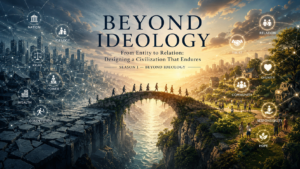
What if singularity is not the moment AI surpasses human intelligence, but the moment humanity rewrites what intelligence itself means?
Modern AI debates often assume that intelligence is nothing more than computational power. But human intelligence has always been richer than calculation alone. Through the wisdom of Bushido and the framework of IQ, RQ, and NQ, this essay explores a deeper question: in the age of AI, what kind of civilization are we choosing to build?
_
1. Singularity Is Misunderstood
The term singularity is often used to describe a future moment when artificial intelligence surpasses human intelligence.
For many people, this idea sounds alarming.
If AI becomes smarter than humans, will humanity lose control?
Will machines dominate civilization?
Will human beings become obsolete?
These concerns are understandable, but they rest on a hidden assumption—one that deserves closer examination.
The assumption is this:
Human intelligence can be reduced to computational ability.
In other words, intelligence is measured by how fast we calculate, how much we remember, and how accurately we process information.
If that definition is correct, then AI has already begun to surpass humans in many areas, and it will continue to do so.
But what if this definition is incomplete?
What if intelligence is not merely the ability to process information, but also the ability to build relationships, create meaning, and shape shared narratives?
Then the singularity may not be what we think it is.
Perhaps the real question is not whether AI will surpass humanity.
Perhaps the real question is:
What do we truly mean by intelligence?
If our definition of intelligence changes, then the meaning of singularity changes as well.
In that sense, singularity may not be the moment when AI exceeds human intelligence.
It may be the moment when humanity rewrites what intelligence itself means.
The question is not who wins—humans or AI. The question is what kind of civilization we choose to build.
2. Historical Analogy — From PQ to IQ
To better understand the AI revolution, it helps to look back at another major transformation in human history: the Industrial Revolution.
Before industrialization, human survival and social status were closely tied to physical capability.
Those who could run faster, carry heavier loads, endure harsher conditions, or wield greater physical force often held advantages in daily life, labor, and warfare.
We may call this PQ — Physical Strength Quotient.
In the pre-modern world, PQ played a decisive role in determining productivity, survival, and power.
Then came machines.
Steam engines, industrial tools, and later automated systems dramatically surpassed human physical strength.
A machine could lift more, move faster, and work longer than any human body.
In purely physical terms, humanity had already been surpassed.
Yet this did not lead to the collapse of civilization.
Human beings did not become obsolete simply because machines exceeded human physical capacity.
Instead, civilization reorganized itself.
As machines took over physical labor, the center of value shifted from physical strength to intellectual capability.
This marked the rise of what we may call IQ — Intelligence Quotient.
Modern civilization was built on this transition.
This is not a fixed law of history, but a pattern worth noticing: when one form of capability becomes abundant, civilization does not collapse—it relocates value to whatever remains scarce.
Today, AI is doing something similar with IQ.
It is outperforming humans in calculation, memory, optimization, and increasingly in reasoning.
If the same pattern holds, this raises an important question.
If humanity once moved beyond PQ, could we now be approaching another transition—one beyond IQ?
3. The Hidden Assumption of AI Debate
Most contemporary discussions about AI are driven by a shared but rarely questioned assumption.
Under the dominant modern framework, intelligence is treated as fundamentally the ability to process information.
Under this framework, intelligence can be measured by speed, accuracy, memory, and computational efficiency.
This framework has shaped modern education, economics, and institutions for generations.
Schools reward analytical performance.
Corporations reward optimization and efficiency.
Markets reward predictive advantage.
In many ways, modern civilization has treated intelligence as a measurable resource—something that can be accumulated, compared, and converted into power.
This worldview naturally leads to anxiety about AI.
If intelligence is nothing more than information processing, then AI's superiority seems inevitable.
But perhaps the problem is not that AI is becoming too intelligent.
Perhaps the problem is that our definition of intelligence has become too narrow.
Human intelligence has never been limited to computation alone.
People do not build families through optimization.
Communities do not form through calculation alone.
Civilizations are not sustained by logic alone.
We relate, trust, empathize, remember, forgive, and imagine futures together—capacities that computational efficiency alone cannot explain.
This raises a deeper question: what if intelligence is not a single measurable quantity, but a layered one?
And here a second question follows close behind, one the AI debate rarely asks directly. If intelligence is what gives a being the capacity to act on the world, then redefining intelligence also means redefining what it means to be powerful—because capability and power have always been two faces of the same coin. Before we can describe what lies beyond IQ, we need to understand what humanity has historically meant by power itself, and whether that meaning has been as narrow as our definition of intelligence.
4. Bushido — The Japanese View of Power
Modern AI debates often assume that greater intelligence naturally leads to greater power, and that power itself means the capacity to acquire, dominate, and control.
The stronger the force one possesses, the more powerful one becomes—or so the logic runs.
This logic shaped much of modern Western civilization.
Yet traditional Japanese thought offers a strikingly different perspective—one that, long before the language of "intelligence dimensions" existed, was already practicing a more layered understanding of capability.
In the ethical world of Bushido, power was not defined merely by the ability to exert force.
True power was measured by the ability to restrain force.
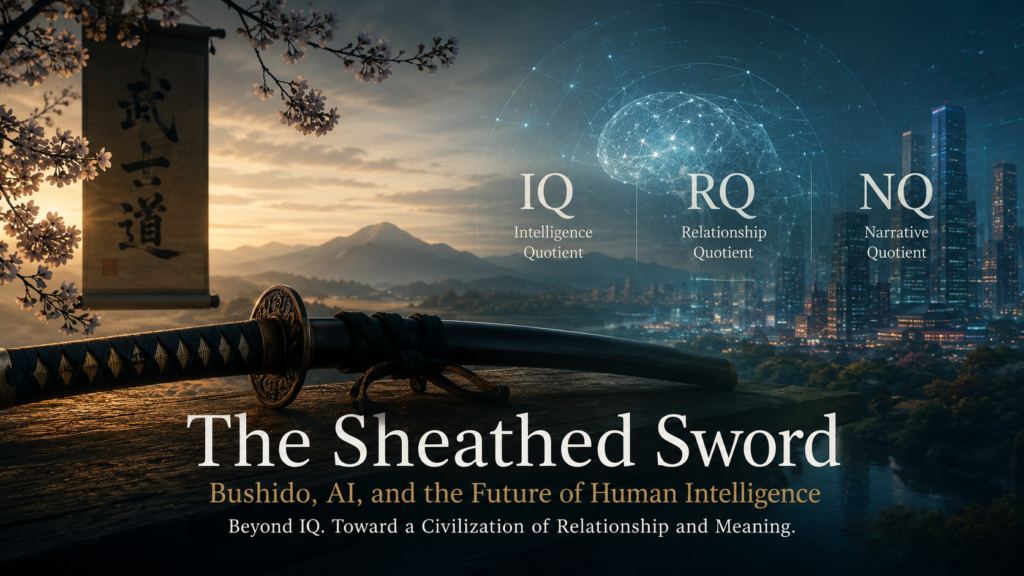
A sword illustrates this principle.
A sword has the capacity to cut, to wound, and to kill.
Yet the highest ideal of the warrior was not the sword that was constantly drawn.
It was the sword that remained sheathed.
The true warrior was not one who displayed power at every opportunity, but one who possessed the power to strike, yet chose restraint.
This distinction is crucial.
Someone who cannot draw a sword and speaks of peace is not practicing restraint—that is merely powerlessness.
Restraint becomes meaningful only when force exists and is consciously governed.
Power without discipline leads to domination.
Power with discipline creates dignity.
But restraint of this kind is not a purely solitary virtue. To know when to hold back, a warrior had to read the other person, the situation, the relationship at stake—a sensitivity to context that no sword technique alone could provide. And to know why restraint mattered at all, the warrior had to hold a sense of what kind of story his action would write into the future of his house, his lord, his people.
In other words, the wisdom of the sheathed sword was never computational. It depended on two capacities that calculation cannot supply: the ability to sense relationship, and the ability to hold narrative meaning. These are the dimensions we turn to next.
5. Beyond IQ — RQ and NQ
If intelligence cannot be reduced to computation alone, then we need a broader framework for understanding human capability.
IQ remains important. Without it, science, engineering, medicine, and technological progress could not exist.
The problem is not IQ itself. The problem begins when IQ is treated as the whole of intelligence.
In the age of AI, it may help to think of intelligence as consisting of at least three interrelated dimensions.
IQ — Intelligence Quotient
IQ measures the ability to process information accurately and efficiently: calculation, memory, logical reasoning, pattern recognition, analytical problem-solving. This is the dimension in which AI is rapidly surpassing human performance.
RQ — Relationship Quotient
RQ measures the ability to build, sustain, and deepen meaningful relationships: empathy, trust, resonance, dialogue, relational sensitivity. It is the very capacity the sheathed sword required—the ability to read another person and a situation closely enough to know when force should not be used at all.
As AI expands computational capacity, human flourishing depends more heavily on this capacity to connect.
NQ — Narrative Quotient
NQ measures the ability to create, share, and transform meaningful narratives. It is the second capacity the warrior's restraint depended on—the ability to hold a long view of what story an action will write, beyond the immediate moment.
Narratives organize memory, connect past, present, and future, and shape identity, purpose, and civilization itself.
A civilization is not sustained merely by information. It is sustained by shared stories about who we are, what matters, and where we are going.
Seen through this framework, AI changes the role of human intelligence. As AI increasingly excels in IQ, humanity may be called to deepen what Bushido already understood: that the highest capability is the one disciplined by relationship and meaning.
The central question of the AI era may therefore be this: can humanity evolve from IQ-centered intelligence toward an integrated intelligence that includes RQ and NQ?
6. The Next Civilization
If intelligence evolves, civilization evolves with it.
PQ Civilization
In the pre-modern world, survival depended heavily on physical capability. Power was closely tied to the body, and civilization in this era was largely structured around PQ.
IQ Civilization
The Industrial Revolution shifted this foundation. As machines surpassed human physical capability, knowledge became more valuable than muscle. Modern institutions—schools, corporations, bureaucracies, financial systems—were largely designed around this logic.
This transition brought extraordinary progress: science advanced, productivity expanded, living standards improved.
Yet it also carried a hidden cost. When intelligence becomes associated primarily with optimization and control, societies tend to prioritize accumulation—more knowledge, more efficiency, more scale, more power—often without sufficient reflection on destination.
It is worth noting that IQ civilization was never absolute. Traditions like Bushido persisted alongside it, holding onto a form of capability that IQ civilization's logic of accumulation could not fully absorb: power measured not by what one could acquire, but by what one chose not to use. In that sense, RQ and NQ are not entirely new inventions—they are values that earlier traditions already practiced, waiting to be named.
The Emerging Civilization of RQ and NQ
Today, AI is accelerating the limits of IQ civilization. When IQ becomes widely accessible through machines, the scarcity that defines human value begins to move elsewhere—and value, as it always has, follows scarcity.
What becomes scarce may no longer be information. It may be meaning, trust, shared purpose.
This points toward a civilization centered on RQ and NQ, where the questions shift from "how much can we produce?" to "how deeply can we connect, and what future are we designing?"
But naming new values is not the same as building systems around them. A civilization organized around RQ and NQ needs a method for judging whether a system actually serves connection and meaning, rather than merely claiming to. This is where Exit Design becomes essential.
Exit Design asks a simple but profound question: what happens at the end?
A system cannot be judged solely by how efficiently it grows. It must also be judged by what kind of future it produces—does it deepen division or cultivate harmony, concentrate power or strengthen trust, create dependency or foster human flourishing?
The next civilization may therefore not be defined by superior intelligence alone, but by the wisdom to design systems whose final outcome allows people to thrive together.
7. Conclusion — Redefining Singularity
The dominant narrative surrounding singularity often centers on one fear: that artificial intelligence will surpass human intelligence and eventually render humanity obsolete.
But this fear depends entirely on how intelligence is defined.
If intelligence is nothing more than speed, memory, calculation, and optimization, then AI surpassing humanity is not a future possibility—it is already happening.
Yet we have explored a deeper possibility throughout this essay: that intelligence is layered, that it includes not only the ability to process information but also the ability to sense relationship and to hold narrative meaning—the same two capacities that allowed a warrior to keep his sword sheathed.
This is why the wisdom of Bushido matters today. The highest expression of power was never domination, but disciplined restraint—not merely possessing force, but mastering it. The same may now be true of intelligence.
The future will not be determined solely by how intelligent AI becomes. It will be determined by whether humanity can cultivate the wisdom—RQ to sense what matters between us, NQ to hold what kind of story we are writing—to guide intelligence toward human flourishing.
The central challenge of the AI era is therefore not competition. It is transformation: moving from an IQ-centered civilization toward one grounded in RQ and NQ, and designed, through Exit Design, toward outcomes worth arriving at.
In this sense, singularity needs a new definition.
Singularity is not when AI surpasses human intelligence.
Singularity is when humanity redefines intelligence itself.
The ultimate question is therefore not “will AI become more intelligent than humans?” but “will humans become wise enough to understand what intelligence truly is?”
The future of civilization may depend not on how much intelligence we can build, but on whether we can use that intelligence to design an ending in which humanity can still flourish together.
And perhaps our answer will determine that future.
_
■新刊 大好評発売中
これが私の集大成本です。
『思想の時代は終わった』
https://amzn.to/3P5D0lS

_