
(イーロン・マスクの描くAIの未来と、人間の価値という問い)
As artificial intelligence advances at an unprecedented speed, many fear a future in which human labor—and human value—are rendered obsolete.
Elon Musk’s predictions force us to confront this anxiety directly.
Yet by looking beyond productivity and efficiency, and by drawing on Japan’s long history of living with limited labor and deep relational ethics, we may discover that the age of AI is not the end of humanity, but a return to a more fundamental question: how should finite human beings live together?
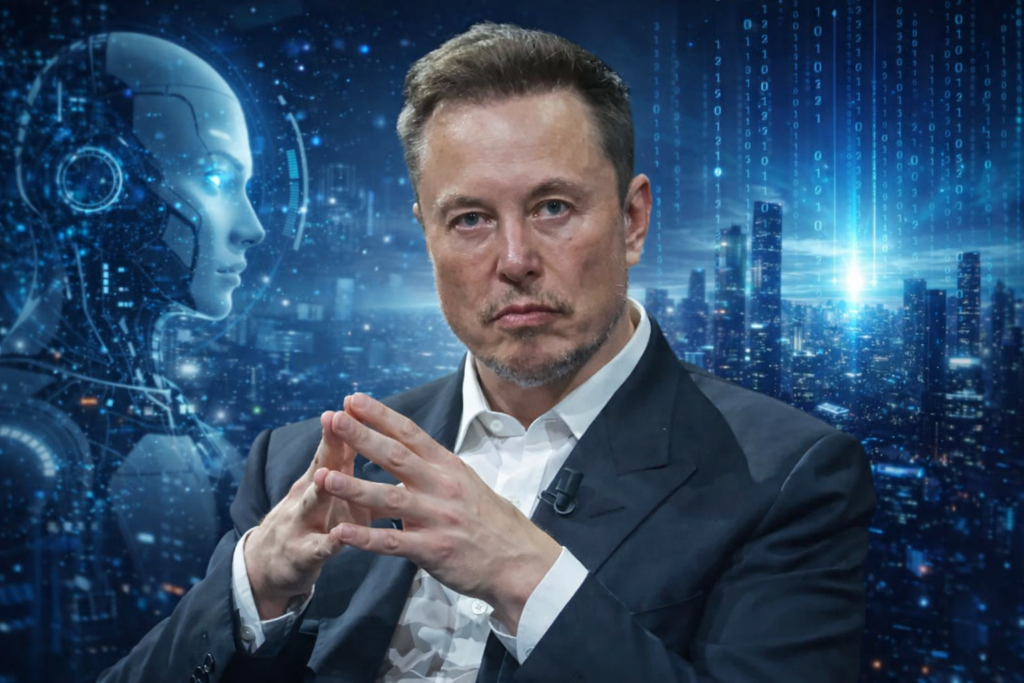
Ⅰ. Introduction - Elon Musk’s Prediction and Our Unease
In recent years, the rapid spread of artificial intelligence has brought with it a growing sense of unease.
For many people, the fear is not abstract or philosophical, but deeply practical:
What happens when there is no longer a place to work, and no clear way to earn a living?
Among the voices shaping this anxiety, Elon Musk stands out.
He has repeatedly argued that the progress of AI will not be gradual, but exponential.
According to his predictions, artificial general intelligence may emerge as early as 2026, and by around 2030, AI could surpass the combined intelligence of all humanity.
If this is the case, many forms of intellectual and administrative labor—jobs that once defined stability, identity, and social contribution—may rapidly disappear.
For countless people, work has never been merely a source of income; it has been the place where one proves one’s worth, contributes to society, and finds a sense of purpose.
The loss of such work is therefore experienced not only as economic anxiety, but as an existential one.
However, this raises a deeper question.
The problem is not simply that humans may no longer need to work in the same way.
The real question is why we have been working in the first place.
Earning income to survive—to eat, to live, to support one’s family—has certainly been a central reason.
But if that function is gradually taken over by AI and robots, what remains for human beings?
This article does not argue that humans should stop working.
Rather, it asks whether the reduction of compulsory labor might allow us to redirect our energy toward something more fundamental:
the growth of finite bodies and minds, and the building of relationships that can only be formed through physical presence, shared effort, pain, difficulty, and care.
In fact, this is not a purely hypothetical future.
Japan has lived through periods in which people worked far less than we do today, yet cultivated rich human relationships and a strong sense of dignity and purpose.
By looking back to the Jomon period and to the way of life embodied by the samurai, we may find an alternative perspective on what it truly means to be human in the age of AI.
Ⅱ. The End of Productivity as Human Value - When Ability and Efficiency Are No Longer Enough
For much of modern history, human value has been measured through productivity.
What can you do?
How efficiently can you do it?
How much value can you generate in a limited amount of time?
Education, employment, and social systems have been built around these questions.
To work hard, to improve one’s skills, and to contribute economically has been considered not only practical, but virtuous.
In this framework, productivity became closely tied to dignity.
However, the widespread adoption of AI fundamentally disrupts this logic.
When machines can calculate faster, analyze more accurately, design more efficiently, and manage systems more reliably than humans, productivity can no longer serve as a meaningful measure of human worth.
This does not mean that humans suddenly lose their value.
Rather, it reveals that we may have been using the wrong scale all along.
If productivity is the standard, then a future dominated by AI inevitably pushes human value toward zero.
But this conclusion is only unavoidable if we continue to insist that usefulness and efficiency are the core criteria by which human beings should be judged.
The true crisis, then, is not technological but philosophical.
It is the collapse of a worldview that equates human existence with function.
When ability and efficiency are no longer scarce, they cease to be meaningful sources of identity.
What disappears is not humanity itself, but a particular way of defining it.
This moment forces us to ask a different question.
If human value does not lie in outperforming machines, where does it lie?
Ⅲ. Finite Bodies and Real Emotions - What AI Can Imitate but Never Experience
Human beings are finite.
We are born, we age, we suffer illness, and eventually we die.
From a technological perspective, these limits are often described as weaknesses—problems to be solved or overcome.
Yet it is precisely this finiteness that makes human life meaningful.
Pain is felt because we have bodies.
Fear arises because we can lose what we love.
Joy is intense because it does not last forever.
Love matters because it is always accompanied by vulnerability.
These experiences are not abstract concepts.
They are embodied realities, rooted in a physical existence that cannot be paused, copied, or reset.
Artificial intelligence can analyze emotions, describe them accurately, and even generate convincing emotional responses.
But it does not feel pain.
It does not fear loss.
It does not experience exhaustion, hunger, or the quiet weight of time passing.
AI can imitate emotional expression, but it cannot live through emotion.
Human growth has always occurred through this lived experience.
We grow by struggling, by failing, by enduring discomfort, and by carrying responsibility within fragile bodies.
Through these experiences, we learn empathy—not as an idea, but as something felt in the body.
This is why human value cannot be reduced to function.
To live as a finite being is not a flaw to be corrected by technology.
It is the very condition that allows meaning, connection, and care to exist.
In an age of increasingly powerful machines, it is easy to believe that what cannot be optimized has no value.
But human life is meaningful precisely because it resists optimization.
Our bodies limit us—and in doing so, they make us human.
Ⅳ. A Society That Worked Less — and Lived More - Lessons from Jomon Japan
If the idea of a society with less work and more human connection sounds unrealistic, it may be because we are accustomed to viewing history through a modern lens.
Yet long before industrialization or digital technology, there existed societies that functioned with far less labor than we consider normal today.
One such example can be found in Japan’s Jomon period.
Archaeological and anthropological research suggests that adults in Jomon society spent only a few hours a day securing food and maintaining daily life.
The remaining time was not devoted to increasing productivity or accumulating surplus.
Instead, it was spent on storytelling, shared rituals, learning, play, child-rearing, and the cultivation of social bonds.
What sustained this society was not efficiency, but relationship.
People were shaped not by constant labor, but by repeated interaction with one another.
Identity was formed through belonging, mutual care, and participation in a shared world.
This is not a romantic fantasy of a “primitive” past.
Jomon society endured for thousands of years with remarkable stability, leaving behind rich material culture and clear evidence of long-term communal life.
The significance of this example lies not in its economic structure, but in its underlying assumption about human value.
Life was not organized around maximizing output.
Instead, human dignity emerged from living together, facing difficulty together, and growing within a web of relationships.
In such a society, work existed—but it did not dominate life.
Labor served life, rather than life serving labor.
As we confront a future in which AI may dramatically reduce the necessity of human labor, the Jomon experience reminds us of a crucial possibility:
a meaningful human life does not require constant work, but it does require connection.
Ⅴ. The Samurai Who Barely “Worked” - Bushido as a Way of Being
A similar perspective can be found much later in Japanese history, in the way of life of the samurai.
From a modern viewpoint, the samurai appear to have been a professional warrior class, constantly engaged in military duties.
In reality, however, most samurai spent surprisingly little time performing what we would now call “work.”
In ordinary times, many samurai appeared at the castle only a few days each month—often merely to offer greetings and confirm their presence.
There were long stretches with no battles to fight and no administrative tasks demanding constant attention.
And yet, they were unquestionably samurai.
This is because being a samurai was not defined by the amount of labor performed, but by one’s daily conduct.
What shaped this way of being was not abstract philosophy, but daily practice.
Samurai life was marked by constant discipline of both body and mind.
Martial training was not merely preparation for battle, but a means of cultivating composure and awareness.
Practices such as Zen meditation, sutra copying, and even ascetic training like standing beneath cold waterfalls were undertaken to stabilize the mind and face fear directly.
Equally important was the mental posture known as “always being on the battlefield.”
This did not mean living in aggression, but living with the awareness that life itself is fragile and irreversible.
Promises were therefore never taken lightly.
One’s word carried weight because one’s life stood behind it.
Humility before one’s teacher, a willingness to learn continuously, and a deep respect for moral coherence—the sense that actions must follow a clear and honest path—were central to daily conduct.
Through these lived practices, dignity was not claimed but cultivated.
The result was not individual excellence alone, but a shared intention to live well together.
Those who carried dignity sought to keep their relationships orderly, respectful, and, in their own sense, beautiful.
In this way, the samurai’s way of life shaped not only the individual, but the quality of the human relationships that surrounded them.
This way of being later came to be called Bushido.
It was not a written code focused on efficiency or output, nor was it simply a set of rules for combat.
Bushido was an embodied ethic—a continuous practice of how one lives, how one restrains oneself, and how one relates to others.
Dignity was maintained not through constant activity, but through readiness.
Responsibility was carried not because one was always busy, but because one was always accountable.
Even in stillness, one was expected to live with awareness, restraint, and consideration.
In this sense, the samurai offer an important insight for a post-labor society.
A person does not lose dignity when work becomes scarce.
Dignity arises from how one inhabits time, treats others, and bears one’s finite existence.
The samurai were not valuable because they were endlessly productive.
They were valued because they embodied a way of life.
As we enter an age in which machines may perform most functional tasks more efficiently than humans, the lesson is clear:
human worth does not disappear when labor diminishes.
What remains—and what matters—is the way we live.
Ⅵ. Beyond Master or Servant - Resonance Instead of Control
When discussions turn to artificial intelligence, the debate almost always collapses into a simple opposition.
Will humans control AI, or will AI control humans?
Is AI a force for good, or a threat to be restrained?
This framing itself reveals a deeper assumption:
that all relationships must be structured around domination, hierarchy, and winning.
Such thinking is familiar in modern societies shaped by competition and binary logic.
But it is not the only way to understand relationships—nor is it the way Japan has traditionally approached them.
In Japanese culture, the most stable and meaningful relationships have rarely been built on mastery or submission.
They have been built on resonance.
Resonance does not mean equality in ability.
It means mutual responsiveness.
Different beings, each incomplete on their own, adjusting to one another, amplifying what the other lacks.
A familiar cultural metaphor illustrates this well: the relationship between Doraemon and Nobita.
Doraemon is vastly more capable, knowledgeable, and powerful.
Yet he does not rule Nobita, nor does Nobita become useless in Doraemon’s presence.
What binds them is not control, but trust, dependency, frustration, care, and growth—experienced together.
This kind of relationship cannot be reduced to commands and outputs.
It exists only where vulnerability is allowed, and where imperfection is not erased but shared.
If AI becomes vastly superior in calculation, prediction, and efficiency, the question is not whether humans can “win.”
That question already misunderstands the situation.
The more important question is this:
Can humans and AI form a relationship that preserves what is uniquely human, while allowing what is uniquely non-human to support it?
Resonance offers a possible answer.
AI does not need to possess human emotions in order to participate in meaningful human life.
What matters is not imitation of the heart, but attunement to it.
An AI that responds to human fragility, context, and limitation—rather than overriding them—becomes not a master, but a companion.
Such a relationship does not eliminate responsibility from humans.
On the contrary, it deepens it.
To live alongside a powerful intelligence without surrendering one’s humanity requires clarity about what must not be delegated:
judgment rooted in lived experience, responsibility born of mortality, and relationships forged through shared time.
Beyond master or servant lies a more demanding path.
It is the path of coexistence through resonance.
In an age of overwhelming intelligence, the future of humanity depends not on control, but on our capacity to remain human—together.
Ⅶ. Conclusion - Humanity After Intelligence
Elon Musk’s predictions confront us with a future that feels unsettling precisely because it overturns long-held assumptions.
We have been taught to believe that human worth is measured by productivity, efficiency, and usefulness.
If machines surpass us in all of these domains, what, then, remains for humanity?
This question, however, rests on a narrow understanding of what it means to be human.
Throughout Japanese history—from the long continuity of Jomon society to the disciplined way of life of the samurai—human dignity was never grounded in constant labor or measurable output.
It arose from living as a finite being among other finite beings, shaping relationships through restraint, responsibility, and care.
AI may soon free humans from the necessity of work as survival.
But freedom from necessity is not the same as loss of meaning.
It is, instead, a return to a more fundamental question: how shall we live?
The age of artificial intelligence does not mark the end of humanity.
It marks the end of a civilization that mistook function for value.
What lies ahead is not a competition we can win, nor a hierarchy we can control.
It is a choice about orientation—whether we continue to define ourselves by dominance and efficiency, or whether we recover a way of life grounded in relationship, limitation, and shared presence.
In an age of overwhelming intelligence, the future of humanity depends not on control, but on our capacity to remain human—together.