(人は、どのようにして暴力の中へと立たされるのか)
Before judging violence, there is a quieter question we rarely ask. What kind of explanation was given? How much time was allowed? And with what feelings was that person made to stand there? This essay does not seek easy blame or moral superiority. Instead, it invites us to pause at the entrance—the moment where a human being is pushed, persuaded, or prepared to act. By examining war, responsibility, and the forgotten wisdom of Bushido, we explore how societies can either strip people of their humanity or help them remain human, even in the harshest conditions.
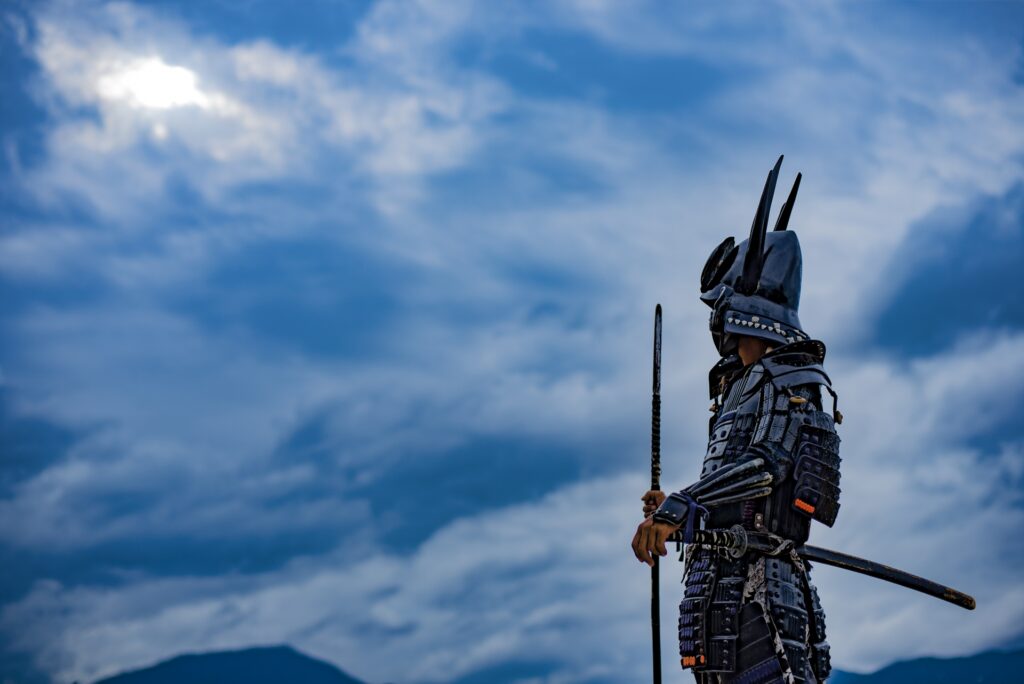
A solitary samurai in traditional armor stands quietly under a vast, cloud-filled sky, holding a spear and sword, symbolizing discipline, responsibility, and ethical resolve rather than aggression.
When we see images of war or hear about acts of extreme violence, a familiar question often arises:
How could they do such things?
It is an understandable reaction.
By labeling those acts as cruel, inhuman, or barbaric, we create a safe distance between ourselves and what we are witnessing. The moment we decide they are different from us, the discomfort eases.
Yet, a quieter and more unsettling question tends to remain unasked.
How were they brought there?
What explanations were they given?
How much time did they have to understand what was happening?
And in what state of mind were they placed into that moment?
Before judging actions, we may need to pause at the entrance.
Violence is often explained through nationality, ideology, or culture.
But these explanations rarely account for the fact that human behavior changes dramatically depending on the conditions under which people are placed.
This essay is not about excusing violence.
It is about understanding how human beings are shaped — or broken — by the way they are introduced into extreme situations.
Because before a person commits an act,
there is always an entry point.
And it is there, at that entrance,
that humanity is either protected or quietly taken away.
1. Violence Is Not a Trait, but a Process
Violence is often discussed as if it were a personal or cultural trait.
We speak of violent nations, violent ideologies, or violent individuals, as though brutality were something embedded in character or blood.
But human beings are not static creatures.
We are shaped — continuously — by the environments we are placed in and the conditions we are asked to endure.
What we call “violence” does not appear suddenly.
It emerges through a process.
People change when they are exposed to constant fear.
They change when questioning is punished.
They change when obedience becomes a condition for survival, and when human life is treated as expendable.
Under such conditions, moral sensitivity does not disappear all at once.
It erodes gradually.
The capacity to hesitate, to empathize, to feel the weight of one’s actions —
these are not removed by nature, but worn down by structure.
When violence is explained solely by who people are,
we overlook how carefully designed systems can push ordinary human beings beyond the limits of what they once believed possible.
Violence, then, is not a fixed identity.
It is the outcome of a process that begins long before the first act is committed.
And that process always starts at the entrance.
2. Two Entrances into the Same Battlefield
Imagine two people standing on the same battlefield.
They wear similar uniforms.
They carry the same weapons.
From a distance, they appear indistinguishable.
Yet the paths that brought them there could not be more different.
One person arrived after being given time.
Time to understand why they were being sent.
Time to reflect on fear, doubt, and responsibility.
Time to decide, consciously, to step forward and accept the consequences of that choice.
The other arrived without such space.
They were taken suddenly.
Given orders without explanation.
Surrounded by threats rather than meaning.
Placed into the battlefield not as a decision, but as a demand.
Can we truly speak of these two people as the same kind of “soldier”?
Courage is often mistaken for fearlessness.
But true courage begins elsewhere.
It begins with the ability to take responsibility for one’s own actions.
And responsibility requires more than obedience —
it requires understanding, agency, and time.
When those elements are present, a person enters violence as a moral subject.
When they are stripped away, a person enters violence as an object.
The difference may not be visible in uniform or rank.
But it shapes everything that follows.
Because how a person enters a battlefield determines
whether they are allowed to remain human once they are there.
3. Brutality as a Result of Dehumanizing Conditions
Brutality is often described as a moral failure.
A collapse of character.
A choice to abandon one’s humanity.
But in reality, brutality is rarely born from a single decision.
It grows in environments where being human becomes dangerous.
When hesitation is punished.
When empathy is mocked as weakness.
When disobedience is met with immediate violence.
When survival depends on suppressing one’s own judgment.
Under such conditions, people do not suddenly become cruel.
They become numb.
What fades first is not conscience, but sensitivity.
The ability to pause.
The capacity to imagine another person’s pain.
The inner voice that asks, Should I do this?
These capacities do not vanish overnight.
They are worn down, slowly, through repetition and fear.
In systems built on absolute obedience,
moral responsibility is quietly relocated.
Decisions appear to belong to “orders,” “rules,” or “necessity,”
rather than to the individual who acts.
This shift is subtle, but profound.
When people are no longer allowed to think,
they are no longer allowed to remain fully human.
Brutality, then, is not the eruption of evil.
It is the result of conditions that make humanity unsustainable.
And once those conditions are normalized,
extraordinary violence can be carried out by ordinary people.
4. The War Does Not End When the Fighting Stops
For many people, war is imagined as something with a clear ending.
The fighting stops.
The guns fall silent.
Peace is declared.
But for those who were placed into violence,
the war often continues — quietly, internally, and long after the battlefield is gone.
The way a person enters violence determines
how they are able to live after it.
Those who entered with time, understanding, and a sense of responsibility
often carry deep pain.
They remember what they did.
They struggle with guilt, grief, and regret.
Yet they retain something essential:
the ability to speak.
They can say, This is what I did.
This is what I carry.
This is what I wish had never happened.
These words do not erase the past.
But they allow mourning, reflection, and, sometimes, healing —
not only for the individual, but for those who live alongside them.
Those who entered violence without choice face a different aftermath.
When actions were taken without understanding,
when responsibility was never allowed to form,
memory becomes dangerous.
To question the past feels like a threat to one’s own survival.
Silence becomes a defense.
But that silence does not remain contained.
It spreads into families.
Into relationships.
Into the unspoken spaces between people.
The war does not end.
It changes form.
This is not a failure of character.
It is the consequence of being denied an entry that allowed one to remain human.
5. The Question We Should Ask
When violence is discussed, the question most often asked is simple and direct:
Who is responsible?
Who committed the act?
Who should be blamed?
These questions are not wrong.
But they are incomplete.
They focus on the moment violence appears,
while overlooking everything that made that moment possible.
Before asking who did it,
we need to ask something more fundamental.
Who created the conditions under which this person was placed?
Who designed the system that allowed violence to become unavoidable?
Who decided that hesitation, doubt, or moral reflection had no place?
These are uncomfortable questions.
They do not point neatly to a single individual.
They force us to look at structures, cultures, and expectations —
including those we may quietly accept in everyday life.
This perspective matters not only for those who fought,
but also for those who waited.
Those who lived with unanswered letters.
Those who raised children while holding uncertainty.
Those who welcomed someone home without knowing how to ask what had happened —
or whether it was safe to ask at all.
Violence does not affect only the person who pulls the trigger.
It reshapes the lives of those who love them, depend on them,
and try to build a future alongside them.
When we focus only on blame,
we often overlook this wider circle of impact.
The question we should ask, then, is not only
Who did this?
But also:
What kind of entrance did we allow into this violence?
And who bears responsibility for creating it?
6. A Historical Example: Bushido as an Ethical Entrance
Japan’s historical experience offers one example of how an ethical entrance into violence was once carefully considered.
In the tradition known as Bushido, the central question was not how to win,
but how to remain human while facing the possibility of death.
Before entering battle, a warrior was expected to prepare inwardly —
to reflect on responsibility, fear, and the weight of taking a life.
Courage was not defined by aggression, but by the ability to act without losing moral awareness.
This ethical preparation was not meant only for those who fought.
It shaped the expectations of those who sent them, waited for them,
and lived with the consequences of their return.
Bushido did not glorify violence.
It treated violence as something that demanded restraint, reflection, and shame —
precisely because human life was understood to be irreplaceable.
This is not presented here as a universal model.
Nor is it unique to Japan.
Rather, it is an example of a society recognizing
that how people are led into extreme situations matters as much as what happens within them.
An ethical entrance does not prevent tragedy.
But it can preserve the space in which humanity survives.
7. A Society Built on Questions, Not Commands
A society that preserves human dignity does not rely primarily on commands.
It does not function by distributing correct answers and demanding obedience.
Instead, it places questions at the point of entry.
Before action.
Before judgment.
Before participation.
Questions such as:
Why am I here?
What am I being asked to take responsibility for?
How will this affect the dignity of others — and my own?
When such questions are present, people do not act as mere instruments.
They act as participants.
This way of thinking does not belong only to war.
It applies to education, to workplaces, to politics,
and to the countless decisions that shape everyday life.
When people are rushed into action without time to reflect,
when compliance is valued more than understanding,
the same patterns that enable violence quietly take root.
But when space is preserved for questioning,
responsibility becomes personal rather than imposed.
This kind of society cannot be built through control alone.
Nor can it be imposed from above.
It grows when individuals are trusted to think,
to hesitate,
and to choose with awareness.
A society built on questions may move more slowly.
But it moves in a direction where humanity is not sacrificed for efficiency.
And over time,
that difference matters more than we often realize.
8. Conclusion: Changing the Direction of Civilization
Civilizations are often described as being shaped by power, technology, or ideology.
But beneath these forces lies something quieter and more fundamental.
The way people are brought into action.
Whether into war, education, work, or political life,
the point of entry determines how people understand themselves —
as instruments to be used,
or as human beings capable of responsibility and care.
When people are rushed forward without explanation,
when questions are replaced by commands,
and when obedience is valued more than understanding,
humanity is slowly eroded.
But when societies protect the space to ask why before demanding how,
something different becomes possible.
People begin to act not because they are forced,
but because they have chosen to take responsibility.
They remain capable of hesitation, reflection, and restraint —
even in difficult circumstances.
This shift does not announce itself loudly.
It does not arrive through dramatic reform or sweeping control.
It begins quietly,
at the entrances we create every day.
In the questions we allow.
In the time we give.
In the dignity we choose to preserve.
Such changes may seem small.
But over time, they accumulate.
And in doing so,
they have the power to quietly, yet steadily,
change the direction of civilization.
Author’s Note
Why I Wrote This
I did not write this essay to judge violence,
nor to excuse it.
I wrote it because I have long felt uneasy
with explanations that stop at blame.
When we call violence a matter of nationality, ideology, or character,
we often relieve ourselves of a more difficult responsibility:
to examine the conditions that make such violence possible.
Before any act is committed,
someone is placed somewhere, in a certain way,
with a certain amount of explanation, time, and dignity — or without it.
That moment of entry matters more than we usually admit.
I believe that if we want to prevent violence from repeating itself,
we must look not only at what people did,
but at how they were led there.
This essay is an invitation to pause at that entrance —
quietly, carefully,
and without turning away.