Modern societies know many ways to win, punish, and expose guilt. But do we still know how to end conflict without destroying the future? Through Bushido, Saigo Takamori, and the bloodless surrender of Edo, this essay explores the Japanese wisdom I call “Exit Design.”
_
Introduction Why Modern Societies Struggle to Heal After Conflict
In today’s world, we have become remarkably skilled at identifying who is right and who is wrong.
Modern legal systems are highly sophisticated.
Courts determine guilt.
Laws define responsibility.
Media and social networks amplify accusations within seconds.
And yet, despite all this progress, many societies seem unable to truly heal after conflict.
Families break apart even after legal disputes are settled.
Political divisions deepen even after elections end.
Online arguments continue long after “facts” have been established.
Punishment may be delivered, but bitterness often remains.
Why is this happening?
One reason may be that modern civilization has become overwhelmingly focused on the “entrance” of conflict — who started it, who violated the rules, who deserves blame — while paying far less attention to the “exit.”
How do people continue living together afterward?
How can trust be restored?
How can a divided society become whole again?
These questions are far more difficult than determining guilt.
And yet they may be the most important questions of all.
In many Western traditions, justice developed through the pursuit of truth under written law.
This approach brought enormous achievements to human civilization, including the protection of rights and the limitation of arbitrary power.
But there is another dimension of justice that modern societies often struggle to preserve:
the restoration of relationships.
In Japan, especially during the age of the samurai, conflict was not always understood merely as a matter of punishment and victory.
There was also deep concern for how a conflict should end.
How could resentment be prevented from continuing into the next generation?
How could former enemies live together again?
How could society return to harmony after violence?
This wisdom did not emerge from weakness.
It emerged from the painful experience of civil wars, political upheavals, and centuries of internal conflict.
The samurai tradition known today as Bushido was not simply a code for fighting bravely.
At its deepest level, it was also a philosophy of responsibility for what comes after conflict.
In other words, it was a way of thinking about how to end conflict without destroying the future itself.
That perspective may hold unexpected meaning for our world today.
Chapter 1 Western Justice and the Search for Guilt
The English word “court” originally referred to the court of a king.
In medieval Europe, justice was closely connected to royal authority.
The king’s court was not only a political center, but also a place where disputes were judged and order was maintained.
Over time, however, Western justice gradually evolved away from the personal will of rulers.
The arbitrary judgment of kings came to be restrained by written law, legal procedure, and religious morality.
One of the deepest influences behind this transformation was the Biblical understanding of sin and truth.
In the Judeo-Christian tradition, wrongdoing is not merely a social inconvenience.
It is understood as a moral violation before God.
Because of this, discovering the truth became an essential task of justice.
Who committed the act?
What was the intention?
Who bears responsibility?
These questions became central to the Western legal tradition.
This pursuit of truth was not meaningless formalism.
It helped create one of the greatest achievements in human history:
the rule of law.
Power could no longer operate entirely according to emotion or personal preference.
Even rulers were expected to obey legal principles.
Evidence mattered.
Procedure mattered.
Individual rights mattered.
Modern democratic societies owe an enormous debt to this development.
Without such legal traditions, freedom itself could easily collapse into tyranny.
At the same time, this legal framework naturally placed strong emphasis on identifying guilt.
The courtroom became a place where opposing sides presented evidence in order to determine who was right and who was wrong.
This structure proved extremely powerful for resolving questions of legality and responsibility.
It protected societies from arbitrary violence and unchecked authority.
But human conflict is not always limited to legal questions.
Even when facts are clarified, emotions often remain unresolved.
Even when punishment is carried out, resentment may continue beneath the surface.
Even when justice is formally achieved, relationships may still collapse.
This does not mean Western justice failed.
On the contrary, its achievements are extraordinary.
But it does suggest that determining guilt and restoring harmony are not always the same thing.
A legal system can establish accountability.
Yet healing a divided society may require something more than legal correctness alone.
That tension would appear repeatedly throughout modern history — in revolutions, civil wars, political polarization, and even in everyday human relationships.
And it is precisely at this point that Japan developed a somewhat different emphasis.
Chapter 2 When Punishment Cannot Restore Relationships
Modern societies possess immense power when it comes to identifying wrongdoing.
Through laws, courts, media systems, and digital technologies, we can expose misconduct faster than ever before.
Evidence can be gathered instantly.
Public opinion forms within hours.
Entire reputations can collapse overnight.
In many ways, this is a remarkable achievement.
For much of human history, the powerful could commit injustice without consequence.
Today, even governments, corporations, and celebrities may be held accountable before the public eye.
And yet, despite this growing ability to expose wrongdoing, many societies feel increasingly fragmented.
Why?
Because exposing guilt and restoring relationships are not necessarily the same process.
A lawsuit may determine legal responsibility, yet leave a family permanently divided.
A political victory may defeat an opponent, yet deepen hatred across society.
A public apology may satisfy procedural expectations, while trust itself never returns.
Modern systems are often designed to answer one question:
“Who is guilty?”
But human beings continue to face another question afterward:
“How do we live together now?”
This second question is far more difficult.
In recent years, this tension has become especially visible in digital culture.
Social media platforms have created environments where accusation spreads rapidly, often rewarding outrage more than reconciliation.
Public exposure itself can become a form of social punishment.
In some cases, genuine wrongdoing must indeed be confronted openly.
Societies cannot survive if injustice is ignored.
But digital outrage often continues long after responsibility has already been acknowledged.
Punishment alone rarely satisfies collective anger.
Instead, conflict can become self-perpetuating.
This phenomenon is sometimes called “cancel culture.”
A single mistake — or even a statement taken out of context — may lead to permanent social exclusion.
The individual is no longer seen as a human being capable of growth or restoration, but as a symbol of guilt itself.
Such dynamics create fear throughout society.
People become hesitant to speak honestly.
Dialogue weakens.
Mutual trust erodes.
In this environment, even justice itself can gradually lose its humane character.
Political polarization reveals a similar pattern.
In many countries today, elections no longer function merely as disagreements over policy.
They increasingly resemble moral battles between absolute good and absolute evil.
Opponents are not simply mistaken; they are portrayed as dangerous, immoral, or unforgivable.
Under such conditions, compromise itself begins to look like betrayal.
But when every conflict becomes a moral war, societies lose the ability to heal after victory.
Even the winning side remains trapped within ongoing hostility.
This may be one of the central crises of modern civilization:
we have developed extraordinary systems for identifying guilt, yet far weaker systems for rebuilding trust.
Human communities cannot survive through punishment alone.
At some point, every society must face the difficult question of how former opponents can continue living together after conflict ends.
And this is precisely where Japanese historical experience offers an alternative perspective — not by ignoring responsibility, but by asking a different question alongside it:
How should conflict end so that the future itself is not destroyed?
Chapter 3 A Different Tradition in Japan
Japan also developed systems of law and governance.
There were regulations, official codes, punishments, and formal authorities.
Yet historically, written law was not always treated as the sole foundation of social order.
Particularly during the samurai era, justice often operated within a broader concern:
the preservation of relationships and communal harmony.
This difference can be seen in the roles played by magistrates and local administrators.
In Edo-period Japan, officials such as bugyō (magistrates) and daikan (regional administrators) were not separated into strictly independent institutions in the modern Western sense.
Administrative authority, policing, taxation, mediation, and judicial responsibilities were often interconnected.
From a modern perspective, such systems may appear insufficiently specialized.
But their purpose was also somewhat different.
The central question was not always:
“How should the law punish this offense?”
Often, the deeper concern was:
“How can order and human relationships be restored afterward?”
For this reason, compromise and mediated settlement were frequently encouraged.
Even today, Japanese society places strong cultural value on shidankai (mediation), apology, reconciliation, and negotiated resolution.
Historically, prolonged legal confrontation was not always considered socially desirable.
This tendency reflected the realities of village-based life.
For centuries, many Japanese communities functioned as tightly interconnected agricultural societies.
People could not simply separate permanently after conflict.
Neighbors would continue planting rice together, maintaining irrigation systems together, raising children together, and surviving natural disasters together.
Under such conditions, destroying relationships entirely could threaten the stability of the whole community.
As a result, justice often involved not only determining responsibility, but also preventing resentment from endlessly expanding.
This does not mean Japanese society was free from harsh punishments or abuses of power.
History contains many examples of injustice, social hierarchy, and suffering.
Nor does it mean harmony was always achieved successfully.
But culturally, there remained a strong awareness that conflict could not be understood purely as an abstract legal problem.
Human relationships themselves had to be managed carefully if society was to endure.
This difference can also be seen in the Japanese concept of “wa” — harmony.
In many Western contexts, harmony may sometimes be viewed as secondary to individual assertion or legal principle.
In Japan, however, maintaining social balance itself often became a central ethical concern.
This did not necessarily mean suppressing all disagreement.
Rather, it reflected an understanding that communities are fragile, and that unresolved resentment can continue damaging society long after formal disputes have ended.
In this sense, Japanese justice historically tended to ask not only:
“What punishment is deserved?”
but also:
“What kind of ending will allow people to continue living together afterward?”
That perspective would become especially visible during one of the greatest political transitions in Japanese history:
the fall of the Tokugawa shogunate and the birth of modern Japan.
And at the center of that transformation stood a man named Saigo Takamori.
Chapter 4 Saigo Takamori and the Bushido of Reconciliation
Few figures in Japanese history embody the spirit of reconciliation more profoundly than Saigo Takamori.
Today, he is often remembered as a legendary samurai — courageous, uncompromising, and deeply loyal.
But what made Saigo historically remarkable was not merely his strength in war.
It was the way he understood how conflict should end.
Ironically, Saigo himself was once treated as a political outcast.
During the final years of the Tokugawa shogunate, he became entangled in political struggles surrounding imperial reform and the future of Japan.
As a result, he was exiled not once, but twice, to remote southern islands.
In many societies, such a fall from power might have marked the permanent end of a political life.
A disgraced official could be erased, forgotten, or destroyed entirely.
But Japan’s political culture often retained a different possibility:
restoration.
Even after punishment, a person was not always viewed as permanently irredeemable.
Relationships could sometimes be repaired.
Trust could sometimes be rebuilt.
Saigo eventually returned from exile and rose once again into national leadership.
This alone reveals something important about Japanese historical culture.
Punishment existed.
Responsibility existed.
Yet exclusion was not always absolute.
The possibility of return remained open.
That cultural tendency would later shape one of the most extraordinary moments in modern history.
In 1868, Japan stood on the edge of catastrophic civil war.
The Tokugawa shogunate, which had ruled Japan for over 260 years, was collapsing.
Imperial loyalists and shogunate forces moved toward open military confrontation.
At the center of the crisis stood Edo — the enormous city now known as Tokyo.
At the time, Edo was one of the largest cities in the world, with a population exceeding two million people.
If full-scale urban warfare had broken out there, the destruction could have been unimaginable.
Saigo Takamori became the leading military figure of the imperial side.
From a purely strategic perspective, destroying the Tokugawa resistance completely may have seemed logical.
Victorious revolutions throughout world history had often relied upon terror, mass executions, and total elimination of former enemies.
But Saigo pursued a different path.
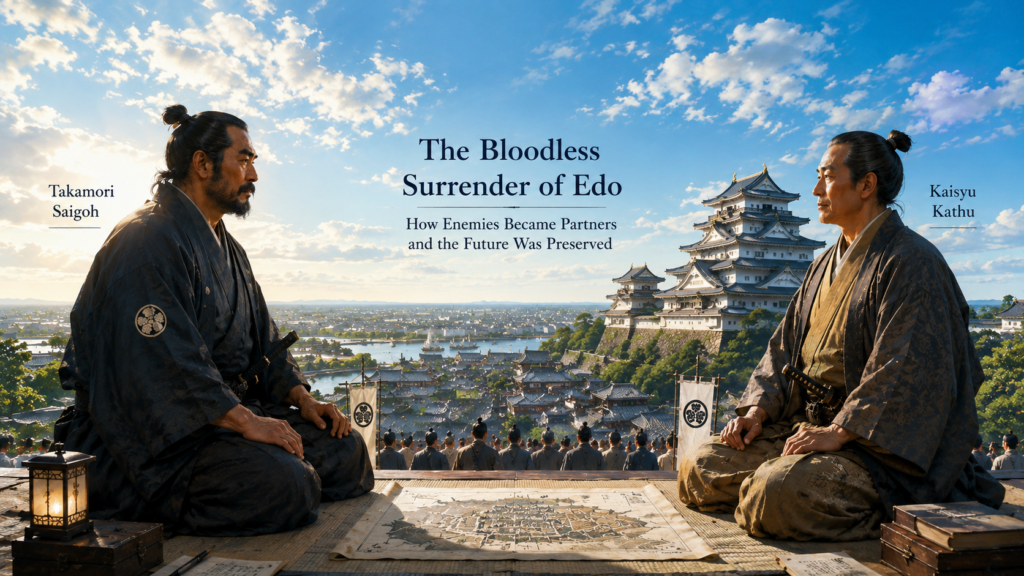
He entered negotiations with Katsu Kaishu, the chief representative of the shogunate forces.
The two men came from opposing sides of a collapsing political order.
Yet both understood a deeper danger:
if hatred continued expanding, Japan itself might be destroyed.
The result was the peaceful surrender of Edo Castle.
The city was spared large-scale destruction.
Millions of civilians survived.
Former enemies would later help build the same modern nation together.
This was not simply an act of mercy.
It was a form of political wisdom.
Saigo understood that victory achieved through endless humiliation and revenge could poison the future of the country itself.
A nation cannot remain stable if half its people are treated forever as unforgivable enemies.
What mattered was not only winning the conflict.
What mattered was what kind of society would remain afterward.
This perspective reflects something central within Bushido.
Bushido was never merely about defeating opponents.
At its highest level, it demanded responsibility toward the future that would exist after violence ended.
Even in war, there remained awareness that today’s enemy might become tomorrow’s fellow citizen.
In this sense, Saigo Takamori was not simply a warrior.
He became a statesman of reconciliation.
And perhaps that is why his legacy still carries such emotional power in Japan today.
Chapter 5 The Bloodless Surrender of Edo
In the history of revolutions and civil wars, great cities are often destroyed.
When political systems collapse, violence tends to expand rapidly.
Victorious forces seek revenge.
Defeated factions resist desperately.
Civilians become trapped between fear, anger, and chaos.
History offers many examples.
Cities burned during religious wars in Europe.
Revolutionary movements in France, Russia, and China unleashed waves of executions and political terror.
Modern civil wars across the world have repeatedly shown how quickly hatred can consume entire populations.
Against this historical background, the peaceful surrender of Edo in 1868 appears almost astonishing.
At the time, Edo was not a small feudal town.
It was one of the largest cities on earth, with a population exceeding two million people.
If large-scale urban warfare had erupted there, countless civilians could have died.
Fires alone might have destroyed enormous sections of the city.
The political transition that became the Meiji Restoration could easily have descended into prolonged national catastrophe.
And yet, that did not happen.
The city surrendered with remarkably little bloodshed.
This outcome was not inevitable.
Military tensions were extremely high.
Many on both sides demanded harsher action.
There were factions within the imperial forces that favored complete military suppression of Tokugawa resistance.
Likewise, among the shogunate side, there were those who preferred continued armed resistance rather than surrender.
The situation could easily have spiraled into mass destruction.
What prevented that outcome was not merely military calculation.
It was the existence of leaders who understood that preserving the future mattered more than satisfying immediate revenge.
The negotiations between Saigo Takamori and Katsu Kaishu became one of the defining moments in Japanese history.
Neither man was naïve.
Both understood war.
Both knew violence was possible.
But they also understood something else:
once a great city burns, hatred may continue for generations.
A nation divided by vengeance cannot easily rebuild trust afterward.
For Saigo in particular, the destruction of Edo would have created a contradiction at the heart of the new government itself.
The imperial cause claimed to act for the restoration and renewal of Japan.
But if the restoration began through the slaughter of millions in the country’s greatest city, what moral legitimacy would remain afterward?
Victory alone was not enough.
The future had to survive the victory.
This perspective differed profoundly from many revolutionary movements in world history.
In numerous revolutions, destroying former enemies became part of proving ideological purity.
Fear itself became a political instrument.
But in Japan, although violence certainly occurred during the Meiji Restoration, there also remained a strong impulse toward reintegration.
Former Tokugawa retainers were not exterminated as a class.
Many later served within the new government, military, educational institutions, and industrial modernization of Japan.
In other words, former enemies became participants in building the future nation together.
This was not because conflict had been trivial.
The political struggle was real, and the tensions were profound.
Rather, it reflected a deeper civilizational instinct:
a country cannot endure if internal hatred becomes permanent.
The bloodless surrender of Edo was therefore more than a successful negotiation.
It represented a philosophy of ending conflict without destroying the social fabric itself.
This may be one reason why the Meiji Restoration, despite enormous upheaval, succeeded in transforming Japan with remarkable speed.
The transition was not built entirely upon annihilation.
Enough human continuity remained for society itself to survive.
And perhaps this reveals something important about the Japanese understanding of power.
True strength was not merely the ability to defeat an enemy.
It was the ability to prevent victory itself from destroying the future.
Conclusion Bushido as the Wisdom of “Exit Design”
Today, Bushido is often imagined as a warrior code centered on courage, loyalty, discipline, and honor in battle.
Certainly, these qualities were important.
The samurai lived in an age where conflict and violence were unavoidable realities.
But if we look more deeply into Japanese history, another dimension gradually emerges.
Bushido was not only about how to fight.
It was also about how to end conflict without destroying the future.
This perspective can be seen repeatedly throughout Japanese history.
Enemies were sometimes punished, yet not always permanently erased.
Political rivals were often reintegrated into society.
Negotiation was valued alongside military strength.
Even after civil conflict, rebuilding communal continuity remained a central concern.
Such patterns did not emerge because Japanese society was uniquely peaceful or free from violence.
Japan experienced wars, rebellions, political struggles, assassinations, and deep internal divisions.
Yet alongside these realities, there remained a persistent awareness that societies cannot survive through endless cycles of hatred alone.
At some point, conflict must end in a way that allows people to live together again.
This may be the deeper meaning behind many aspects of Bushido.
A true leader was not merely someone capable of defeating opponents.
A true leader also bore responsibility for what would remain after victory.
Would resentment continue expanding?
Would society fracture permanently?
Would revenge consume the next generation?
Or could conflict be concluded in a way that preserved the possibility of future harmony?
This was not weakness.
In many ways, it required greater strength than destruction itself.
Destroying an enemy can be immediate.
Preserving a society after conflict demands patience, restraint, and long-term vision.
That wisdom may be especially important today.
Modern civilization has developed extraordinary systems for competition, efficiency, and victory.
Nations compete economically.
Political parties compete ideologically.
Individuals compete socially online.
We have become highly skilled at winning arguments, exposing wrongdoing, and defeating opponents.
But we often struggle with what comes afterward.
Families remain divided.
Communities remain polarized.
Nations remain trapped in historical resentment.
Even after “victory,” distrust continues spreading.
In other words, modern society possesses many methods for winning conflicts — but far fewer methods for ending them well.
Perhaps this is why the historical experience of Japan still matters.
Not because Japan was perfect.
Not because its history should be romanticized.
But because it preserved, in its own imperfect way, an important civilizational question:
How can human beings end conflict without destroying the possibility of living together afterward?
That question may become increasingly important in the twenty-first century.
Technology will continue advancing.
Political systems will continue changing.
Artificial intelligence may transform human civilization itself.
Yet no matter how advanced society becomes, human beings will still face the same fundamental challenge:
How do we preserve relationships after conflict?
Perhaps Bushido, at its deepest level, was never simply a martial ethic.
Perhaps it was a form of wisdom about how to guide conflict toward an ending that allows the future to survive.
The modern world already possesses many ways to win.
What it increasingly lacks is the wisdom of how to end.
I call this wisdom “Exit Design.”