
『竹取物語』――「手放す」という選択をした文明の設計図
The Tale of the Bamboo Cutter is one of the most familiar stories in Japan. Known to nearly everyone from childhood—and reimagined in modern animation—it is often remembered as a gentle fairy tale about a mysterious moon princess. Yet beneath its quiet beauty lies something far deeper. This ancient story is not simply about love, loss, or separation. It is a reflection on civilization itself—on desire, authority, and the moment when holding on begins to destroy what was once precious. Written over a thousand years ago, The Tale of the Bamboo Cutter offers a strikingly relevant insight for the modern world: that some values remain alive only when they are not possessed, and that true wisdom lies not in accumulation, but in knowing when to let go.
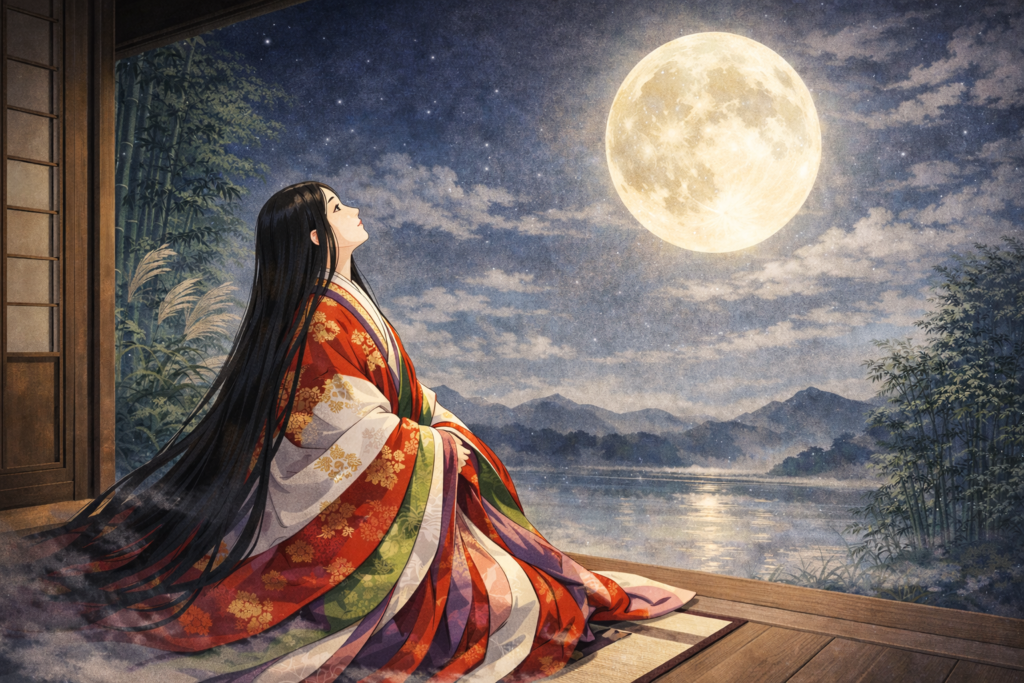
Kaguya-hime in a classical Japanese illustration, wearing a layered junihitoe robe and sitting on a traditional veranda, looking toward the full moon rising over a bamboo forest, symbolizing impermanence and quiet acceptance.
Ⅰ Introduction
The Tale of the Bamboo Cutter is one of the most widely known stories in Japan.
Almost everyone grows up hearing it in some form — as a children’s tale, a picture book, or an animated film.
Yet what is rarely noticed is this:
beneath its simple and gentle surface, this story contains a remarkably deep reflection on civilization itself.
It asks questions that feel unexpectedly modern.
Why do human relationships break down?
Why do desire and possession so often lead to loss?
And what does it truly mean to let go — not as defeat, but as a conscious choice?
Written more than a thousand years ago, The Tale of the Bamboo Cutter quietly offers a blueprint.
Not for a civilization that grows stronger by accumulating power,
but for one that survives by recognizing its limits,
and by knowing when something must be released.
Ⅱ Why This Story Still Matters Today
At first glance, The Tale of the Bamboo Cutter may appear to be a simple fairy tale.
In Japan, it is one of the most familiar stories—known to almost everyone from childhood—and it has even inspired modern films, including a well-known animated adaptation.
Yet beneath its gentle surface, this story carries a question that feels surprisingly contemporary.
Modern society often celebrates growth, accumulation, and permanence.
We are taught to acquire more, protect what we have, and extend things as long as possible—life, power, success, even relationships.
The Tale of the Bamboo Cutter presents a different perspective.
It suggests that civilizations do not endure by holding on to everything,
but by understanding limits,
by recognizing what cannot be possessed,
and by knowing when something must be released.
This is not a story about victory or failure.
It is a story about boundaries—
between humans and what lies beyond them,
between desire and acceptance,
between what can be kept and what must return to its origin.
In an age that struggles with excess, control, and exhaustion,
this thousand-year-old story offers a quiet but firm alternative way of seeing the world.
Ⅲ The Outline of the Story
The Tale of the Bamboo Cutter begins with an old bamboo cutter who discovers a tiny girl shining inside a stalk of bamboo.
He and his wife raise her as their own, and she grows into a woman of extraordinary beauty.
They name her Kaguya-hime.
As her reputation spreads, powerful noblemen seek to marry her.
Rather than choosing among them, Kaguya-hime presents each suitor with an impossible task—requests that appear noble or heroic, yet cannot be fulfilled without deception.
One by one, the suitors fail.
Some attempt to deceive her.
Others abandon the challenge.
None are punished, but none succeed.
Eventually, even the Emperor himself becomes captivated by Kaguya-hime.
He approaches her with sincerity and restraint, yet she still refuses to belong to him.
No matter how great the authority, there remains a boundary that cannot be crossed.
As time passes, Kaguya-hime begins to gaze at the moon and weep.
She reveals that she is not of this world, but comes from the Moon Capital, and that she must soon return there.
On the night of the full moon, heavenly beings descend to take her back.
Human resistance proves meaningless—not through force, but through the simple impossibility of opposition.
Before leaving, Kaguya-hime writes farewell letters.
She leaves behind a robe and an elixir of immortality.
The Emperor, unable to live eternally without her, orders the elixir to be burned atop a mountain.
The smoke rises into the sky, and the story ends—not with triumph or despair, but with separation.
Ⅳ What Makes This Story Unique
What makes The Tale of the Bamboo Cutter truly unique is not its fantasy elements,
but the way it treats power, desire, and loss.
In many stories, the narrative moves toward conquest, resolution, or fulfillment.
A hero succeeds, love is secured, or a conflict is overcome.
But this story does something very different.
Each time a human character attempts to possess something precious—
whether through wealth, status, intelligence, force, or even legitimate authority—
the attempt quietly fails.
Not because the characters are evil.
Not because they are punished.
But because what they seek cannot be owned in the first place.
Even the Emperor, who represents the highest form of human authority in the story,
does not overcome this boundary.
He does not lose through defeat.
He simply recognizes a limit—and steps back.
This is rare.
The story does not celebrate victory.
It does not glorify sacrifice.
And it does not frame separation as moral failure or tragedy.
Instead, it presents something far more subtle:
A civilization that understands
there are things that must not be taken,
relationships that must not be absorbed into systems,
and values that remain alive only when they are allowed to leave—
a distinctly Japanese blueprint for civilization.
Ⅴ Deeper Interpretation
At its deepest level, The Tale of the Bamboo Cutter is not a story about longing, loss, or separation.
It is a story about boundaries.
Every major conflict in the tale arises when something that should not belong to the human world is treated as if it could be kept there.
Kaguya-hime herself is one such presence.
She is beautiful, kind, and deeply loved—but she is not meant to remain.
Her tragedy is not that she must leave, but that humans try to make her stay.
The five suitors fail not because they lack effort or sincerity, but because each attempt turns into a form of substitution.
Instead of meeting what is asked, they offer imitations, excuses, or clever shortcuts.
The story does not condemn them; it simply shows the inevitable result of treating truth as something that can be negotiated.
Even the Emperor, the most powerful figure in the human realm, cannot cross this boundary.
His authority, compassion, and devotion are all genuine—yet none of them grant ownership.
When he refuses the elixir of immortality and orders it to be returned to the heavens, this is not resignation.
It is discernment.
Immortality would free him from death, but it would also sever him from time, grief, and responsibility.
To live forever would be to step outside the weight that makes human life meaningful.
Seen this way, the story offers a clear civilizational insight:
some things lose their value the moment we try to possess them.
What must be protected is not permanence, but proportion.
Not acquisition, but release.
Not control, but the wisdom to know where a boundary lies.
Ⅵ What This Story Teaches Us Today
What The Tale of the Bamboo Cutter teaches us today is not a rule to follow,
nor a moral to enforce.
It offers something more restrained, and far more difficult:
a way of understanding limits.
In this story, nothing truly collapses because of evil intent.
Things fall apart because something is held too tightly,
pursued beyond its rightful place,
or mistaken for something that can be owned.
The suitors fail not because they lack effort or passion,
but because they try to replace what cannot be substituted.
They confuse symbols with reality,
achievement with authenticity,
and possession with relationship.
Even the Emperor, the highest authority in the human world,
chooses not to cross a boundary he can see but cannot enter.
He does not conquer loss.
He accepts it.
And at the end of the story,
the elixir of immortality is not destroyed, hidden, or controlled.
It is returned.
This is not a story about giving up.
It is a story about knowing what must not be kept.
For the modern world—
a world obsessed with accumulation, optimization, and permanence—
this tale offers a radically different wisdom:
Some things lose their meaning when we try to secure them.
Some relationships survive only when they are not absorbed into systems.
Some values remain alive only when we allow them to leave.
The Tale of the Bamboo Cutter does not teach us how to win.
It teaches us how to remain human.
What this story quietly reveals is that collapse does not begin with malice.
It begins when care turns into control,
when devotion hardens into possession,
and when meaning is forced to stay where it no longer belongs.
Modern society is filled with systems designed to preserve, optimize, and retain.
Relationships are measured.
Careers are managed.
Beliefs are codified.
Even values are stored, branded, and defended as assets.
But The Tale of the Bamboo Cutter suggests something different.
Some things lose their meaning the moment we try to secure them permanently.
Love fades when it is confined.
Faith breaks when it is institutionalized.
Life becomes hollow when it is extended without purpose.
The tragedy in this story is not loss.
It is the refusal to recognize when holding on has already begun to destroy
what was once precious.
Ⅶ A Civilization That Chose to Let Go
The Tale of the Bamboo Cutter ends without victory, punishment, or resolution.
There is no final triumph, no restoration of order, no promise that everything will be all right.
What remains instead is a quiet clarity.
The story does not ask us to reject desire, ambition, or attachment.
It simply shows what happens when they are mistaken for things that can be owned, secured, or made permanent.
Kaguya-hime does not leave because the human world is cruel.
She leaves because the human world is finite.
And it is precisely this finiteness that gives human life its depth, its tenderness, and its meaning.
The Emperor does not drink the elixir of immortality, not because he despises life,
but because life without relationship, without encounter, without loss, would no longer be human.
And the elixir itself is not destroyed in anger or fear.
It is returned—acknowledged as something that does not belong in the human world.
In this way, The Tale of the Bamboo Cutter presents a civilization that chose restraint over conquest,
distance over domination,
and release over possession.
It is a civilization that understood
that not everything valuable should be preserved,
that not everything precious should be held,
and that some things remain alive only when they are allowed to pass on.
More than a thousand years later,
we live in a world that struggles to let go.
We measure success by what we accumulate,
safety by what we control,
and meaning by what we can secure.
Against this backdrop, The Tale of the Bamboo Cutter does not shout a warning.
It offers a mirror.
And in that mirror, we may glimpse a different possibility:
a way of living that honors limits,
respects distance,
and finds humanity not in holding on forever,
but in knowing when—and how—to let go.
[Supplement] The Patterns of Civilizational Failure Shown by the Suitors and the Emperor
The figures who appear in The Tale of the Bamboo Cutter are not merely individual characters with distinct personalities.
Together, they form a quiet map of how civilizations lose their way when they mishandle value, meaning, and relationship.
Each suitor represents a different mode of substitution—
an attempt to replace what cannot truly be replaced.
- Prince Ishitsukuri
He does not pursue faith itself, but steals the vessel of faith.
By appropriating an object that once held sincere prayers, he attempts to borrow spiritual authority without cultivating inner virtue. - Prince Kuramochi
He relies on craftsmanship and narrative.
Through advanced technique and elaborate storytelling, he believes truth itself can be manufactured and authenticated. - Abe no Mimuraji
He turns to markets and wealth.
By spending vast sums and mobilizing trade networks, he assumes that value can be purchased and verified by price alone. - Ōtomo no Dainagon
He places his faith in power and command.
Through authority and the enforcement of loyalty, he attempts to bend natural order—only to discover that force itself violates the very principle he seeks. - Isonokami no Chūnagon
He does not deceive, buy, or coerce.
Instead, he trusts information, observation, and clever strategy.
His failure reveals how unchecked knowledge, when detached from reality, can lead not to insight but to bodily collapse. - The Emperor
He possesses genuine authority, compassion, and depth of feeling.
Yet even he recognizes a boundary that cannot be crossed.
His strength lies not in conquest, but in restraint—in knowing when not to reach. - Kaguya-hime
The moment she dons the heavenly robe, she is no longer a finite being of the human world.
She becomes an eternal existence, untouched by longing, attachment, or sorrow—no longer capable of remaining within human time.
What unites these figures is not moral failure, but misalignment.
They are not condemned as evil.
They are shown as human—and profoundly limited.
The story does not judge them.
It simply shows what happens when value is mistaken for possession,
when meaning is forced into systems,
and when something that must remain free is held too tightly.
[A Final Note] A Civilization That Knows When to Let Go
What The Tale of the Bamboo Cutter ultimately offers is not a lesson about success,
nor a warning about failure.
It leaves us with something more subtle.
A way of living that recognizes when holding on begins to do harm.
Throughout the story, collapse does not come from cruelty or malice.
It comes from devotion that turns into fixation,
from care that crosses into control,
and from values that are forced to remain where they no longer belong.
Each figure in the tale reveals a different misunderstanding.
The suitors believe effort, wealth, power, knowledge, or technique
can replace what must be encountered as it is.
They do not fail because they are immoral,
but because they attempt to substitute rather than meet.
Even the Emperor—who possesses authority, dignity, and genuine affection—
recognizes a boundary he cannot cross.
He does not attempt to absorb what lies beyond him.
He chooses restraint over conquest.
And when immortality itself is offered,
it is not preserved, secured, or passed down as a treasure.
It is returned.
This gesture is central.
The elixir is not rejected out of fear,
but because it does not belong in the human world.
Some powers are too heavy to carry within ordinary life.
Some gifts distort meaning when they are kept too long.
Some truths must remain unheld in order to remain true.
What makes this perspective remarkable is that it did not remain only in story.
At several moments in its history, Japanese civilization enacted this same logic—not as metaphor, but as lived choice.
In the mid-nineteenth century, Japan underwent a radical transformation.
The warrior class that had governed the country for centuries did not vanish through violent overthrow.
Instead, the samurai voluntarily relinquished their hereditary status, their privileges, and even their right to bear arms, in order to reshape society around a new civic order.
Power was not seized from them.
It was returned.
Earlier still, during the late sixteenth century, a local lord named Shimizu Munenori chose to surrender his own life to bring an end to a prolonged siege.
Rather than prolonging conflict for honor or survival, he withdrew himself from the equation entirely—ending bloodshed by stepping away from power itself.
These moments are not anomalies.
They reflect the same civilizational intuition found in The Tale of the Bamboo Cutter:
that there are times when the most responsible act is not to win, preserve, or endure—but to release.
This is what sets this story apart.
It does not imagine a civilization that grows endlessly stronger.
It imagines one that survives by knowing its limits.
A civilization that understands
there are things that must not be taken,
relationships that must not be absorbed into systems,
and values that remain alive only when they are allowed to leave.
In a modern world shaped by accumulation, optimization, and permanence,
this perspective feels almost foreign.
We are taught to secure what we love,
to preserve what matters,
to extend what gives comfort.
But The Tale of the Bamboo Cutter suggests something else.
That love can fade when confined.
That faith can break when institutionalized.
That life can lose its depth when prolonged without loss.
The story does not ask us to abandon meaning.
It asks us to notice when meaning is already slipping away
because we are holding it too tightly.
What endures here is not possession,
but respect.
Not permanence,
but balance.
Not mastery over the world,
but a willingness to step back when the moment calls for it.
That, perhaps, is the quiet strength of the civilization this tale reveals—
one that does not collapse because it knows when to let go.