
(日本神話が教える『正義』の別のかたち)
What if the highest form of justice is not to decide who is right, but to protect what must not be broken? In the ancient Japanese myth of Ame-no-Wakahiko, a man is said to have betrayed heaven and died — yet the story refuses to confirm his guilt, his death, or even the truth itself. Instead of a verdict, it gives us a song.
This article explores how that silence reveals a profoundly different kind of moral intelligence — one that values human bonds over accusation, and protection over punishment — and why this ancient way of thinking may be exactly what our divided world needs today.
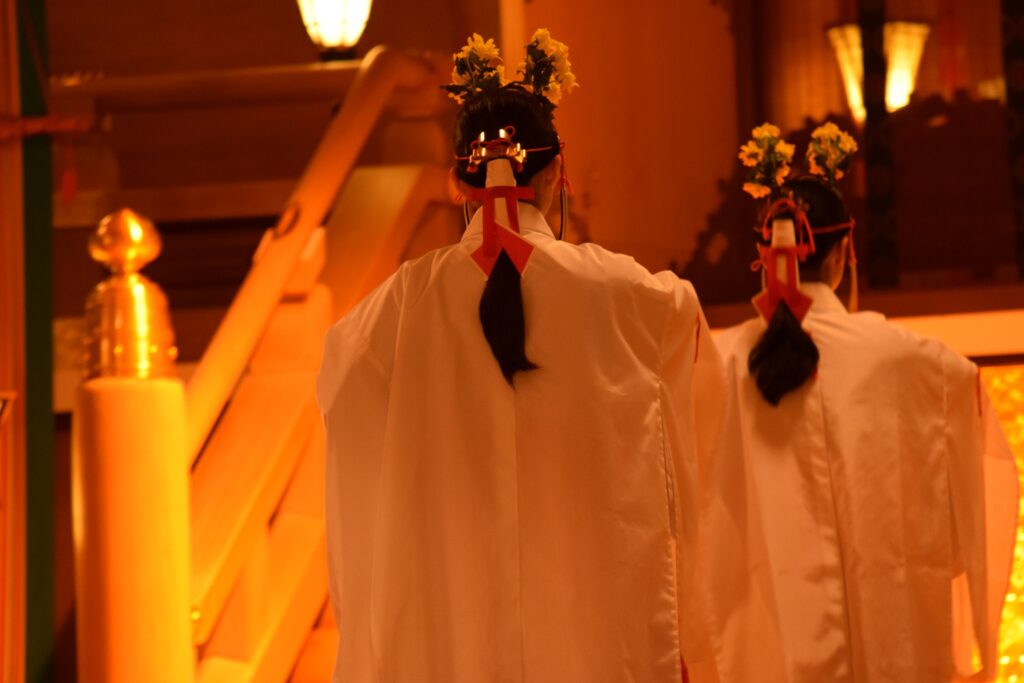
Ⅰ. Introduction – A Story That Was Never Meant to Be Explained
Most people who encounter Japanese mythology for the first time are told a simple story.
A god named Ame-no-Wakahiko was sent from heaven to bring order to the human world.
Instead, he betrayed the heavenly command, fell in love, and was killed for his disobedience.
It sounds like a familiar moral tale:
a failure, a punishment, and a warning about what happens when someone defies authority.
But the oldest Japanese text, the Kojiki (712 CE), does something very strange here.
It never actually explains what happened.
It records a long funeral, birds performing ritual roles, a god who looks exactly like the dead man, and a woman singing a mysterious song — but it never clearly says whether Ame-no-Wakahiko truly died, or whether he was punished, or even whether he was guilty.
To a Western reader, this feels incomplete.
Where is the verdict?
Where is the judgment?
But this is not a mistake.
It is a deliberate choice.
In that silence lies one of the most distinctive moral ideas of Japanese civilization — an idea that is radically different from the Western tradition of justice, confession, and forgiveness.
This article is not about proving what “really” happened to Ame-no-Wakahiko.
It is about understanding why the story refuses to tell us.
Ⅱ. The Man Who Was Supposed to Be Dead
According to the Kojiki, after Ame-no-Wakahiko was struck by an arrow, a grand funeral was held for him.
Birds took on ritual roles.
Some carried offerings.
Some prepared food.
Some wept.
The ceremony lasted eight days and eight nights.
What is striking, however, is what the text does not describe.
It never mentions a body.
There is no scene of parents clinging to their dead child.
No grieving wife embracing a corpse.
Only a funeral — and nothing more.
In many ancient cultures, this would suggest something very specific:
a death that has not yet been accepted as final.
A time in which the soul might still return.
Then, in the middle of this ceremony, another god appears:
Ajishikitakahikone, a close friend of Ame-no-Wakahiko.
Everyone is stunned.
His face, his presence, even his bearing are identical to the man who was supposed to be dead.
Ame-no-Wakahiko’s parents cry out in relief.
His wife does the same.
“My child is alive.”
“My husband is alive.”
The text explains this away by saying that the two gods simply looked alike.
But anyone who has ever recognized a loved one in a crowd knows this is not how recognition works.
Parents do not mistake strangers for their children.
Spouses do not cry out in joy over a mere resemblance.
They recognized him because, in some deeper sense, it really was him.
Ⅲ. Love That Chose to Be Misunderstood
If the man who appeared at the funeral was truly Ame-no-Wakahiko, one question immediately arises.
Why did he not reveal himself?
Why did he draw his sword, destroy the mourning hall, and leave in anger?
The answer lies in what would have happened if he had stayed.
Ame-no-Wakahiko had been sent from heaven.
If it became known that he was alive after disobeying that command, those closest to him would have been blamed — his wife, his parents, and everyone connected to him.
So he chose another path.
He allowed himself to be seen as a stranger.
As an intruder.
As someone who did not belong.
By becoming the villain of the scene, he protected the people he loved.
This is not the love of innocence.
It is the love of responsibility.
A love that accepts being misunderstood,
so that others do not have to suffer.
Ⅳ. The Song Instead of the Truth
After Ame-no-Wakahiko disappears, something unexpected happens.
His wife sings.
In the Kojiki, her song ends with a single, enigmatic line:
“This song is called Hinaburi.”
That is all the text gives us.
No explanation.
No interpretation.
Just a song.
But the words of the song quietly tell another story.
They speak of a jeweled cord, spun in heaven, still connecting two souls across valleys and distance.
In other words, the bond between Ame-no-Wakahiko and his wife was not broken.
He was supposed to be dead.
But the song says otherwise.
And yet, no one stands up and declares the truth.
No one says, “He is alive.”
No one accuses heaven.
No one demands justice.
Instead, the truth is placed into a song.
A song that those who understand can understand,
and those who do not can simply enjoy.
This is not vagueness.
It is care.
By refusing to turn truth into an accusation,
the story protects the people inside it.
Ⅴ. Western Justice and the Ethics of Confession
In the Western moral tradition, truth is not meant to remain silent.
It must be spoken, named, and recorded.
A person is expected to confess.
A society is expected to judge.
And justice is expected to be made visible.
Even mercy follows this structure.
In the Christian story of the woman accused of adultery, Jesus prevents her execution.
But he does not deny that she has sinned.
He says, “Your sins are forgiven. Go, and sin no more.”
Here, forgiveness does not erase guilt.
It redefines it.
The woman becomes a forgiven sinner — still marked by her wrongdoing, but now granted mercy.
This structure runs deep in Western civilization.
Truth must be articulated.
Guilt must be named.
Forgiveness must be declared.
This is how order is restored.
But there is a hidden cost.
Once truth becomes an accusation,
someone must carry the burden of being guilty.
Ⅵ. Japan’s Different Moral System
The world of Ame-no-Wakahiko works very differently.
No one ever says that he is innocent.
No one ever says that he is guilty.
Instead, something else happens:
the people he loves are protected.
His wife is safe.
His parents are safe.
Their future together is not destroyed.
This is not forgiveness.
It is something deeper.
It is protection without accusation.
In Japanese thought, moral action does not always begin with deciding who is right.
It begins with deciding what must not be broken.
Relationships.
Families.
Human bonds.
This is why the truth is placed inside a song instead of a verdict.
A verdict would have demanded responsibility.
A song allows everyone to remain whole.
Ⅶ. Why This Matters Today
We live in an age obsessed with truth.
Every mistake must be exposed.
Every wrongdoing must be named.
Every person must be held accountable.
On the surface, this sounds like justice.
But in practice, it often becomes something else.
It becomes a culture of accusation.
A world where truth is used as a weapon.
Families are torn apart.
Communities collapse.
People are reduced to the worst thing they have ever done.
In such a world, silence is treated as weakness.
Not speaking is seen as complicity.
But the story of Ame-no-Wakahiko offers a different possibility.
It suggests that sometimes,
the most humane response is not to speak,
but to protect.
Not to erase the truth,
but to keep it from destroying what still matters.
Ⅷ. Conclusion – A Civilization That Protects by Not Saying Everything
The story of Ame-no-Wakahiko does not end with a verdict.
There is no final judgment.
No confession.
No official truth.
Instead, there is a song.
A song that carries what cannot be said without causing harm.
A song that preserves love without turning it into a scandal.
A song that allows people to remain whole.
This is not a lack of morality.
It is a different kind of moral intelligence.
One that understands that sometimes,
the highest form of justice is not to decide who is right,
but to decide what must not be broken.
In a world that increasingly demands exposure, accusation, and division,
this ancient Japanese myth offers another way.
A way that does not deny truth,
but refuses to weaponize it.
A way that chooses protection over punishment.