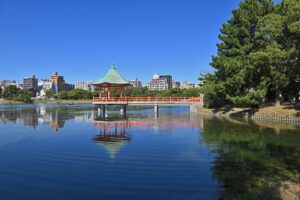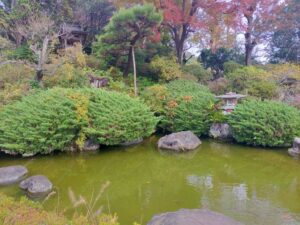
(日本に“NPC(モブキャラ)”はいない──尊厳を基盤にした文明)
In much of today’s online culture, the idea of “NPCs” — background characters without inner life — is taken for granted.Yet Japanese civilization has long held a profoundly different view: no human being is ever a background character.This essay explores why Japan rejects the NPC worldview and what this reveals about the heart of a resonance-based civilization.
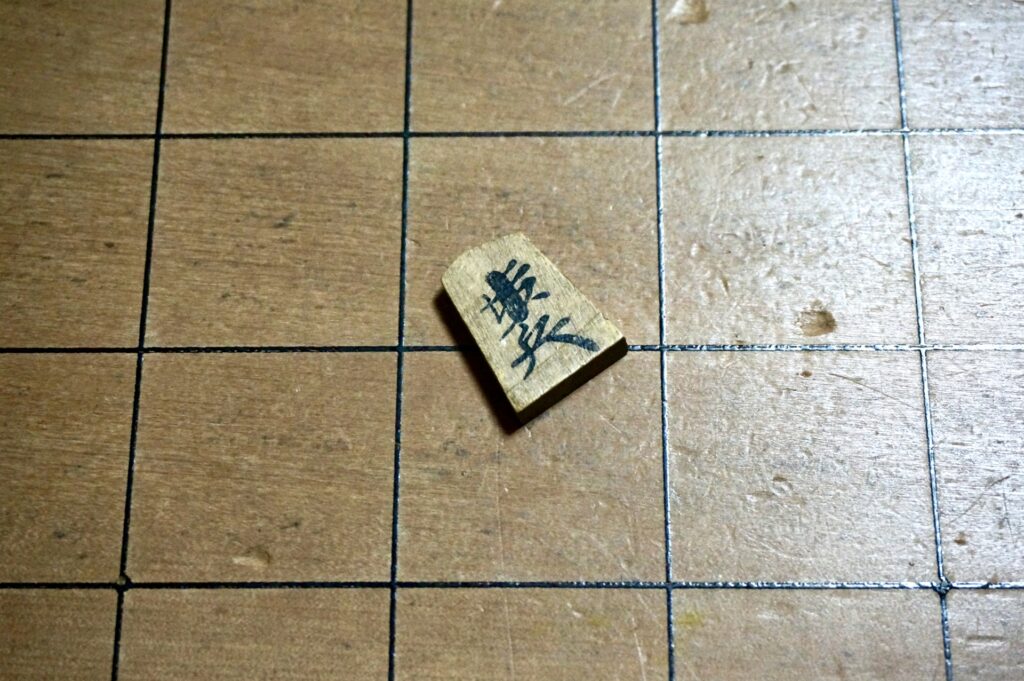
A single shogi piece labeled “歩兵” (foot soldier) lying slightly tilted on a wooden shogi board — symbolizing that even the smallest piece holds unique value.
Ⅰ. Introduction: NPC Culture and the Hidden Assumption Behind It
In the English-speaking world, the term “NPC” has moved far beyond video games.
It is now common internet slang for a person who appears to have no individuality, no agency, and no inner voice — merely a “background character” in someone else’s story.
The idea sounds harmless at first.
But behind it lies a deep, often unconscious assumption:
Only a few people are the protagonists of history.
Everyone else exists as scenery.
This worldview has shaped Western narratives for centuries — from classical epics to national histories to modern news reporting.
Some lives are spotlighted; others remain invisible.
But Japan stands apart.
Across its mythologies, its literature, and its social ethics, Japan has long rejected the notion that any human being can be reduced to a background character.
Here, the ordinary person is never “just ordinary.”
Every life is considered worthy, and every individual is seen as carrying a unique spark of dignity.
This raises the central question of this essay:
Why does Japan have no NPCs?
What makes Japanese civilization so different that the very concept of “background characters” falls apart when placed within its cultural frame?
To answer this, we must first look at why Western culture naturally produces NPC thinking —
and why Japan’s worldview leads to an entirely different understanding of the human being.
Ⅱ. Why the West Creates NPCs: The Narrative of “Heroes and the Rest”
In Western storytelling — from ancient Greece to Hollywood — history is often framed as the actions of a few exceptional individuals.
Achilles. Caesar. Napoleon. Churchill.
The names change across eras, but the structure remains the same:
A small number of “heroes” move the world.
Everyone else is simply “the rest.”
This mindset did not arise by accident.
It comes from deep cultural roots:
1. The Legacy of Greek Tragedy and Epic
Western literature begins with epics like the Iliad and Odyssey,
where only kings, warriors, and demigods have agency.
Ordinary people appear only as crowds, victims, or consequences.
The template becomes clear:
“Protagonists = powerful individuals.”
“Others = disposable masses.”
2. The Biblical Narrative
The Old Testament reinforces the same hierarchy.
God chooses a single prophet.
A chosen hero leads.
The masses either follow, rebel, or are destroyed.
The idea that most humans are “background characters”
becomes religiously normalized.
3. Modern Media: News and Movies
Even today, global events are reported through the decisions of leaders:
“Putin’s intentions,”
“Biden’s strategy,”
“Xi’s ambitions,”
while millions of ordinary people living in those regions remain unseen.
Hollywood follows the same pattern:
-save-the-world heroes,
-elite agents,
-chosen ones.
Everyone else is scenery.
Thus, across thousands of years, a consistent worldview takes shape:
History = The story of a few extraordinary individuals.
Humanity = A hierarchy of protagonists and NPCs.
This cultural blueprint makes NPC-thinking feel natural in the modern West.
But Japan has a different blueprint altogether —
one that refuses to divide the world into “heroes” and “background characters.”
Ⅲ. Why Japanese Civilization Rejects NPC Thinking
While Western culture grew around a hierarchy of heroes and background characters,
Japanese civilization developed upon a completely different foundation —
a worldview in which every being has a center, a spirit, and a place of dignity.
This difference is not political, not modern, and not accidental.
It is woven into Japan’s mythology, literature, and ethical consciousness.
1. The World of Eight Million Kami: A Universe Without “Background Characters”
Shinto teaches that the world is filled with yaoyorozu no kami — eight million kami,
not because the number is literal,
but because every part of existence carries its own sacred essence.
Mountains, rivers, trees, tools, animals, ancestors —
and of course, every human being.
There is no “chosen people,”
no single prophet with exclusive access to truth.
Instead:
Everything that exists has a role, a dignity, and a center.
No being is a background object.
A worldview like this cannot produce NPC thinking.
2. “Ohomikata-ra” — People as the Great Treasure
From ancient times, the Japanese state described its people as:
おほみたから — the Great Treasure.
Not subjects.
Not followers.
Not expendable masses.
A treasure.
This single word captures the essence of Japanese political philosophy:
The ruler exists to care for the people,
because the people are precious beyond measure.
The idea that “some matter, others do not”
is completely foreign to this tradition.
3. The Manyōshū: A National Anthology of Ordinary Lives
The Manyōshū, Japan’s oldest poetry collection, makes this worldview unmistakable.
It includes:
• poems by emperors,
• poems by nobles,
• and an astonishing number of poems by farmers, soldiers, mothers, widows, travelers, and laborers —
people who would be “NPCs” in Western historical logic.
But in Japan, they must be included.
Because every life has a voice worth recording.
The Manyōshū is not an anthology of heroes.
It is an anthology of humanity.
4. Japanese History Honors the “Nameless Ones”
Throughout Japanese storytelling —
from war chronicles to folktales to local histories —
individual, unnamed people shine quietly.
The woman who waited.
The soldier who stayed behind.
The villager who prayed for rain.
The craftsman who shaped a tool with devotion.
These figures often have no power, no fame, no position —
yet their sincerity is treated as something that can move heaven and earth.
Japanese culture sees history not as the stage of a few great men,
but as the accumulation of countless sincere lives.
5. A Civilization Where Every Person Is a Protagonist
When we bring these strands together —
Shinto cosmology, political philosophy, literature, and ethics —
one principle stands firm:
Japan is a civilization where each person is a protagonist.
Not metaphorically.
Not sentimentally.
But structurally.
NPC thinking cannot exist in a worldview
where every individual is a being with a center, a spirit, and a sacred place in the cosmos.
Japan does not merely “reject” NPC thinking.
It renders the concept meaningless.
In such a world, nobody is disposable.
Nobody is scenery.
Everyone is a life with weight, with purpose, and with story.
Ⅳ. Emperor Shōwa’s Words: The Ultimate Rejection of NPCs
One of the most profound expressions of the Japanese worldview comes from Emperor Shōwa.
He once said to a botanist:
“There are no such things as weeds.
Every plant has a name
and lives where it chooses to live.”
For English-speaking readers, this line lands with surprising depth.
In cultures where “weeds” often means “worthless plants”,
these words quietly overturn the hierarchy behind that idea.
What the Emperor is really saying is:
There is no such thing as a “background life.”
Every being has a story, a name, and a rightful place to exist.
In other words:
There are no NPCs among human beings.
This statement reflects the heart of Japanese civilization:
• Existence is not divided into “main characters” and “background extras.”
• Every person carries their own sacred center — their tamashii, their soul.
• Dignity is not earned by role or status. It is inherent.
You can see this worldview everywhere in Japanese tradition:
• The Manyōshū is filled not with aristocrats’ poetry, but with the voices of common people.
• Historical chronicles record the words and sorrows of unnamed farmers and villagers.
• Mythology speaks of Yaoyorozu-no-Kamigami, the “eight million kami,”
meaning that divinity is not concentrated—it is distributed.
Japan is a civilization where every life is a protagonist.
Emperor Shōwa’s gentle words express this more beautifully than any political theory ever could.
They offer a quiet, elegant rejection of NPC thinking:
“There are no weeds” → “There are no disposable lives.”
“Every plant has a name” → “Every person has their own destiny.”
And this principle is exactly what the Resonance Civilization aims to revive:
A world where
• no one is “background,”
• every person’s presence carries weight,
• and society is shaped not by dominance, but by mutual resonance.
In this sense, the Emperor’s words are not merely botanical philosophy.
They are a civilizational message:
A society without NPCs is a society capable of true resonance.
Ⅴ. Conclusion: A World With No NPCs Is a World That Resonates
The phrase “NPC” may have begun as gaming slang,
but it quietly shaped how many people see the world:
some as main characters, others as background.
Japan’s cultural tradition gently but firmly rejects this idea.
From the Manyōshū to the concept of Yaoyorozu-no-Kamigami,
from village festivals to everyday expressions of care,
and especially through Emperor Shōwa’s words,
a consistent message runs through Japanese civilization:
Every life holds a center.
Every person is an irreplaceable presence.
No one is a “background character.”
And when a society embraces this truth, something remarkable happens:
People stop trying to dominate the story
and begin listening for each other’s rhythm.
They begin to resonate.
This is the foundation of the Resonance Civilization —
a vision where human society evolves not through competition or hierarchy,
but through the subtle vibrations that move from heart to heart.
A world without NPCs is a world where:
• everyone matters,
• everyone belongs,
• everyone carries a voice that deserves to be heard.
It is a world where
your existence naturally reinforces mine,
and mine naturally lifts yours.
In such a world, progress is not a race but an unfolding.
Community is not an obligation but a natural response.
And civilization becomes something we co-create,
not something we impose.
Perhaps this is why Japan nurtured a culture
that never needed a single savior-hero to define it.
When every person is a protagonist,
and every life a sacred presence,
the story is not led by one shining figure —
it is shaped by the resonance of many.
This is the secret Japan has carried since ancient times.
And it is the key the world may need today
as we move toward a future defined not by domination,
but by shared harmony.
There are no weeds.
There are no NPCs.
There are only presences meant to resonate together.
Author’s Reflection
Resonance Civilization is not a religion.
It is simply the natural result of a culture that has chosen, for thousands of years, to cherish other human beings.
What I describe here is not part of any religious doctrine or system of belief.
What Japanese civilization has valued over the span of millennia is not an abstract deity,
but the warm and direct gaze we offer to the person standing right in front of us.
To care for that person,
to honor the relationship that connects us —
these small acts ripple outward and gradually form a community.
Out of this long accumulation emerged
Japan’s unique worldview in which there are no NPCs,
a cultural foundation that I later came to call a “Resonance Civilization.”
It is not a religion.
It is not a philosophy.
It is simply a human attitude.
And this simple attitude has been nurtured in Japan for more than a thousand years —
quietly, patiently, and with great sincerity.
The spirit of Bushidō, too, arises from this very same lineage.
● Japanese Edition of This Article: https://hjrc.jp/?p=7925