
(日本語の歴史を変えた幽霊の物語 — 剣なき時代の武士道入門)
When we think of Bushido, we often picture swords and warriors.
Yet the spirit of Bushido has long lived beyond the battlefield—quietly shaping language, stories, and the responsibility carried by words.
Through the ghost tale Botan Dōrō, this essay explores how Japanese prose was transformed, how balance was taught without commands, and why learning Bushido today begins not with force, but with how we speak, listen, and choose.
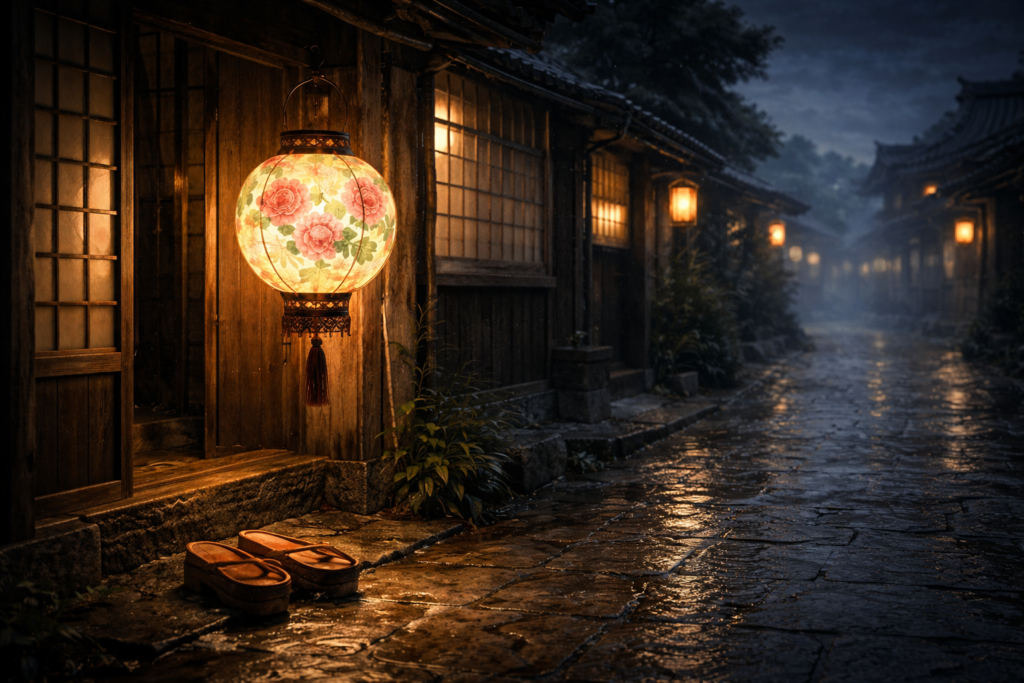
A quiet Edo-period street at night, illuminated by a glowing peony-patterned lantern hanging outside a wooden house, with rain-soaked stone pavement, empty geta sandals by the doorway, and warm lantern light fading into mist and darkness.
Ⅰ. Introduction : Beyond the Sword
When people hear the word Bushido,
they often imagine swords, battles, and warriors standing on the battlefield.
Yet long before Bushido was spoken of as a “code,”
and long after swords were laid down,
the spirit of the warrior continued to live quietly
in places far removed from combat.
One such place was language itself.
In Japan, stories have never been mere entertainment.
They have carried values, shaped sensibilities,
and quietly guided how people think, speak, and live.
Among these stories, ghost tales—kaidan—played a surprisingly important role.
This essay begins with one of Japan’s most famous ghost stories,
Botan Dōrō (The Peony Lantern).
At first glance, it appears to be a simple tale of love and death,
fear and illusion.
But beneath its eerie beauty lies something far more enduring.
Through this story, modern Japanese prose took shape.
Through spoken words, carefully preserved and passed on,
a new way of writing—and a new way of expressing the self—was born.
More importantly, Botan Dōrō reveals a side of Bushido
that cannot be found in swords or battles.
It is a Bushido of restraint, responsibility, and quiet resolve—
a way of protecting what matters
without conquering, without dominating,
and often without being noticed at all.
To learn Bushido beyond the sword,
we must listen not only to history’s battles,
but also to its stories—
and to the footsteps that echo softly in the night.
Ⅱ. Why Ghost Stories Matter in Bushido Culture
At first glance, ghost stories may seem far removed from Bushido.
After all, Bushido is often associated with discipline, honor, and action,
while ghost tales appear to dwell in fear, illusion, and the supernatural.
Yet this apparent contradiction reveals something essential about Japanese culture.
Bushido was never only about fighting.
It was about restraint—knowing when not to act.
It was about responsibility—carrying consequences beyond one’s own life.
And it was about awareness—living as if one’s actions would echo beyond death.
Ghost stories spoke directly to these sensibilities.
In a society shaped by warriors, the most dangerous failures were not always cowardice or defeat.
They were excess, obsession, and the inability to let go.
Ghosts, in Japanese storytelling, are rarely evil invaders from outside.
They are born from unresolved attachments, broken duties, and emotions that exceeded their proper bounds.
This is precisely why kaidan mattered in a Bushido-shaped world.
A warrior was expected to control desire, anger, and fear.
But rather than preaching these values abstractly,
ghost stories embodied them.
They showed what happens when restraint collapses—
not through moral lectures, but through unforgettable images.
In this sense, ghost stories functioned as ethical mirrors.
They did not command behavior.
They reflected consequences.
To listen to a ghost story was not merely to feel fear.
It was to rehearse responsibility—
to imagine how one’s choices might linger,
even after one’s life had ended.
This quiet moral imagination, cultivated through stories rather than rules,
lies at the heart of Bushido beyond the sword.
Ⅲ. The Story of Botan Dōrō
About two hundred years ago, in the middle of the Edo period,
there lived a man named Ogihara Shinsuke near Yushima Tenjin in Edo.
Shinsuke was a rather handsome man, but shy and fond of books.
He rarely went out and spent most of his nights reading quietly by lamplight.
One humid night in mid-July,
as Shinsuke sat absorbed in his reading,
he heard the faint sound of footsteps in the distance.
Karankoron… karankoron…
The sound of wooden geta sandals echoed softly through the silent streets.
“Could someone be coming at this hour?”
Curious, Shinsuke stepped outside into the narrow alley.
There he saw a beautiful young woman, no more than twenty years old,
walking toward him with a small girl of about ten.
The child carried a small lantern decorated with peony flowers.
So striking was the woman’s beauty that Shinsuke found himself speaking without thinking.
Shinsuke:
“What brings you out so late at night?”
Woman:
“We are returning from an errand,
but the road has grown frightening in the darkness.
The child is tired, and we have nowhere to rest.”
Moved by her words, Shinsuke replied,
Shinsuke:
“Then please, rest here for a while.
I have nothing but cold water to offer,
but you are most welcome.”
Trusting the gentle, earnest-looking man,
the woman entered his small house—a single room with open windows,
a book spread open on the floor, and a few poems written beside it.
Seeing the poems, the woman asked,
Woman:
“Do you compose waka poetry?”
Shinsuke:
“Only as a humble pastime.
I am ashamed of my poor skill.”
Smiling, the woman completed one of his unfinished verses with ease.
When Shinsuke offered another opening line,
she responded again with a flawless closing.
They spoke through the night,
and before they realized it,
the eastern sky had begun to pale with dawn.
Woman:
“It would not do to be seen.
I must take my leave.”
From that night on, the woman—who called herself Otsuyu—
visited Shinsuke every evening after sunset.
Twenty days passed in this way, and Shinsuke could think of nothing else.
Next door lived an old man, who grew suspicious.
“One cannot sleep,” he muttered,
“hearing a woman’s voice night after night in this heat.”
One evening, the old man looked into Shinsuke’s open room—
and froze.
There sat Shinsuke,
speaking softly to a white skeleton,
which nodded as if in reply.
Terrified, the old man fled.
The next day, he confronted Shinsuke and told him what he had seen.
Old Man:
“The woman you speak of is no living being.
If you continue like this, your life will be drained away.”
They went together to Manju-ji Temple,
where they found an old spirit shrine bearing the inscription:
Otsuyu, daughter of Iijima Heizayemon.
Beside it hung a child-sized doll
and the same peony lantern carried each night.
A monk warned Shinsuke:
Monk:
“In ten days, your life will be gone.
Place this image of Kannon in your room
and seal your doors with these talismans.
Never meet her again.”
That night, as Shinsuke chanted sutras in desperation,
the sound returned.
Karankoron… karankoron…
Outside, Otsuyu wept, unable to enter.
Otsuyu:
“You promised we would meet.
How cruel of you to shut me out.”
Shinsuke remained silent, chanting until dawn.
After that night, she no longer appeared.
Fifty days later, believing himself saved,
Shinsuke drank sake for the first time since the warning.
Overcome by longing, he returned to the temple.
There, Otsuyu appeared once more.
Otsuyu:
“You have come. I am so happy.”
Shinsuke:
“I no longer care who you are.
I will never leave you again.”
She took his hand and led him into the inner grounds.
The next morning,
a temple novice found Shinsuke’s body in the grave—
clutched to a skeleton.
Soon after, people claimed to see Shinsuke and Otsuyu
wandering the streets at night,
accompanied by a child carrying a peony lantern.
Those who saw them, it was said,
fell gravely ill.
Ⅳ. Botan Dōrō and the Birth of Modern Japanese Prose
The story you have just read did not remain confined to the world of ghost tales.
In fact, Botan Dōrō played a decisive role in shaping how modern Japanese is written and read.
Until the late Edo period, written Japanese was dominated by classical literary language.
It was formal, rigid, and distant from everyday speech.
Texts were something to be studied—often aloud, often with explanation—but rarely something that felt spoken.
That changed in the early Meiji era.
The ghost story Botan Dōrō was retold on stage by the celebrated storyteller San’yūtei Enchō.
His performance style was vivid, conversational, and emotionally direct.
Listeners felt as though the story was happening before their eyes.
What transformed this spoken performance into a linguistic revolution was its transcription.
The oral performance of Enchō was written down in colloquial Japanese by Futabatei Shimei.
Instead of translating the tale back into classical prose, he preserved its spoken rhythm—
its pauses, repetitions, and emotional turns.
The result was startling.
Readers said:
• “It’s easy to read.”
• “It sounds like someone is speaking to me.”
• “I can feel the story.”
Newspapers serialized the text, and it spread rapidly among the public.
For the first time, written Japanese aligned closely with living speech.
In other words,
a summer ghost story became a gateway through which modern Japanese prose entered everyday life.
This was not a planned reform.
No committee designed it.
No government decree mandated it.
It happened because a story needed to be felt, not merely understood.
Ⅴ. Botan Dōrō and Bushido: The Discipline of Balance
Japanese ghost stories were never meant to be mere entertainment.
They were not created simply to frighten people on summer nights, nor to sell fear as spectacle.
Ghost stories functioned as a quiet space where the consequences of human choices could be felt—without sermons, without moral lectures.
They were a way of bringing things back into balance.
Bushido, too, is not a collection of rigid rules.
What defined the warrior was not blind obedience, but a refined sensitivity—an ability to sense how far one may step, and when one must stop.
A warrior was not judged solely by how bravely he fought.
He was judged by whether he could restrain himself at the critical moment.
In this sense, ghost stories served as a mirror reflecting the same inner discipline.
In Botan Dōrō, there are no villains.
No crimes are committed.
What appears instead is an attachment that could not be released.
A love that refuses to accept death.
Emotion that pushes past warning.
A moment when compassion quietly transforms into obsession.
These are not “sins” in the Western moral sense.
They represent a loss of balance.
Because there is no sin, there is no judgment.
Yet once a boundary is crossed—between life and death, duty and desire, self and other—order collapses.
The question becomes not who is guilty, but how balance can be restored.
Warriors lived daily beside death.
Yet Bushido never glorified death itself.
By accepting the possibility of death tomorrow, one learns how to remain centered today—no matter how violently emotions may surge.
Fear, love, grief—these are natural to being human.
But when a person becomes ruled by them, the path is lost.
This is what ghost stories quietly teach.
Emotion is not something to be suppressed.
Suppression only leads to eruption.
Instead, emotion must be settled.
Before drawing the sword, the warrior first returns the sword of the heart to its sheath.
In this sense, ghost stories are not the opposite of Bushido.
They are its shadow—appearing precisely when the Way begins to slip from view.
Ⅵ. Language, Responsibility, and the Living Voice
Ghost stories did not shape only moral sensibility.
They also reshaped language itself.
Until the late Edo period, written Japanese followed classical forms.
These literary styles were elegant, but distant—something to be read, not heard.
They belonged to the world of court poetry and official documents, not to the living voice of ordinary people.
This began to change in the early Meiji era.
When Botan Dōrō was serialized in newspapers, it was told orally by the rakugo master San’yūtei Enchō.
What readers encountered was not stiff literary prose, but spoken language—rhythmic, intimate, and alive.
The person who transformed Enchō’s spoken storytelling into written form was Futabatei Shimei.
By recording the story in colloquial Japanese, he helped give birth to modern Japanese prose.
Readers responded immediately.
“This is easy to read.”
“It feels like someone is speaking directly to me.”
“I can hear the voice.”
What had changed was not only style, but responsibility.
Once language becomes something that sounds like a human voice, the writer can no longer hide behind formality.
Words now carry weight.
They reach the reader directly.
This, too, resonates deeply with Bushido.
Just as the warrior could no longer rely solely on rank or armor,
the writer could no longer rely on classical form alone.
Speech demands sincerity.
A living voice exposes intention.
In this sense, Botan Dōrō did more than frighten its audience.
It quietly taught Japan how to speak to itself.
Ⅶ. The Responsibility of Words, and the Way of the Warrior
In Japanese culture, words have always been understood to carry responsibility.
This idea is often expressed through the concept of kotodama—the belief that words contain spirit.
Traditionally, language has not been seen as a mere tool for self-expression.
To speak is to connect one’s inner world with the outer world.
Words are not simply released; they are entrusted.
Once spoken, a word cannot be taken back.
This is why silence and ma—the space between words—have been valued as deeply as speech itself.
Not because words are dangerous, but because they possess power.
A spoken word enters another person’s heart and alters how that person sees the world.
For the warrior, this was never an abstract notion.
A single command could determine life or death.
A single promise could bind a family for generations.
And one careless phrase could create a rupture that could never be repaired.
For this reason, Bushido demanded discipline not only of the sword, but of language itself.
At this point, the deeper meaning of ghost stories comes into view.
Japanese ghosts do not scream.
They speak quietly, in the dark—at a distance that draws the listener closer.
Rather than suppressing fear, sorrow, or longing, they guide these emotions into shape.
In this sense, storytellers and warriors share the same discipline.
Not force, but timing.
Not loudness, but presence.
Knowing when to speak.
Knowing when to remain silent.
And knowing when to let a story come to an end.
This sensibility did not vanish with the end of the samurai era.
It continues to live within Japanese language, literature, and everyday communication.
Implication over assertion.
Balance over judgment.
Botan Dōrō stands precisely at this crossroads.
It does not impose.
It does not condemn.
Yet it quietly brings things back into order.
This, too, is the Way of the Warrior—
a path that extends beyond the sword.
Ⅷ. Conclusion: Learning Bushido in an Age of Endless Voices
We live in an age of endless voices—an era shaped by social media.
Words are produced instantly and spread without limit, reaching others before we have time to think, and before we have accepted responsibility for them.
Precisely because of this, we are prone to forget that words once carried weight.
Bushido reminds us that language was never merely a tool.
Words were understood as something that connected one’s inner intentions with the outer world, a means of maintaining balance.
It does not demand silence, nor does it celebrate unchecked self-expression.
It asks only one thing: to take responsibility for the space—the ma—between thought and action.
Ghost stories such as Botan Dōrō continue to be told for this very reason.
They do not command.
They do not condemn.
They do not impose.
What they depict is simple and precise:
what happens when balance is lost.
Nothing more.
Everything else—what one feels, what one notices, even the act of restoring balance within oneself—is entrusted to the listener.
This is not teaching from above.
It is a posture in which the storyteller and the listener share responsibility.
Not overpowering with strong words.
Not drifting along with the noise.
This sensibility shaped the Japanese language, nurtured literature, and sustained the Way of the Warrior beyond the sword.
To learn Bushido today is not to return to the past.
It is to live with the awareness that today could be one’s last day,
and with that awareness, to handle words carefully amid the noise,
and to bring order to each choice, one by one.
That steady accumulation, I believe, is what Learning Bushido means in the age ahead.