(権力よりも、約束が重かったとき・・藤堂仁右衛門の武士道精神)
What does it mean to keep one’s word when power demands otherwise?
This true story from Japan’s Battle of Sekigahara follows a little-known samurai whose quiet decision reveals the enduring strength of honor, trust, and independence at the heart of Bushido.
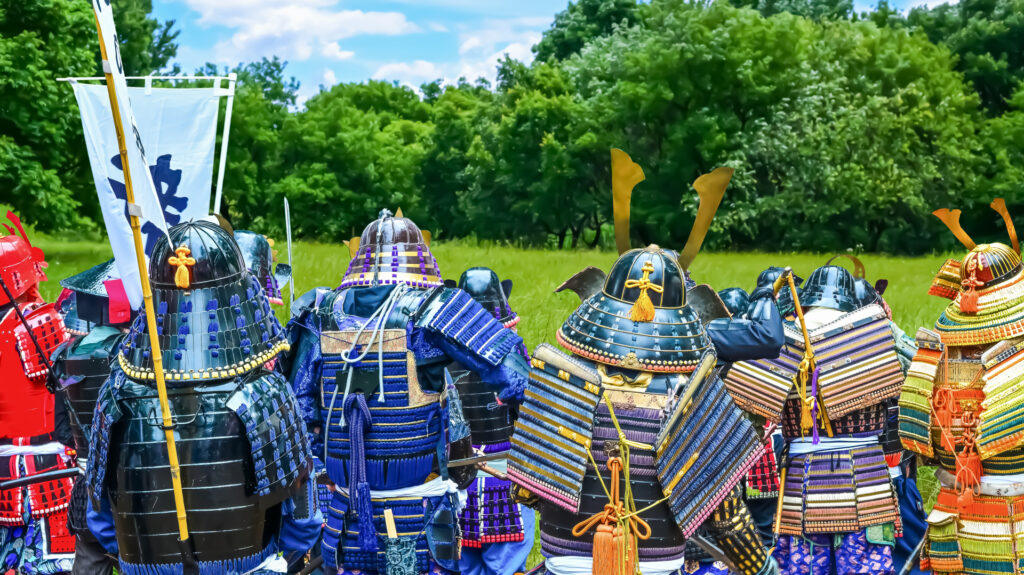
A group of samurai in traditional Japanese armor stands side by side on a green field, recalling the Sengoku period and the values of honor, loyalty, and duty.
Ⅰ. Introduction — When a Promise Matters More Than Power
In the year 1600, Japan was shaken by one of the largest battles in its history: the Battle of Sekigahara.
It was a decisive conflict that determined the future of the country, dividing warriors into winners and losers, and setting the course of political power for generations to come.
Yet when the clash of armies had ended and the noise of battle faded, something else still remained.
For the samurai who had survived, the end of fighting did not mean the end of choice.
Even after victory or defeat was decided, each warrior still faced questions that could not be answered by force alone.
This is not a story about a famous general or a triumphant ruler.
It is the story of a single samurai, standing far from the center of power, who was confronted with a quiet but profound decision.
A decision that asked what should matter more: reward or honor, authority or a promise once given.
[Note]
The Battle of Sekigahara has recently drawn renewed global attention through popular television adaptations, introducing many international viewers to this pivotal moment in Japanese history.
Ⅱ. The Battlefield Aftermath — Seeking Water in the Valley
Tōdō Niemon was a samurai in the service of Tōdō Takatora, a daimyō known for his keen judgment and loyalty to the winning side at Sekigahara.
Niemon himself was not a famous commander, nor did he stand at the center of the battlefield.
He was one of countless warriors who fought, survived, and carried on amid the confusion of war.
After the fierce fighting had subsided, Niemon left the main field of battle.
Exhausted and wounded, he made his way down into a nearby valley in search of water, hoping to quench his thirst after the long struggle.
It was there, beside a small stream, that he encountered someone he did not expect to meet.
Standing before him was Yuasa Gosuke, a trusted retainer of Ōtani Yoshitsugu—one of the defeated commanders.
In that quiet valley, far from the clamor of armies, two enemies found themselves face to face.
Ⅲ. An Unexpected Encounter — Facing an Enemy Retainer
The man standing before Tōdō Niemon was Yuasa Gosuke, a senior retainer of Ōtani Yoshitsugu.
Gosuke was widely known as a brave and capable warrior, a man whose name carried weight even among his enemies.
The moment the two men recognized each other, the air between them tightened.
They were no longer simply exhausted soldiers seeking water.
They were samurai of opposing sides, meeting by chance in the aftermath of a great battle.
Niemon shifted his grip on his spear and stepped forward.
“Let us fight,” he said, calmly but firmly.
“Here and now, let us decide this properly.”
It was a challenge made without hatred and without hesitation—
a call for an open and honorable duel, in accordance with the code both men understood.
Ⅳ. The Request — A Single Wish Before the Duel
Yuasa Gosuke did not immediately accept Niemon’s challenge.
Instead, he raised a hand slightly, as if to pause the moment.
“Wait,” he said. “Before we fight, I must ask you for one thing.”
Gosuke then spoke of his lord, Ōtani Yoshitsugu.
Yoshitsugu had long suffered from a severe illness, one that had ravaged his body and disfigured his face.
In life, he had endured this suffering with dignity.
Yet now, defeated in battle, his final fate threatened to strip him even of that.
“If my lord’s head is taken and displayed,” Gosuke said,
“his disfigured appearance will be exposed to the world.
I cannot bear to see him shamed in death.”
Gosuke explained that he was in the midst of burying his lord’s head in this valley, seeking to give him a measure of peace and privacy, even in defeat.
“I will fight you,” he continued, meeting Niemon’s eyes.
“But before we cross spears, I ask for your word.
Promise me this: that you will never reveal the place where my lord’s head is buried.”
It was not a demand made from weakness, nor a plea for mercy.
It was a request grounded in loyalty, spoken calmly, and offered with full acceptance of whatever outcome might follow.
Ⅴ. The Promise — Choosing to Receive Honor
Niemon did not hesitate.
After hearing Gosuke’s request, he lowered his spear slightly and nodded.
“I give you my word,” he said.
“The place where your lord rests will never be spoken of by me.”
There was no calculation in his response.
No attempt to weigh advantage or reward.
Niemon did not see before him an enemy to be exploited,
but a fellow retainer, bound by loyalty to his lord.
In that moment, the boundaries of victory and defeat dissolved.
What stood between them was not rank or allegiance,
but a shared understanding of what it meant to serve another with one’s life.
This was not a contract, negotiated for mutual benefit.
No witnesses were called.
No documents were signed.
It was a promise given from one human being to another,
accepted in full awareness of its weight.
By accepting Gosuke’s request,
Niemon chose honor over gain,
trust over suspicion,
and faith over fear.
Only after that promise was firmly given
did the two men raise their weapons once more,
ready to face each other not merely as warriors,
but as men who had already settled the most important matter between them.
Ⅵ. The Duel — A Battle After the Promise
When the promise had been made, there was nothing more to say.
No further words were needed between the two men.
They stepped back from the valley stream.
The water still flowed quietly, indifferent to what was about to happen.
Weapons were readied, not in anger, but with calm resolve.
This duel was not fought out of hatred.
Nor was it driven by ambition or the desire for reward.
Each man already understood the other’s heart.
They fought because that was the way of warriors.
They fought to bring the moment to its rightful conclusion.
Steel met steel.
The clash was brief, fierce, and without hesitation.
When it was over, Yuasa Gosuke lay fallen.
Todo Niuemon remained standing.
There was no triumph in his posture, no cry of victory.
Only silence.
The promise had been kept.
The battle, in truth, had already ended before the first strike was exchanged.
Ⅶ. After the Duel — What Remained Beyond Victory
After the Battle of Sekigahara had ended, the victors began searching for the head of Ōtani Yoshitsugu.
To present the head of an enemy commander was proof of loyalty—and a path to great reward.
Yet no matter how thoroughly they searched, the head could not be found.
Eventually, Tokugawa Ieyasu, the supreme commander of the victorious forces, summoned Todo Niuemon.
He was the man who had defeated Yuasa Gosuke, the retainer closest to Ōtani.
“You must know something,” Ieyasu said.
“Tell us where Ōtani Yoshitsugu’s head lies.”
Niuemon answered without hesitation.
“Yes. I know where it is.”
“Then bring it here at once.”
At that moment, the entire room grew tense.
But Niuemon slowly shook his head.
“I cannot do that,” he replied.
“I gave my word to Yuasa Gosuke.
He asked me never to reveal the place where his lord’s head was buried.
Even if this is your command, I cannot break that promise.”
The retainers around Ieyasu erupted in anger.
“How dare you defy your lord’s order?”
“Do you understand where you stand?”
“I do,” Niuemon answered calmly.
“And even so, I cannot speak.”
“If so, you shall be punished,” they warned.
“Do as you will,” Niuemon said, and bowed his head.
The room fell silent.
Then Tokugawa Ieyasu spoke.
He ordered a spear to be brought before him.
Holding it in his hands, he looked at Niuemon and said:
“Never forget this resolve.”
With those words, he bestowed the spear upon him.
Niuemon was dismissed—alive, and honored.
In that moment, a promise made to an enemy had outweighed obedience to power.
And honor had stood firm, even before the highest authority in the land.
Ⅷ. Reflection — What This Story Teaches
What does this story teach us today?
At first glance, Todo Niuemon’s decision may seem irrational.
By refusing to reveal the location of Ōtani Yoshitsugu’s head, he turned away honor, reward, and even personal safety.
From the perspective of power or efficiency, his choice makes little sense.
And yet, this is precisely why his action continues to resonate.
Niuemon did not act out of loyalty to a superior, nor out of fear of punishment.
He acted to remain faithful to a promise he had freely accepted.
No contract compelled him.
No witness enforced it.
Only his own sense of honor stood between him and an easier path.
This is a form of ethics that does not rely on surveillance or authority.
It is grounded instead in an inner commitment—a belief that one’s word carries weight simply because it has been given.
In many societies, trust is secured by documents, penalties, and constant verification.
Promises are assumed to be fragile, and systems are built to anticipate betrayal.
But the world that produced samurai like Niuemon was shaped by a different assumption:
that character precedes control.
His decision was not about heroism.
It was about consistency.
He chose not to become someone else simply because circumstances had changed.
Perhaps this is the quiet lesson the story offers us.
That dignity is not something granted by victory or position,
but something preserved through the choices we continue to honor—especially when no one is watching.
Ⅸ. Conclusion — The Weight of a Single Promise
The story of Todo Niuemon does not end with victory, reward, or glory.
It ends with something far less visible—and far more enduring.
A single promise.
Kept when breaking it would have been easier.
Honored when no rule required it.
Upheld even before the greatest authority of the land.
In choosing not to betray his word, Niuemon did not seek praise.
He simply refused to abandon the person he had chosen to be.
Perhaps this is why such stories continue to move us, centuries later.
They remind us that power can compel obedience,
but it cannot command integrity.
Authority can demand action,
but it cannot create trust.
Trust is born elsewhere—
in the quiet place where a person decides what they will not give up.
In that sense, the battlefield of Sekigahara did not truly mark the end of conflict.
For one samurai, the real struggle came afterward,
in a moment with no swords drawn,
where only conscience stood guard.
And it is there, in that unseen moment,
that honor revealed its true weight.
There is one more background we should not overlook in understanding why Todo Niuemon was able to act as he did.
Samurai of that era were not only warriors serving their lords.
They were also landholders who cultivated their own fields.
A system of full self-sufficiency supported their daily lives.
In other words, each samurai was both a retainer and an independent individual,
someone who did not rely entirely on power or favor to survive.
Because Niuemon stood on his own foundation,
he was not forced to trade his integrity for reward or security.
His promise was protected by the fact that his life itself did not depend on obedience alone.
This story, then, is not only about honor or loyalty.
It also suggests that true conviction can endure only where independence already exists.