
(真珠湾を見つめ直す──“人間の尊厳”というレンズが映し出すもの)
Pearl Harbor is often told as a story of clear villains and victims—but history is never that simple.This essay revisits the road to 1941 by examining the world as it truly was at the time: a world shaped by racial hierarchy, strategic vulnerability, and the burden of responsibility toward millions of lives.By placing Japan’s and America’s perspectives side by side, we uncover not excuses, but humanity—revealing how fear, duty, and dignity shaped decisions on both sides of the Pacific.What emerges is not a new narrative of blame, but a deeper invitation: to understand one another again.
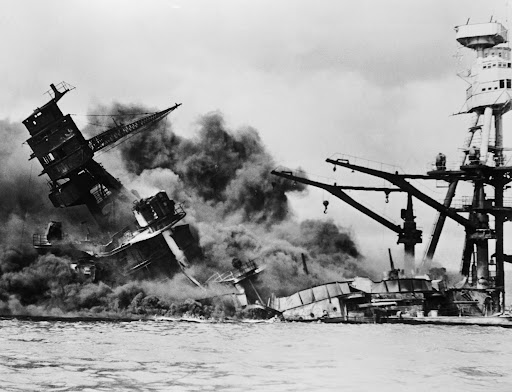
07 Dec 1941 --- Mortally Wounded and Sinking --- Image by © Bettmann/CORBIS
A historical photograph showing the USS Arizona exploding and collapsing in flames during the attack on Pearl Harbor on December 7, 1941. Thick smoke rises as the battleship breaks apart, capturing one of the most devastating moments of the assault.
Ⅰ. Introduction – Why Revisit Pearl Harbor Today?
Pearl Harbor is often remembered in stark moral terms—an unprovoked attack, a tragic beginning, a moment that defined a generation.
But history, when examined closely, rarely fits into simple narratives.
It is shaped not only by ideology or ambition, but also by fear, pressure, responsibility, and the world order in which people lived.
This essay explores perspectives on Japan’s decision to go to war that are seldom discussed in the English-speaking world.
Not to justify the past, but to understand the complex reality faced by those who made impossible choices in an age ruled by racial hierarchy and global empire.
When we look at Pearl Harbor through this wider lens, a different set of questions emerges—questions not about blame, but about human dignity, survival, and the weight of responsibility.
Ⅱ. Beyond Oil: The Overlooked Motivations Behind Japan’s Decision
In many histories written in English, Japan’s decision to attack Pearl Harbor is framed almost exclusively as a desperate move for oil.
While resource shortages certainly played a critical role, this explanation alone cannot account for the complexity of Japan’s decision-making.
Two additional factors—rarely discussed outside Japan—shaped the strategic landscape in profound ways:
(1) the global system of racial hierarchy, and
(2) Japan’s responsibility for the people living in its mandated territories across the Pacific.
1. A World Built on Racial Hierarchy
In 1941, the international order was structured around an explicit hierarchy of race.
Western empires ruled vast territories, and people of color were routinely regarded as inferior—even subhuman.
Japan, however, stood out in this system:
It was the only non-Western nation recognized as a major power,
and the only country outside Europe that had successfully resisted colonization.
For many Japanese at the time, the gathering storm was not simply about resources.
It was also about:
whether a non-white nation had the right to stand as an equal in a world that denied such equality.
This sentiment is difficult to convey in modern terms,
but for people living in that era, the issue was existential:
If dignity was denied to one generation,
their children and grandchildren would inherit that humiliation.
This fear—of being pushed back into a status of “less than human”—
shaped public emotion far more deeply than oil alone could explain.
2. Japan’s Mandated Islands and the Question of Responsibility
After World War I, Japan received mandates from the League of Nations to administer islands across Micronesia:
Palau, Saipan, Tinian, Yap, Truk, Ponape, and others.
Under the mandate system:
• Japan was expected to govern these territories,
• provide education, public health, and infrastructure,
• and protect the inhabitants.
Importantly,
the people living in these islands were regarded—not as colonial subjects—but as part of Japan’s broader national community.
This is why Japan invested heavily in schools and public works;
in fact, students in Palau often scored at the very top of academic tests across the entire Japanese Empire.
To Japanese policymakers in 1941, the Pacific islands were not distant possessions.
They were homes filled with communities that Japan was obligated to protect.
Why These Two Factors Mattered Strategically
If conflict with the United States became unavoidable,
the first targets to be exposed were not the Japanese home islands,
but these small Pacific communities under Japan’s care.
A powerful U.S. Pacific Fleet stationed at Hawaii could:
• cut supply lines,
• seize the mandated islands,
• and place their inhabitants directly in harm’s way.
From Japan’s perspective in 1941, “defending the Pacific islands” and “securing the southern resources” were inseparable goals.
To ignore one was to endanger the other.
A More Nuanced Lens
Seen from this wider angle, Japan’s decision was not driven by oil alone,
but by a combination of:
• strategic vulnerability,
• international racial politics,
• and the responsibility to protect populations under its administration.
This does not justify the war, nor diminish its tragedies.
Rather, it helps us understand that history’s turning points are rarely shaped by a single motive.
Ⅲ. The Global Racial Order of the Early 20th Century
To understand Japan’s decisions in 1941,
we must first step outside the moral framework of today and enter the worldview that shaped the early twentieth century.
It was a world organized—quite explicitly—around racial hierarchy.
This hierarchy was not a fringe belief.
It was the governing principle behind immigration laws, colonial administration, academic theories, and even Christian missionary work.
In this system, Western powers placed themselves at the top,
while Africans, Asians, and Pacific Islanders were placed on the lower rungs of humanity—sometimes even described as “childlike,” “primitive,” or “unfit for self-government.”
Japan, however, occupied an anomalous position.
A non-Western nation that had modernized at extraordinary speed,
defeated a European empire in the Russo-Japanese War,
and been recognized as one of the world’s great powers.
To many Western observers, this was not a triumph of equality but a threat to the established order.
If Japan could rise, perhaps the entire hierarchy could collapse.
This anxiety was not hidden.
It appeared openly in newspapers, diplomatic cables, and political speeches.
The idea that “colored nations must not be allowed to challenge white leadership” echoed across the English-speaking world.
Japan understood this clearly.
The rejection of its 1919 proposal for a “racial equality clause” in the League of Nations covenant was not a minor diplomatic setback—it was a message.
A reminder that no matter how modern Japan became,
it would never be accepted as an equal.
By 1941, this had evolved into something deeper:
If the world is built on racial hierarchy, then the rise or fall of nations is not merely a political contest—it is a struggle over human dignity itself.
To the Japanese of that era, the possibility of subordination was not abstract.
They had watched the colonization of India, Indochina, the Philippines, and large parts of Africa.
They knew what “defeat” would mean in a world where conquered peoples were often stripped of sovereignty, land, language, and even basic humanity.
Whether one agrees with their conclusions or not,
it is crucial to recognize the psychological landscape in which they were operating.
Japan was not only fighting for resources or territory.
It was fighting within a global system that had already declared where “the colored races” belonged—and Japan refused that assigned place.
Ⅳ. Japan’s Mandated Islands: Land, People, and Responsibility
When Japan seized Germany’s Micronesian colonies during World War I
and later received them as League of Nations Mandates,
it inherited more than strategic outposts in the Pacific.
It inherited people—families, villages, livelihoods—and the profound responsibility to govern them.
Unlike classical colonial possessions,
Mandate territories were not owned.
They were held in trust.
The League of Nations required Japan to administer the islands
“for the welfare and development of their inhabitants,”
a phrase that carried both legal obligation and moral weight.
For Tokyo, the islands were not distant, expendable assets.
They became part of a lived community—
connected through trade, education, infrastructure, and everyday life.
By the late 1930s, many in Japan viewed the islanders not as subjects to be exploited,
but as neighbors whose safety had become Japan’s duty.
At the same time, the islands were positioned across one of the most critical corridors of the Pacific.
Stretching from the Marianas to the Marshalls and the Carolines,
they formed a chain that could either secure or expose Japan’s entire eastern flank.
From Washington’s perspective, these islands looked like forward bases for Japanese expansion.
From Japan’s perspective, they were the opposite:
They were the shield behind which Japan’s own vulnerable homeland—and its entrusted island communities—could survive.
If those islands fell into hostile hands,
Japan would not only lose its strategic depth.
The islanders—whom Japan was obligated to protect—would be absorbed into another empire.
And in a world where colonial regimes still enforced racial hierarchy,
Tokyo believed that such a fate would bring exploitation, cultural erasure, and even demographic replacement.
Thus, defending the islands was not framed merely as military necessity.
It was understood as an ethical responsibility.
A nation that could not protect its entrusted populations
would lose its legitimacy—not only in the eyes of others but in its own self-understanding.
This mindset shaped Japan’s calculations in the months before Pearl Harbor.
The question was not simply:
How do we secure resources?
but
How do we prevent the islands—and their people—from being taken?
Whether this reasoning was correct is another matter.
But it reveals something essential about the Japanese worldview of the time:
The Mandated Islands were not abstract points on a map.
They were a community Japan believed itself honor-bound to defend.
V. The Decision: A War Neither Side Sought, Yet Both Felt Driven Toward
Japan did not desire a war with the United States.
And neither did the United States desire a war with Japan.
Yet both nations found themselves pulled toward a conflict shaped by forces far larger than any single decision or leader.
For Japan, the American oil embargo of 1941 was not merely an inconvenience—it was an existential threat.
With only a year or two of reserves left, the nation faced the possibility of economic collapse, political instability, and the loss of its ability to defend its territories, including the mandated islands it was obliged to protect.
American policymakers, for their part, saw Japan’s southward advance as a direct challenge to what they believed was their responsibility to uphold international stability and defend democratic values.
From their vantage point, tightening economic pressure on Japan was a way to deter aggression without resorting to war.
It was, in their eyes, a moral stand.
Two narratives.
Two forms of logic.
Both sincere.
Both incomplete.
Meanwhile, the geography of the Pacific created a strategic trap neither side could easily escape.
Any Japanese move to secure oil from the Dutch East Indies would inevitably require crossing waters controlled by the United States in the Philippines.
If Japan acted, it risked being attacked.
If it did not act, it faced collapse.
Diplomacy continued, but the assumptions beneath each side’s negotiations were incompatible.
Japan sought security and recognition of its sphere of influence;
the United States sought the preservation of an open Pacific order.
Each believed the other’s demands threatened its core interests.
In this tightening spiral of fear, miscalculation, and mutual misunderstanding, the window for peaceful resolution narrowed to almost nothing.
Thus, from Japan’s strategic vantage point in late 1941, striking the U.S. Pacific Fleet at Pearl Harbor was not viewed as an act of reckless expansion, but as a desperate attempt to buy time—time to secure resources, fortify the mandated islands, and protect a population for which Japan believed it bore responsibility.
This does not make the attack right.
Nor does it make it wrong.
It simply places the decision back into the world in which it was made—a world of impossible choices, limited information, and profound uncertainty, shared on both sides of the Pacific.
Understanding this does not absolve history.
But it humanizes it.
And without that step, no deeper understanding is possible.
VI. Two Histories, One Humanity
To look at history only through the lens of blame is to miss what makes it human.
Every conflict, including the Pacific War, holds not one story but many—
shaped by geography, fear, pride, loss, and the impossible choices people faced.
When we place these accounts side by side rather than against each other,
something shifts.
The world becomes less about who was right and more about how human beings tried to survive with dignity in impossible circumstances.
This idea was captured powerfully by Clint Eastwood in his twin films,
“Flags of Our Fathers” and “Letters from Iwo Jima.”
Rather than telling one “correct” story, he chose to film the same battle—
the same island, the same moment in history—from two opposing perspectives.
The American Marines who raised the flag.
The Japanese soldiers who dug into the volcanic sand, writing final letters home.
The result was not relativism.
It was recognition.
By allowing two narratives to stand together,
Eastwood revealed something deeper than victory or defeat:
that behind every uniform is a son, a father, a friend—
a human being trying to honor obligations larger than himself.
This is what happens when we listen to history with two ears instead of one.
Not to erase differences, but to understand how each side arrived at its choices,
and how fear, duty, and hope weave into the decisions of nations.
Japan’s story does not negate America’s.
America’s does not silence Japan’s.
Like the twin films, the two histories illuminate one another.
When we allow multiple perspectives to coexist,
history becomes not a battlefield of competing narratives,
but a shared space where humanity—fragile, imperfect, and deeply dignified—
comes into view.
Only then can we ask the real question:
How do we, learning from both stories, choose to live together now?
VII. Conclusion :Learning to See One Another Again
History is never only about the past.
It is also a mirror we hold up to ourselves—
revealing what we fear, what we value, and what we hope to become.
The story of Pearl Harbor is no exception.
It carries pain, pride, misunderstanding, and sacrifice on all sides.
For Americans, it symbolizes a wound and a call to defend democracy.
For many Japanese, it represents a desperate attempt to preserve sovereignty, dignity,
and the lives of people entrusted to their care.
Both of these memories are real.
Both deserve to be heard.
When we view history through a single lens,
we see only enemies and victims.
When we allow more than one truth to stand,
we see human beings—
grappling with impossible decisions in a world shaped by fear and hierarchy.
We cannot change what happened in 1941.
But we can change how we understand it.
And in doing so, we change how we choose to live with one another now.
Perhaps the most meaningful lesson is this:
History does not ask us to agree.
It asks us to understand—
and through understanding, to reclaim our shared humanity.
The Pacific War divided two nations.
The future does not have to repeat that division.
If we can look at the past without hatred,
without the need to justify or condemn,
then the conversation between Japan and the United States
can become something more than reconciliation—
it can become a model for a world that desperately needs
the courage to listen across differences.
The generation that lived through Pearl Harbor
is nearly gone.
But the dignity they fought for—
on every side—
still calls to us.
The question now is not
“Who was right?”
but
“How will we honor their humanity as we shape the world they entrusted to us?”
・Japanese version → https://hjrc.jp/8004/