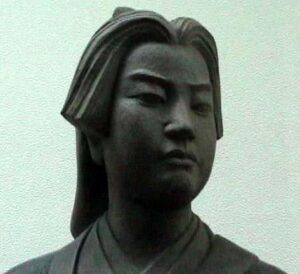
(天若日子の物語が映し出す「日本的哲学」──役割と本心のねじれが生む悲劇)
A short episode from Japan’s 1,300-year-old Kojiki contains one of the most profound insights into modern life: what happens when the role society demands no longer matches the truth of the human heart. By re-reading the story of Ame-no-Wakahiko and his beloved Shitateruhime, we find an ancient blueprint for resolving the identity fractures shaping today’s world—and for imagining a civilization rooted in resonance rather than obedience.
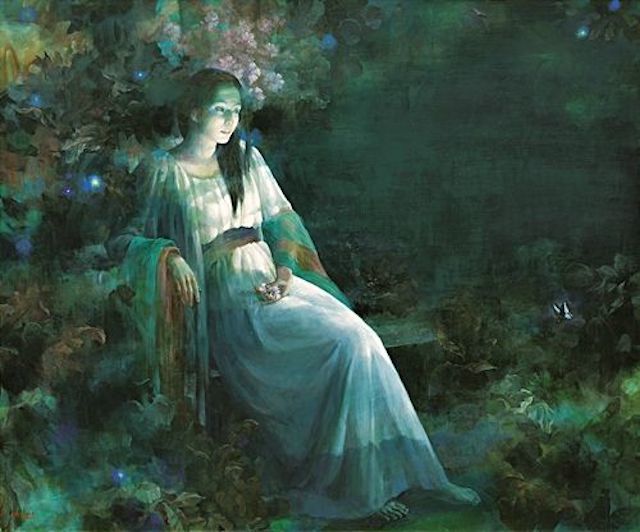
A serene painting of Shitateru-hime, a goddess from the Japanese Kojiki, seated in a dim, mystical forest. Soft green and blue light surrounds her as she gazes quietly at a small shining object in her hands. Her white robe glows gently in the darkness, and faint orbs of light float around her, creating an atmosphere of sorrow, devotion, and otherworldly beauty.
Introduction — A Myth About the Misalignment Between Role and Heart
In Japan’s oldest book, the Kojiki—written 1,300 years ago—there is a short but extraordinary story about a heavenly envoy named Ame-no-Wakahiko.
Though brief, the tale reads like a mirror held up to modern society.
It is a story of a man caught between two worlds, two identities, and two expectations.
It is also a story about what happens when the role you are given no longer matches the voice of your inner heart.
This ancient myth survives because its question is timeless:
What breaks first—
the world that demands a role,
or the human heart that can no longer play it?
Body 1 — The Story: What Actually Happened
Ame-no-Wakahiko was sent from heaven (Takamagahara) to govern the earthly realm.
But instead of reporting back or completing his mission, he fell in love with a woman of the earth—Shitateruhime—and settled into a peaceful life.
He became silent.
No reports. No progress. No clarity of intentions.
Heaven grew suspicious.
To test him, the heavenly deity Takagi-kami shot a divine arrow downward.
If Ame-no-Wakahiko were disloyal, the arrow would strike him.
It did.
He was killed instantly.
Shitateruhime cried so deeply that her grief reached the heavens.
When Ame-no-Wakahiko’s parents and siblings descended for the funeral, a new figure arrived:
Achi-shiki-taka-hikone-no-kami, a powerful deity whose appearance was strikingly similar to the dead Ame-no-Wakahiko.
Mistaking him for their son, the grieving family clung to him, sobbing.
But the deity, offended at being compared to a corpse, destroyed the mourners’ funeral hut and flew away in anger.
Shitateruhime then sang a mysterious poem—one that ancient tradition says “reveals the truth.”
That poem is the key to the entire story.
Body 2 — What the Story Is Actually Saying
1. The arrow that returns reveals divided identity
Ame-no-Wakahiko was killed not by malice, but by misalignment.
• Heaven expected “the perfect envoy.”
• Earth asked him to be “a husband, a man, a lover.”
• His heart chose the second.
• His role required the first.
He lived between two worlds—and the arrow symbolically “punished the contradiction,” not the man.
2. The look-alike god shows two versions of the same soul
Why does another deity look exactly like him?
In ancient Japanese thought、
a person has multiple aspects(見えない魂の層),
and when roles and essence drift apart、
“two selves” appear.
Ame-no-Wakahiko = the inner self who wished to live with Shitateruhime
Achi-shiki-taka-hikone = the outer role he could not fulfill
The myth presents this not psychologically, but poetically.
3. The wife’s poem restores the truth
Her song says:
“The jewel that crosses two valleys was him.”
Two valleys = two worlds
The jewel = one soul
The thread = the connection that never breaks
Her poem declares:
He did not die.
Only the role died.
The soul lived on.
This is why her name later changes from Shitateruhime (“the one who shines below”) to Takayorihime (“the one who rises high”) —
because her understanding elevated both of them.
Body 3 — What This Myth Really Teaches
This myth is not about disobedience.
It is about the pain of becoming two different people:
• The role others expect
• The heart that longs for truth
Every modern human understands this.
We play roles at work, in society, in the family.
We suppress the voice that says “This is not truly me.”
Ame-no-Wakahiko is not a fallen envoy.
He is the universal symbol of the moment a role becomes a lie.
The Japanese myth does not condemn him.
Instead, it mourns him.
It says:
When role and heart fall apart,
the human breaks before the system does.
And yet—
It also says that truth can survive through love, song, and remembrance,
even when power cannot acknowledge it openly.
This is profoundly Japanese:
• Truth is not shouted.
• Truth is sung.
• Truth is carried as resonance, not decree.
The wife’s poem is the real ending—not the arrow.
Conclusion — When a Civilization Changes Its Soul
Civilizations do not collapse.
They shed their skin.
Old assumptions fall away.
Old forms lose meaning.
A new age begins when humans rediscover how to align role, heart, and world.
Ame-no-Wakahiko’s story lasts 1,300 years because it teaches:
A society breaks not from evil,
but from the quiet misalignment between role, heart, and reality.
And:
A civilization is renewed
when its people learn to hear
the resonance of their own soul again.
Today we face the same condition:
• Systems that no longer fit humanity
• Roles that no longer match our inner truth
• Lives stretched between incompatible expectations
We must choose:
Continue performing dead roles,
or begin building a civilization that aligns with who we truly are.
Ancient Japan left us the blueprint:
• Harmony instead of punishment
• Relationship instead of domination
• Resonance instead of obedience
• Inner truth instead of external performance
Civilizations change clothes.
But only a few dare to change their soul.
The next transformation will not be led by power or markets—
but by those who revive the ancient art of living in resonance.
Ame-no-Wakahiko’s story is not the past.
It is the instruction manual for the civilization we have not yet built.