(文明の転換点──世界はなぜ変わりつつあり、私たちは何を学ぶべきか)
The world is not falling apart—it is changing its clothes. War, division, economic anxiety, and social fragmentation are not signs of collapse but signals that the old assumptions of modern civilization have reached their limit. In this series, we trace this transformation from the end of ownership-based civilization to the rise of self-reliance, relationality, and co-creation. We also explore why the next stage of human civilization will be shaped above all by education.
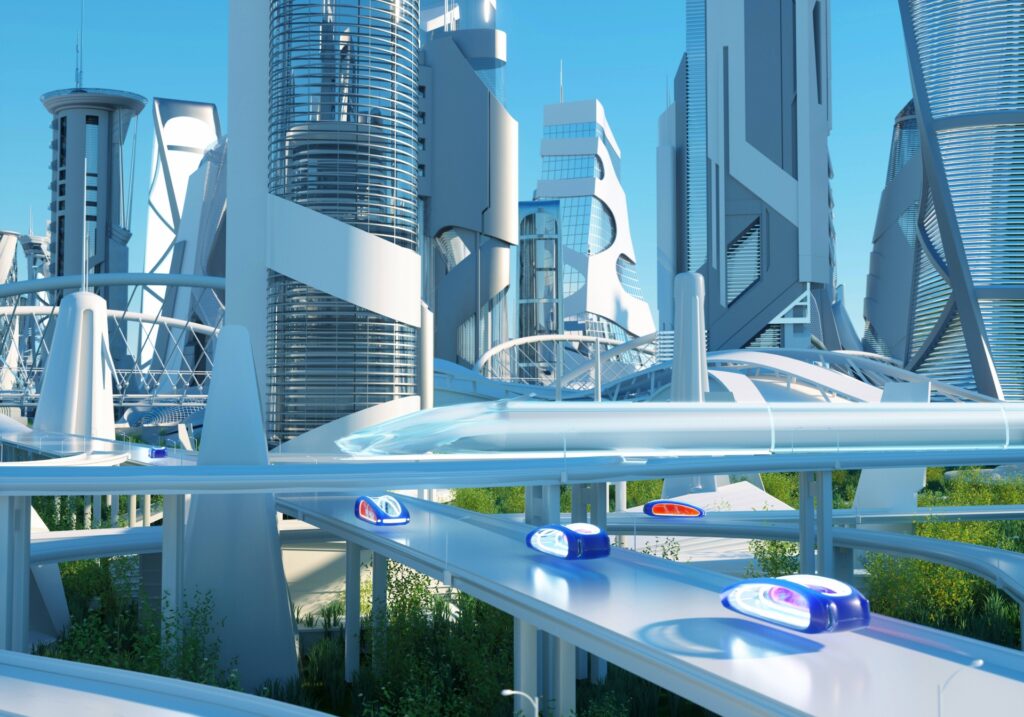
A futuristic eco-city with sleek high-rise buildings, elevated transparent transport lanes, and autonomous pod-like vehicles moving through a clean, green urban landscape.
Chapter 1 — Why the World Feels So Unstable Today
Today, many people around the world feel that something is “off.”
Wars break out, prices rise, societies become divided, and international relations seem increasingly fragile. News headlines portray this moment as an age of confusion, crisis, or decline.
But the instability we are witnessing is not simply the result of isolated events.
It is the symptom of something much deeper.
For more than a century, our societies have been operating on assumptions that no longer match the world we now live in. Population structures, energy systems, technology, and the global economy have transformed—but the foundational ideas that organize our societies have not.
We are still wearing the “clothes” of the previous civilization.
The modern world continues to rely on a value system shaped during the 19th and 20th centuries—
a world built on ownership, competition, expansion, and endless growth.
This model functioned when societies were young, resources seemed unlimited, and populations were expanding.
But that world no longer exists.
When the conditions of society change but its assumptions remain the same, cracks naturally appear:
• economic systems lose balance,
• geopolitical tensions escalate,
• social cohesion weakens,
• and people feel disoriented without knowing why.
In other words:
The world feels unstable today not because it is collapsing,
but because it is outgrowing the old civilization.
We are witnessing not the “end of the world,”
but the beginning of a transition—
a shift toward a new set of values and organizing principles.
And this shift will affect every field of human life:
economics, politics, technology, education, and our understanding of what it means to be human.
To move forward, we must first understand why the old assumptions no longer fit the realities of our age.
Only then can we begin to imagine what a new civilization might look like.
Chapter 2 — The Collapse of the 20th-Century State Model
For more than a century, the modern state has been built on a simple logic:
Protect the territory.
Manage the population.
Grow the economy.
Win in global competition.
This model emerged in the 19th and early 20th centuries,
when nations sought power by expanding their borders,
controlling resources, and increasing industrial output.
And for a time, it worked.
But the world that created this model no longer exists.
Today, people, goods, information, and capital move freely across borders.
Technologies connect individuals more tightly than governments do.
National economies are interdependent to the point that a crisis in one country can instantly ripple across the world.
Yet our political structures remain designed for a past era—
an era of walls, boundaries, and central control.
This creates a structural mismatch:
• The functions of society are global,
• But the institutions remain national.
When actions must be coordinated globally but decisions remain locked within national borders,
several stresses inevitably arise:
• Governments lose the ability to manage complex systems
• Public trust declines as state power feels both intrusive and ineffective.
• Citizens feel abandoned or overcontrolled.
• Societies become polarized between those demanding stronger authority and those rejecting authority altogether.
This is not because governments are “failing.”
It is because governments were designed for a world that no longer exists.
Around the world, a new expectation is emerging:
The state should not “contain” society—it should cultivate it.
People increasingly seek governments that:
• protect culture and daily life rather than merely territory,
• invest in citizens rather than manage them,
• pursue resilience rather than endless growth,
• and foster coexistence rather than competition.
This shift represents the quiet but profound collapse of the 20th-century state model.
It is not the disappearance of the nation-state,
but the transformation of its purpose.
The state of the future will be less of a “fence”
and more of a “garden.”
A place not for control,
but for cultivation.
Chapter 3 — The Quiet End of the Money-Centered Economy
Self-Reliance as the Missing Foundation of the New Civilization
For decades, futurists have been predicting the rise of new kinds of value:
• “Trust will become currency.”
• “Connection will become capital.”
• “Communities will replace markets.”
These ideas sound inspiring—and they capture part of the truth.
But they overlook one essential foundation:
Without self-reliance, none of these values can stand.
A person who is not self-reliant cannot offer true trust.
A community that is not self-reliant cannot build stable connections.
A nation that is not self-reliant becomes vulnerable to manipulation.
What emerges in place of trust and connection is something entirely different:
dependence and control.
The Hidden Flaw in Post-Money Narratives
In the last decade, many discussions—DAO, well-being economics, regenerative finance—have emphasized “non-financial value.”
Yet these models quietly assume that individuals and communities are already self-sufficient.
They are not.
A society that lacks food security, resilient infrastructure, or local autonomy cannot operate on “trust as currency.”
Because survival anxiety always overrides idealism.
Self-reliance is not a luxury.
It is the precondition for any higher form of value exchange.
This is why the shift away from money-centered civilization is happening quietly, indirectly, and unevenly:
Before new values rise, societies must resolve their dependencies.
The Japanese and American Corporate Shift: Escaping External Control
A striking example can be seen in the behavior of major companies in Japan and the United States.
Japan
Japanese firms have spent the last decade increasing internal reserves and reducing dependence on bank loans.
Why?
• Borrowing makes companies vulnerable to “credit withdrawal,”
• Banks can effectively control corporate decisions,
• And a single financial shock can bring down decades of work.
Companies realized:
“Dependence is risk.
Self-reliance is stability.”
United States
A similar shift is emerging in the U.S.
Many founders who once welcomed investment capital now reject it.
They watched their companies—built with years of devotion—get:
• split apart,
• sold to the highest bidder,
• or redirected toward goals they never agreed with.
This is not simply an emotional reaction.
It is a recognition of a deeper truth:
External capital does not support self-reliance—it replaces it.
Both Japan and the U.S. show the same pattern:
The quiet exit from external control.
Toward a Self-Sufficient Economic Behavior
As global supply chains falter and geopolitical risks rise,
nations, companies, and individuals are rediscovering a simple principle:
A system survives only when it can stand on its own legs.
Self-reliance is not isolationism.
It is the capacity to contribute, cooperate, and trust others without fear of collapse.
And because self-reliance reduces the need for coercion,
it clears the ground for a new kind of economic logic:
• exchange based on trust rather than necessity,
• collaboration rather than dependency,
• resilience rather than growth for its own sake.
This is why we can say:
The money-centered civilization is not collapsing with a loud crash.
It is quietly ending—
because societies are outgrowing it.
And at the center of the next economy
is not currency, markets, or technology.
It is self-reliance.
Chapter 4 — The Long Era of Ownership and Competition Is Ending
For nearly five centuries, the world has been shaped by a simple rule:
own more, control more, win more.
Nations fought over land. Corporations fought over markets.
Individuals competed for money, status, and resources.
This “ownership-and-competition civilization” has been so dominant
that many assumed it was simply human nature.
But history tells a different story.
And surprisingly, one of the clearest clues comes from the Mongol Empire.
1. Rethinking the Mongol Empire — the First “Network Civilization”
In Western textbooks, the Mongol Empire is portrayed as
“barbaric horsemen who conquered by force.”
But this view misses the deeper truth:
The Mongols created the world’s first global network
— a vast system of connected regions, safe trade routes,
shared communication protocols, and decentralized cooperation.
They did not rule by building walls or ownership.
They ruled by linking people, cultures, and knowledge.
• Silk Road security
• passport systems
• standardized weights and measures
• protected trade routes
• religious tolerance
• information networks(駅伝制・ジャムチ)
These are not the tools of conquerors.
These are the tools of connectors.
In a very real sense, the Mongol Empire was not a “land empire.”
It was the prototype of an open-network civilization
— one that spread cooperation faster than armies.
Western modernity did not inherit this idea.
Instead, Europe chose a different road.
2. Western Misinterpretation → 500 Years of Conquest Civilization
When European intellectuals studied Asian empires,
they interpreted everything through the lens of:
“To rule is to own.”
“To grow is to conquer.”
This mindset gave birth to:
• the colonial system
• global extraction economies
• zero-sum views of power
• competitive capitalism
• nation-states defined by territorial fencing
The result was a civilization that saw competition not as a choice,
but as the engine of progress itself.
And for a time, it worked—
as long as the planet had infinite resources,
growing populations, and expanding markets.
But those conditions have all reversed.
3. The Limits: Resources, Population, Ecology
The ownership-competition model breaks down when:
• resources stop expanding
• population begins shrinking
• environmental stress rises
• supply chains become fragile
• conflicts no longer produce wealth
In the 20th century, these pressure points were already visible.
In the 21st century, they became impossible to ignore.
Today’s instability—war, inflation, social fragmentation—
is not random chaos.
It is the natural consequence of a system
that has reached the end of its operating range.
4. Why the Old Model Cannot Continue
Ownership requires infinite expansion.
Competition requires infinite winners.
Neither is mathematically or ecologically sustainable anymore.
The old model depends on three assumptions:
1. Population keeps growing
2. Resources keep expanding
3. Competition produces innovation
All three have collapsed.
Population is shrinking.
Resources are finite.
Competition now destroys more than it creates.
We are witnessing something unprecedented:
The sunset of an entire civilizational operating system.
5. Today’s Turbulence Is Not Collapse — It’s a Civilization Sunset
When the sun sets, the sky becomes chaotic—
but it is not the world ending.
It is a transition into a new phase.
Likewise, today’s instability is not a collapse.
It is the quiet ending of the ownership-and-competition era.
A new model is emerging—
one based not on owning but connecting,
not on competing but co-evolving.
This shift will redefine politics, economics, technology,
and even human identity itself.
And just like in the Mongol era,
the cultures that understand “connection” will lead the next phase.
Japan’s historical strength lies exactly there.
Chapter 5 — The Three Pillars of the Next Civilization
For the first time in human history,
we are entering an era where survival and flourishing
no longer depend on owning more or competing harder.
Instead, the next civilization will be built upon
three foundational pillars:
1. Self-Reliance
2. Relationality
3. Co-Creation
These are not abstract ideals.
They are the minimum requirements for any society
to function in a world that is shrinking, aging, and interconnected.
1. Self-Reliance — The Foundation of Freedom
The old system rewarded dependency:
• nations depended on global finance
• companies depended on cheap labor and external capital
• individuals depended on institutions instead of competence
But dependency is a fragile architecture.
When any external pillar collapses, everything collapses.
Self-reliance does not mean isolation.
It means being able to stand upright,
so that cooperation becomes a choice, not a necessity.
Self-reliant people:
• generate value instead of consuming it blindly
• think long-term instead of reactively
• become resilient in crisis
• can negotiate as equals
Self-reliant nations:
• stabilize their economies
• avoid unnecessary conflict
• protect cultural identity
• innovate sustainably
Without self-reliance, all “connections” become chains.
With self-reliance, connections become bridges.
This pillar is indispensable.
2. Relationality — The Architecture of a Peaceful World
If self-reliance is the pillar of standing upright,
relationality is the pillar of standing together.
Relationality means:
• understanding how one’s actions affect others
• valuing harmony over domination
• building trust as a form of capital
• seeing society as an interconnected ecosystem
Competitive individualism fails here.
It encourages fragmentation:
• politics becomes polarization
• social media becomes conflict
• economies become unstable
• communities lose cohesion
Big problems—climate, migration, aging, inequality—
cannot be solved by isolated individuals or isolated nations.
They require relational thinking.
Japan has preserved a unique cultural prototype for this:
the concept of 和(Wa).
Wa does not mean “avoiding conflict.”
It means creating a field where conflict does not escalate,
because relationships are more important than winning.
This is not weakness.
It is advanced social engineering.
3. Co-Creation — The New Engine of Human Progress
The old civilization used competition as its engine:
“If people fight for rewards, they will produce innovation.”
This worked only as long as resources were infinite
and the planet could absorb the cost of perpetual rivalry.
Now that those conditions no longer exist,
competition produces diminishing returns
and enormous collateral damage.
Co-creation is the only engine capable of replacing it.
Co-creation means:
• multiple actors generating value together
• collaboration replacing extraction
• solutions emerging from shared intelligence
• progress measured not by “winners” but by “outcomes”
AI and humans will co-create.
Nations will co-create regional ecosystems.
Companies will co-create supply chains instead of exploiting them.
Co-creation is not utopian.
It is mathematically the only sustainable model
for a finite planet.
The New Human Model: Cooperative, Relational, Self-Standing
These three pillars produce
a fundamentally different type of human:
• self-standing(自立)
• relational(関係性を理解)
• cooperative(共創できる)
This human model is not naïve or idealistic.
It is adaptive.
It is what the era requires.
Competitive individualism is simply incapable of solving:
• global crises
• shared-resource problems
• fragmented societies
• AI-era labor transitions
• planetary-scale ethics
The new individual is not a “fighter.”
The new individual is a node—
one that stands on its own
and connects responsibly with others.
Japan’s Wa as a Prototype for the Next Civilization
Japan’s cultural heritage offers something rare:
• governance based on relational harmony
• communities built on mutual responsibility
• decision-making grounded in long-term stability
• a tradition of “standing alone while connecting with all”
This is not nostalgia.
It is a blueprint.
The next civilization will not be led by empires,
but by cultures that understand:
How to connect without dominating,
how to cooperate without losing identity,
and how to create without destroying.
Japan has already lived these principles for centuries.
Now, the world is finally ready to learn from them.
Chapter 6 — Why Education Becomes the Heart of the New Civilization
Every civilization produces its own kind of human being.
Agricultural societies raised cooperative villagers.
Industrial societies raised disciplined workers.
The 20th century raised competitive individuals.
Now, as humanity moves toward a civilization based on
self-reliance, relationality, and co-creation,
we require a different kind of human being—
one who can stand independently, connect responsibly,
and create collaboratively.
And the place where this transformation begins
is education.
1. When Civilization Changes, the Required Human Qualities Change
A society is only as strong as the people it cultivates.
The old civilization rewarded:
• obedience
• memorization
• productivity
• competition
So schools were designed to produce:
• standardized workers
• efficient test-takers
• compliant citizens
But the world those schools prepared us for
no longer exists.
Today we need:
• adaptive thinking
• empathy
• collaborative problem-solving
• contextual intelligence
• autonomous judgment
In this sense, education becomes the blueprint of civilization.
2. Education Defines the Type of Human a Society Creates
Economies do not shape people.
Governments do not shape people.
Technologies do not shape people.
Education shapes people—
and people shape everything else:
• markets
• politics
• social norms
• community relationships
• international relations
A nation’s future is determined by who its schools produce.
If schools teach competition, society becomes divided.
If schools teach obedience, society becomes stagnant.
If schools teach memorization, society becomes fragile.
If schools teach conformity, society becomes brittle.
But if schools teach:
• self-reliance
• relational awareness
• co-creation
then society becomes resilient, harmonious, and innovative.
Education is the root system of civilization.
3. From Competition-Based Learning to Co-Creative Learning
The old model viewed learning as a race:
• “Who is better?”
• “Who wins?”
• “Who gets the highest score?”
This produced efficient workers,
but not resilient or creative citizens.
Co-creative learning asks instead:
• “What can we build together?”
• “How can we combine our strengths?”
• “What problems require multiple viewpoints?”
In a world where major problems—
food, energy, climate, demographics, technology—
are all interconnected, competition cannot solve them.
Only co-creation can.
This is precisely the learning model
that educators across the English-speaking world
have been searching for.
4. From Memorization to Relational Intelligence
In the past, memorization had value because information was scarce.
But now AI can recall any fact instantly.
Thus, the core of human learning becomes:
Relational Intelligence —
the ability to understand how things connect.
This includes:
• sensing context and background
• reading feelings and intentions
• understanding social dynamics
• finding harmony where there is no single “right answer”
AI can provide knowledge,
but only humans can build relationships.
Relational Intelligence will become
the most important human skill in the AI era.
5. Why the Future of Society Is Decided in the Classroom
A classroom is not merely a place where children sit.
A classroom is where a civilization is shaped.
The values formed there
become the structure of society 30 years later.
• Teach competition → the nation chooses conflict
• Teach obedience → the nation loses creativity
• Teach self-reliance → the nation becomes resilient
• Teach relationality → society becomes peaceful
• Teach co-creation → civilization evolves
The future is not built in parliaments or markets.
It is built in classrooms.
Civilization is created by people,
and people are created by education.
This is why education becomes
the heart of the next civilization.
And importantly, the term education here does not refer only to schooling.
It includes adult learning and the continuous education of society itself—
because it is lifelong learning, not childhood alone,
that accelerates a civilizational shift.
Conclusion — A Civilization Changing Its Clothes
The world is not collapsing.
It is transforming.
What looks like chaos is simply the sound of old assumptions peeling away—
the assumptions of ownership, competition, expansion, and domination
that shaped the last five hundred years.
A new civilization cannot grow on those foundations.
It requires new qualities of being human:
self-reliant, relational, cooperative, and capable of co-creation.
And such humans are not born by accident.
They are grown — through education.
Not only in schools, but throughout society,
in the ways we speak, work, create, and live together.
This moment is not a crisis.
It is the beginning of something that comes only a few times in human history:
the Second Transformation of Civilization.
We are not watching the end of the world.
We are watching the world choose a new form—
just as a person chooses new clothes
when the old ones no longer fit.
Humanity is standing before the wardrobe of the future.
What we choose to wear next
will be decided by how we educate ourselves today.