
(忠臣蔵外伝・矢頭右衛門七の恋 ― 忠義と純愛に生きた若き浪士 ―)
Chūshingura is widely known as a heroic tale of loyalty and revenge. Yet within this famous story lies a quieter, almost forgotten human drama. This is the story of a seventeen-year-old samurai and a love that was never spoken aloud—one that reveals a different form of honor, found not in victory, but in silence.
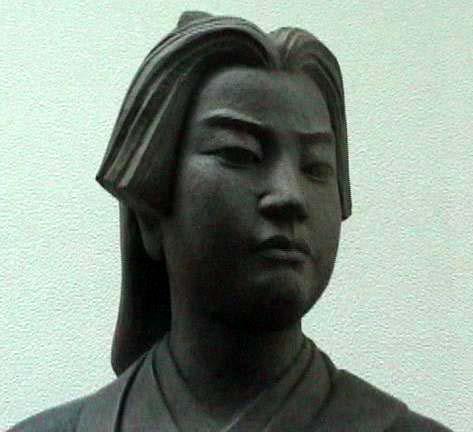
Portrait of Yahazu (Yato) Uemonshichi, a young samurai of the Forty-Seven Rōnin, preserved at Ōishi Shrine in Akō City.
Introduction
Chūshingura is one of the most famous stories in Japanese history.
It tells of forty-seven masterless samurai who sacrificed their lives to avenge their lord, becoming symbols of loyalty and honor.
For centuries, this tale has been celebrated as a heroic drama of duty and justice.
Yet hidden within this great historical narrative are quieter stories—ones that are rarely told.
Among them is the story of a very young samurai, only seventeen years old, and a love that never sought to be fulfilled.
This is not a tale of battlefield glory or triumphant heroism.
It is a story of hesitation, restraint, and feelings left unspoken.
A small human drama, unfolding quietly in the shadow of a great event.
By looking closely at this forgotten corner of Chūshingura, we may glimpse a different kind of honor—one that reveals itself not through victory, but through silence.
Body 1: The Young Samurai and the Fallen Red Fan
He was only seventeen years old.
Young even by the standards of his time, yet already carrying the composure of a samurai.
One autumn day, as crimson leaves filled the air near Asakusa, he walked alone along the hillside.
The sky was clear, the river below reflected the red of the maples—and then, suddenly, a red folding fan fell softly at his feet.
He picked it up.
Looking up the slope, he saw a young woman standing there.
“Could this fan belong to you?” he asked.
She flushed, her face turning red like the leaves around them.
“Please… don’t interfere,” she said, and quickly turned away.
He stood there, holding the fan, not understanding what he had done wrong.
The fan remained in his hand—bright, fragile, and strangely heavy.
It was the first quiet thread that bound their lives together, though neither of them yet knew it.
Body 2: Kindness, Missteps, and a Growing Distance
After that day, he returned to the hillside again and again.
Not to seek her out boldly, but to offer a quiet apology—if fate allowed their paths to cross once more.
When he finally saw her again, she was standing on tiptoe, reaching for a branch of red leaves.
Without a word, he drew his sword.
In a single, practiced motion, he cut the branch and returned the blade to its sheath.
“Please, allow me,” he said.
Her eyes widened in shock.
“What have you done?” she cried.
“I was going to tie my wish to that branch!”
Once again, his good intentions had gone astray.
What he thought was kindness became intrusion.
What he believed to be help became disappointment.
Later, by the river, he saw her standing still, watching something float away in the water.
Before acting, he paused.
“May I ask,” he said carefully,
“is this part of some custom as well?”
“No,” she replied.
“I dropped something important. Please—help me.”
Without hesitation, he leapt into the cold river.
He retrieved the bundle, but his body was soaked, trembling in the winter air.
Wrapping himself in a mat, he ran off to warm himself, leaving her calling after him.
He did not know it then, but this awkward kindness would quietly bind their lives more tightly than words ever could.
Body 3: Love Under a Shadow of Duty
As the days passed, their meetings became fewer, yet more precious.
In those quiet moments, something gentle and unmistakable began to grow between them.
But he knew what awaited him.
He was a man preparing for death.
To join the vendetta meant one thing only: he would not return alive.
He looked at her and thought,
If I love her, I cannot make her happy.
And yet, another thought followed, heavier still.
Her family did business with the house of Kira.
To draw closer to her might offer useful information.
And the thought struck him deeply:
Am I approaching her out of love—or am I using her?
The question tormented him.
Even knowing her life was short, even knowing his own was already forfeited,
he hesitated.
And yet—
Still, he wanted to see her.
Uncontrollably.
Painfully.
Love did not erase his sense of duty.
Duty did not extinguish his love.
They stood facing one another, neither willing to surrender.
Body 4: A Silent Farewell in the Plum Garden
Snow fell quietly on the morning of December fourteenth.
She came to see him, burning with fever, her body already weakened.
Before leaving, she told him only this:
“Tonight, there will be a gathering at Kira’s residence.
He will be there.”
He listened in silence.
He sent her home in a palanquin and went at once to report to his comrades.
That night, the raid was carried out.
Weeks later, after the snow had melted and plum blossoms had begun to open,
she came again—this time to the residence where he was being held.
They were not allowed to meet.
Yet the lord of the house noticed her frail figure and quietly said,
“If you wish to see the plum blossoms, you may walk around the garden.
But you must not speak.”
Inside, he was told the same.
“Go and see the plum blossoms.
And whatever you see, do not utter a word.”
They stepped into the garden from opposite sides.
Across a low hedge, their eyes met.
No words were spoken.
None were needed.
He took from his robe a red folding fan—the same one that had fallen between them on that autumn day.
He placed a small branch of plum blossoms upon it
and gently set it afloat on the stream.
The fan drifted toward her.
Their gazes held.
Everything that could not be said passed silently between them.
Body 5: Death, and What Remains
Not long after their silent farewell, word reached him that she had passed away.
She had come to the garden, it was said,
forcing her weakened body to move,
simply to know the truth of his heart.
Soon after, the order was given.
On the fourth day of the second month,
the forty-seven rōnin were sentenced to die by seppuku.
He went first.
He was eighteen years old.
There were no final messages for her.
No vows spoken aloud.
Only a promise that had been kept—
quietly, completely, to the very end.
Reflection: What This Story Asks of Us
This story is not a historical record.
It may never have happened exactly as it is told.
And yet, it asks something quietly but insistently.
What would we do if no one were watching?
Would we still keep our word?
Would we still choose what feels right, even when it brings no reward?
The young samurai and the woman he loved never spoke their final feelings aloud.
They did not seek understanding from others, nor recognition from the world.
They simply acted in a way they could accept themselves.
In Japanese tradition, this is often expressed as “the sun is watching.”
Not as a threat, but as a reminder:
even when unseen, our choices shape who we are.
Their silence crosses three centuries to reach us.
Not as a lesson to be learned,
but as a question left gently in our hands.
Cultural Note
In traditional Japanese thought, moral conduct has not always been enforced by law or surveillance.
Instead, people often speak of “Otentō-sama is watching”—literally, “the sun is watching.”
This phrase does not imply punishment or divine judgment.
It reflects an inner awareness: even when no one else sees, one should act in a way one can live with.
Keeping promises, restraining desire, and honoring silence were understood as ways of preserving harmony—both with others and within oneself.
For this reason, silence in such stories is not a lack of expression.
It is a deliberate moral choice—one made quietly, and without witnesses.